Why the SaaS-Free Business Model Will Change the Way You Scale Your Company
Current Economic Context of Software Subscriptions
Business operations currently depend on multiple software-as-a-service (SaaS) platforms. Scaling a company correlates with increased subscription costs. These costs are recurring. Price increments occur at the discretion of the provider. Data resides on third-party servers. Access is conditional upon continued payment.
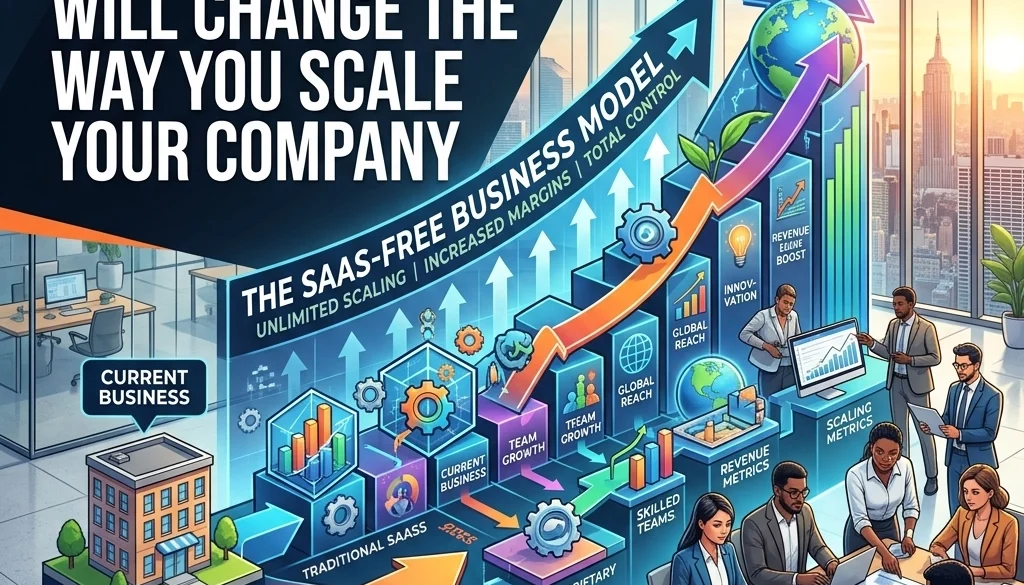
The SaaS-free business model utilizes self-hosted infrastructure. Proprietary subscriptions are replaced by open source software. This model aims to reduce monthly expenditures and increase data control.
Comparative Cost Analysis
Standard SaaS expenditures for a company with 50 employees often include:
- Customer Relationship Management (CRM): $1,500 – $5,000 per month.
- Project Management: $500 – $1,250 per month.
- Business Intelligence and Analytics: $300 – $2,000 per month.
- Email Marketing: $200 – $1,000 per month.
- Communication Tools: $400 – $900 per month.
Monthly totals range from $2,900 to $10,150. Annual totals range from $34,800 to $121,800.
The SaaS-free model shifts these costs to infrastructure and maintenance.
- Virtual Private Server (VPS) Costs: $50 – $500 per month.
- Maintenance Labor: $500 – $2,000 per month.
- Software Licensing: $0 (Open Source).
Annual totals for the SaaS-free model range from $6,600 to $30,000. Potential savings exceed 70%.

Identification of Open Source SaaS Alternatives
Open source saas alternatives exist for primary business functions. These tools require deployment on independent servers.
Customer Relationship Management (CRM)
Proprietary versions include Salesforce or HubSpot.
Alternatives include:
- SuiteCRM: Provides lead management, sales automation, and reporting.
- ERPNext: Integrates CRM with inventory and accounting functions.
- Odoo (Community Edition): Features modular apps for sales and operations.
Project and Task Management
Proprietary versions include Monday.com, Asana, or Jira.
Alternatives include:
- Taiga: Supports Scrum and Kanban methodologies.
- OpenProject: Focuses on project lifecycle management and gantt charts.
- Focalboard: Provides a self-hosted alternative to Trello.
Business Communication
Proprietary versions include Slack or Microsoft Teams.
Alternatives include:
- Mattermost: Provides secure team messaging and file sharing.
- Rocket.Chat: Enables internal communication and customer chat integration.
- Matrix/Element: Offers decentralized, end-to-end encrypted messaging.
Marketing and Analytics
Proprietary versions include Google Analytics, Mailchimp, or Mixpanel.
Alternatives include:
- Plausible or Matomo: Privacy-focused web analytics tools.
- Listmonk or Mautic: Systems for newsletter management and marketing automation.
- Ghost: An open-source headless CMS for content marketing.
Detailed information on deploying these systems is available at Marketrun Open Source Deployment.
VPS Setup and Management Protocols
Transitioning to a SaaS-free model requires VPS setup and management. The server acts as the host for the software applications.
Provider Selection
Selection criteria include uptime guarantees, regional data centers, and resource scalability. Primary providers include:
- DigitalOcean
- Hetzner
- Linode (Akamai)
- AWS (EC2)
- Google Cloud Platform
Server Configuration
Standard configuration involves:
- Operating System Installation: Linux distributions such as Ubuntu or Debian are standard.
- Security Hardening: Implementation of SSH keys, firewalls (UFW/IPTables), and disabling root login.
- Containerization: Utilization of Docker and Docker Compose to isolate applications and simplify deployment.
- Reverse Proxy: Configuration of Nginx or Traefik to manage traffic and SSL certificates.
Maintenance Routines
System integrity requires regular maintenance:
- Automated Backups: Daily snapshots of databases and configuration files.
- Security Updates: Routine patching of the OS and application containers.
- Monitoring: Implementation of tools like Prometheus or Netdata to track resource utilization.
Technical assistance for complex configurations is located at Marketrun Custom Software.

Data Sovereignty and Security
The SaaS-free model addresses data sovereignty. In a subscription model, data is stored by the provider. The provider controls access. In a self-hosted model, the company retains physical or virtual possession of the database.
Compliance
Self-hosting facilitates compliance with:
- General Data Protection Regulation (GDPR).
- Health Insurance Portability and Accountability Act (HIPAA).
- Digital Personal Data Protection Act (DPDP) in India.
Data remains within specified geographic boundaries. Encryption keys are managed by the internal team. Access logs are exhaustive.
Risk Mitigation
Dependence on a single SaaS provider introduces "platform risk." Provider insolvency or service termination disrupts operations. Self-hosting removes this dependency. The source code is available. The software functions independently of the vendor's corporate status.
Scaling Mechanics in the SaaS-Free Model
Scaling a SaaS-free business involves horizontal and vertical infrastructure expansion.
Vertical Scaling
Resources (CPU, RAM) are added to the existing VPS. This supports increased user load for CRM or communication tools.
Horizontal Scaling
Multiple servers are deployed. Traffic is distributed via load balancers. This is necessary for high-traffic web applications and large-scale data processing.
Performance Optimization
Self-hosted tools allow for direct database optimization. Indexing and caching layers (Redis/Memcached) are configured based on specific usage patterns. This level of customization is unavailable in standardized SaaS tiers.
Relevant insights on scaling can be found in the AI Automation ROI Calculator.

Integration of AI and LLMs
The SaaS-free model extends to Artificial Intelligence. Subscription-based LLMs (Large Language Models) involve recurring API costs and data privacy concerns.
Self-hosting LLMs allows for:
- Fixed infrastructure costs.
- Private processing of proprietary data.
- Custom fine-tuning for specific business domains.
Implementation details are documented at Marketrun Self-Hosting LLMs. Technical guides are available at Self-Hosting LLMs 2026 Guide.
Deployment Framework
The transition to a SaaS-free model follows a structured framework.
Phase 1: Audit
Identification of current SaaS subscriptions. Quantification of monthly costs. Mapping of essential features.
Phase 2: Selection
Identification of open source equivalents. Assessment of community support and update frequency.
Phase 3: Pilot
Deployment of a single tool (e.g., Mattermost or Plausible) on a VPS. Testing of functionality and performance.
Phase 4: Migration
Transfer of data from SaaS platforms to self-hosted instances. Training of staff on new interfaces.
Phase 5: Optimization
Implementation of automated maintenance and monitoring scripts.

Strategic Implications for Scaling
The SaaS-free business model alters the financial trajectory of growth. Capital previously allocated to recurring software fees is redirected to core product development or market expansion.
Scaling no longer incurs a linear increase in software costs. Operational efficiency improves. Data security is enhanced through direct oversight.
Entities requiring assistance with deployment protocols may consult Marketrun Solutions. Further resources regarding AI integration are located at AI Agents and Automations Guide.
Infrastructure Management Summary
The effectiveness of this model depends on VPS management. Reliability is achieved through redundancy and systematic updates. Organizations lacking internal DevOps capacity utilize specialized deployment services to maintain system uptime.
Direct comparisons between regional costs for software development and deployment are found at Custom Software India vs USA Cost 2026.
The SaaS-free model represents a shift from software consumption to software ownership. Ownership facilitates long-term stability and financial predictability during company scaling.