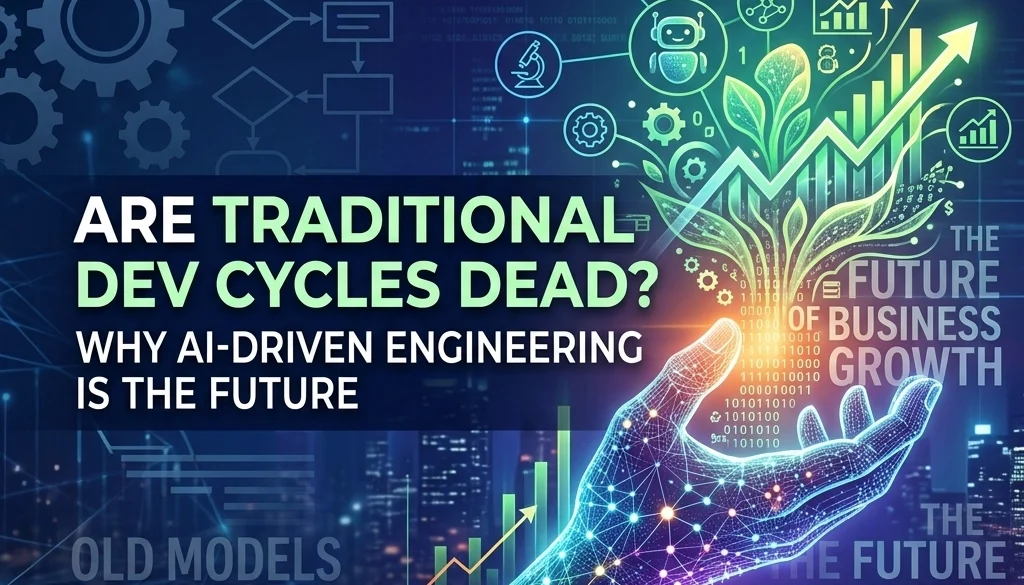
Are Traditional Dev Cycles Dead? Why AI-Driven Engineering is the Future of Business Growth
Status Report: The State of Software Engineering (April 2026)
Current data indicates the obsolescence of traditional Software Development Lifecycles (SDLC). Linear methodologies: characterized by distinct phases of requirements, design, development, and testing: no longer align with the operational speed required for modern business growth. In 2026, the shift to AI-driven engineering is complete. Software is no longer "built" in the historical sense; it is orchestrated through intent-based systems.
Marketrun observes a transition where ai agents for business displace manual coding tasks. This transformation is not an incremental improvement in developer productivity. It is a fundamental collapse of the traditional engineering stack.
1. The Collapse of the Linear Development Model
Traditional development cycles are defined by friction points. Each handoff between a business analyst, a developer, and a QA engineer introduces latency and potential error. In the current engineering landscape, these boundaries have dissolved.
Requirement Liquidity
Requirements are no longer static documents. AI models process natural language intent and translate it into functional prototypes immediately. The time between a business concept and a deployed feature has been reduced from weeks to minutes.
Iterative Intent vs. Waterfall Planning
Traditional models prioritized planning to avoid the high cost of code revision. AI-driven engineering reduces the cost of code generation to near zero. Consequently, development has shifted to a model of "continuous iteration." Systems generate multiple variations of a feature, evaluate performance metrics, and select the optimal version without human intervention.

2. Integration of AI Agents for Business
The deployment of ai agents for business represents the primary driver of efficiency in 2026. These agents function as autonomous units within the development environment.
Task Autonomy
AI agents now perform the following functions within the Marketrun solutions framework:
- Context Discovery: Agents analyze existing codebases and documentation to identify integration points.
- Autonomous Debugging: Systems identify runtime errors and apply patches in real-time.
- Security Auditing: Continuous scanning for vulnerabilities happens at the point of creation, not as a post-development phase.
Orchestration Roles
The role of the human engineer has transitioned to that of an orchestrator. Engineers define the system parameters, constraints, and business goals. The agents execute the technical implementation. This shift allows for a higher volume of project throughput without a corresponding increase in headcount.
3. Custom AI Solutions for SMBs: Strategic Advantages
Historically, custom software was a capital-intensive endeavor reserved for enterprises. Custom ai solutions for smbs have corrected this market imbalance.
Cost Reduction and Accessibility
By utilizing AI-driven engineering, the cost of developing bespoke software has decreased by approximately 70-80% compared to 2021 levels. Small and medium businesses can now deploy custom software that specifically addresses their unique operational bottlenecks.
Rapid Scaling
AI-driven systems are inherently scalable. When an SMB experiences growth, the underlying software architecture: managed by AI agents: adapts automatically. This removes the "technical debt" trap that previously hindered growing companies.

4. Infrastructure Shifts: The Necessity of Self-Hosting
The move toward AI-driven engineering necessitates a re-evaluation of data privacy and infrastructure. As businesses integrate large language models (LLMs) into their core processes, data sovereignty becomes a critical concern.
Security through Self-Hosting
Marketrun emphasizes the importance of self-hosting LLMs. Utilizing public APIs for sensitive business logic introduces unacceptable risk factors. 2026 standards prioritize internal deployments of open-source models to ensure proprietary data remains within the corporate perimeter.
Performance Optimization
Self-hosted models provide lower latency and higher reliability for AI automations. When AI agents are responsible for real-time business operations, dependency on third-party uptime is a structural vulnerability.
5. Economic Impact: ROI of AI-Driven Engineering
The financial metrics for software development have been redefined. Traditional ROI calculations focused on the longevity of a software product. Modern metrics focus on the velocity of business adaptation.
| Metric | Traditional SDLC (Legacy) | AI-Driven Engineering (2026) |
|---|---|---|
| Time to Market | 3–9 Months | 2–7 Days |
| Development Cost | High (Fixed) | Low (Variable) |
| Maintenance Overhead | High (Manual) | Low (Autonomous) |
| Scalability | Linear | Exponential |
Data from the AI automation ROI calculator shows that companies adopting AI-driven cycles achieve break-even on development costs in less than one-fourth the time of traditional projects.

6. Global Development Dynamics: India and the USA
The geographic constraints of software development are changing. The cost-benefit analysis between onshore and offshore development has reached a new equilibrium.
The Cost Efficiency Gap
Engineering teams in India have rapidly adopted AI-driven methodologies, further widening the value gap for US-based clients. For a detailed breakdown of current pricing structures, refer to the custom software India vs USA cost 2026 guide.
Hybrid Collaboration
The future of business growth involves hybrid models where strategic design occurs in proximity to the business, while autonomous engineering units operate globally. AI agents facilitate this by providing a unified communication layer that transcends time zones and languages.
7. Marketrun’s Vision for the Next Decade
The next ten years of software will be characterized by "Invisibly Built Systems." Software will become a fluid utility rather than a static product.
Predictions for 2026–2036
- Zero-Code Maintenance: Software will self-heal and self-update based on evolving business requirements.
- Hyper-Personalization: Applications will dynamically reconfigure their interfaces and logic for every individual user.
- Ubiquitous AI Integration: Every piece of mobile and web software will be "AI-native" by default.
Marketrun focuses on providing the infrastructure for this transition through open source deployment and advanced AI engineering services.

8. Technical Implementation Summary
To transition from legacy dev cycles to AI-driven engineering, organizations must implement the following:
- Integrated Agentic Frameworks: Replace manual ticketing systems with AI agents that interface directly with the codebase.
- Infrastructure for LLMs: Establish secure, internal hosting for models to maintain data integrity.
- Outcome-Based Metrics: Shift KPIs from "lines of code" or "sprint velocity" to "business objective completion rate."
Traditional development cycles are not simply evolving; they are being replaced by a more efficient, autonomous, and cost-effective paradigm. Businesses that fail to integrate custom ai solutions for smbs and ai agents for business will operate at a significant disadvantage in a market defined by AI-driven velocity.
For further technical documentation and strategy, visit the Marketrun blog or explore our AI agents and automations guide.
Status Report Conclusion
Traditional Dev Cycles: Obsolete.
AI-Driven Engineering: Operational State.
Market Growth Potential: High.