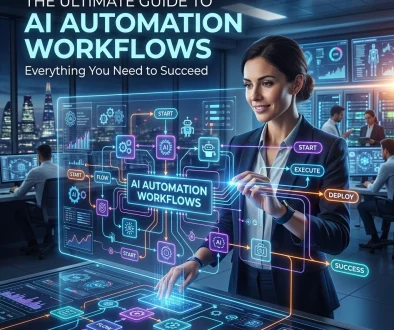
The Ultimate Guide to AI Automation Workflows: How to Connect Disparate Systems and Scale
Operational Definition: AI Automation Workflows
AI automation workflows are organized sequences of tasks where artificial intelligence executes decisions, processes data, and triggers actions across multiple software environments. These workflows differ from legacy automation by utilizing machine learning models to handle unstructured data and non-linear decision paths. The primary objective is to automate business operations with ai to achieve higher output without proportional increases in human resource allocation.
Modern ai automation workflows function as an orchestration layer. This layer resides above existing systems of record, such as Enterprise Resource Planning (ERP) tools, Customer Relationship Management (CRM) platforms, and custom databases. The workflow coordinates the transfer of data and the execution of logic between these silos.
Core Architectural Components
The construction of an enterprise-grade AI workflow requires five primary components.
1. The Trigger Mechanism
Workflows initiate based on specific events. Triggers are categorized as:
- Time-based: Execution occurs at predefined intervals.
- Event-based: Execution occurs when a specific state change is detected in a system (e.g., a new lead in a CRM).
- Webhook-based: External systems push data to the workflow via an HTTP request.
2. The Data Integration Layer
This layer facilitates the movement of information. It requires secure API connections to disparate systems. Data is extracted, transformed to a standardized format, and loaded into the processing environment.
3. The Cognitive Processing Layer
In this stage, Large Language Models (LLMs) or specialized machine learning models analyze the data. Functions include:
- Sentiment analysis of customer communications.
- Extraction of entities from legal documents.
- Classification of support tickets.
- Generation of code or content based on specific parameters.
4. Logic and Policy Guardrails
AI outputs require validation against predefined business rules. This stage ensures that the AI operates within the constraints of corporate policy and legal requirements.
5. The Action Layer
The final stage involves writing data back to systems of record or triggering external events, such as sending an email, updating a database record, or deploying code to a server.

Connecting Disparate Systems: Integration Strategies
Disparate systems are software applications that do not share a common data architecture. Connecting these systems is necessary to automate business operations with ai at scale.
API-First Integration
Application Programming Interfaces (APIs) serve as the primary bridge. Standardized protocols like REST and GraphQL allow the AI workflow to "speak" to different software. When a system lacks a modern API, custom software development is required to build a wrapper that exposes the necessary data endpoints.
Middleware and Orchestration Platforms
Middleware acts as a translator between incompatible data formats. Using an orchestration platform allows for the centralization of logs, error handling, and security credentials. This prevents the creation of "spaghetti code" where every system is connected to every other system individually.
Data Normalization
Data normalization is the process of structuring unstructured data so it can be utilized by different systems. For example, a date format in an older ERP system (DD/MM/YYYY) must be converted to a standardized format (ISO 8601) before being processed by an AI agent or updated in a modern CRM.

Advanced Workflow Patterns
Human-in-the-Loop (HITL)
High-stakes operations require human oversight. The HITL pattern inserts a manual review step when the AI’s confidence score falls below a specific threshold. This ensures accuracy and maintains accountability.
Agentic Orchestration
Unlike linear workflows, ai agents can autonomously determine the best sequence of steps to achieve a goal. Agentic orchestration involves multiple agents collaborating: one agent researches data, another synthesizes it, and a third executes the final action.
Self-Healing Workflows
Advanced systems monitor their own performance. If an API call fails or a model returns an unexpected output, the system can automatically retry the task using a different model or route the issue to a developer for immediate resolution.
Scaling AI Automation
Scaling requires moving from individual task automation to holistic process automation.
Infrastructure Requirements
Scaling demands robust infrastructure. Organizations often choose between managed cloud services and self-hosting llms to maintain data sovereignty and reduce latency. High-volume workflows require load balancing and distributed processing to handle thousands of concurrent operations.
Modular Design
To scale effectively, workflows must be modular. Each component (trigger, logic, action) should be a discrete unit that can be updated or replaced without breaking the entire system. This allows the organization to adopt newer, more efficient AI models as they become available in 2026 and beyond.
Performance Monitoring
Scalability is dependent on observability. Key metrics include:
- Execution Latency: The time taken from trigger to completion.
- Token Usage: The cost associated with LLM processing.
- Success Rate: The percentage of workflows completed without error or human intervention.

Implementation Framework
To successfully deploy ai automation workflows, follow this technical sequence:
- Process Audit: Identify repetitive manual processes that involve multiple software systems.
- Feasibility Study: Determine if the necessary data is accessible via API or database query.
- Prototype Development: Build a Minimum Viable Product (MVP) using a single AI model and two integrated systems.
- Security Review: Ensure data encryption in transit and at rest. Validate that the AI does not have access to sensitive data unnecessary for the task.
- Full-Scale Deployment: Transition the workflow to the production environment with active monitoring and logging.
For organizations requiring specialized assistance, marketrun.io/solutions/ai-development provides technical resources for building and deploying these systems.
ROI and Economic Impact
The financial justification for AI automation is calculated by comparing the cost of manual labor against the cost of automation infrastructure and maintenance.
| Metric | Manual Process | AI Automated Process |
|---|---|---|
| Speed | Hours/Days | Seconds/Minutes |
| Error Rate | 5-10% (Human Error) | <1% (With HITL) |
| Cost per Unit | High (Salary/Benefits) | Low (Tokens/Compute) |
| Availability | 40 hours/week | 24/7/365 |
Detailed calculations can be performed using the ai automation roi calculator.

Governance and Compliance
As workflows become more complex, governance is mandatory.
Audit Trails
Every action taken by an AI must be logged. This includes the input data, the specific prompt used, the model version, and the final output. Audit trails are essential for regulatory compliance and troubleshooting.
Model Versioning
AI models are updated frequently. Workflows must be pinned to specific model versions to prevent unexpected changes in output behavior. Upgrading to a new model requires a "shadow deployment" where the new model's outputs are compared against the old model's outputs before a full transition.
Bias Mitigation
Data used for AI workflows must be screened for bias. Regular testing ensures that automated decisions remain fair and objective, particularly in sensitive areas like hiring, finance, or customer service.

Conclusion on System Interconnectivity
Connecting disparate systems through AI automation is the primary method for achieving operational scale in 2026. By treating automation as an orchestration layer rather than a collection of separate tools, businesses create a flexible, efficient, and data-driven environment. The transition from manual operations to automated workflows requires technical precision, robust integration, and continuous monitoring.
For further technical documentation and deployment strategies, visit the Marketrun blog.