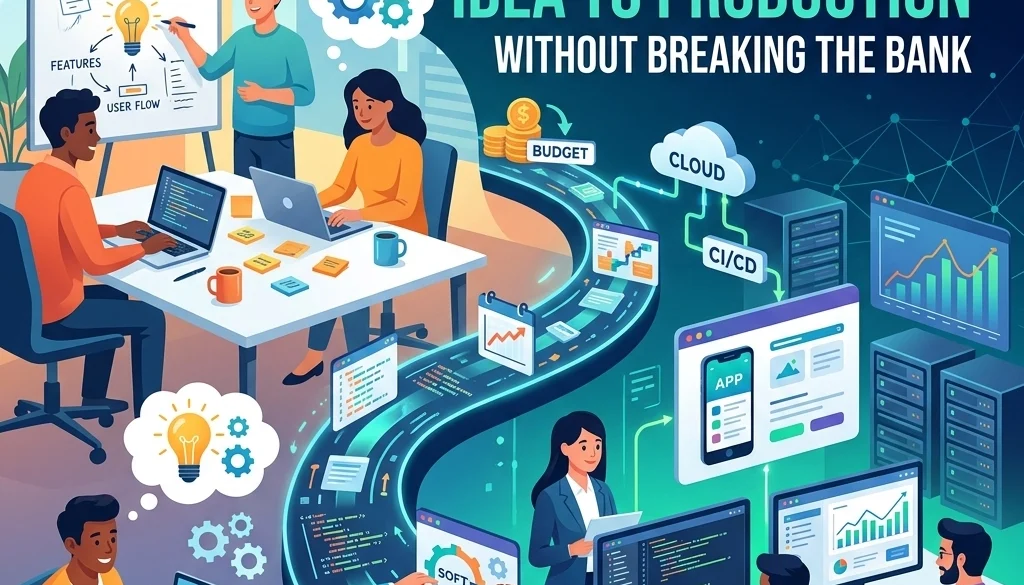
Custom Software Secrets Revealed: How Startups Go From Idea to Production Without Breaking the Bank
Technical Architecture Selection and Requirement Documentation
The transition from conceptualization to production requires formal documentation of technical specifications. Startups frequently fail due to scope creep and undefined parameters. The initial phase involves the creation of a Software Requirements Specification (SRS) document. This document identifies functional requirements, non-functional requirements, and user personas.
Application development begins with the identification of core features. The MoSCoW method is applied to categorize features into Must-have, Should-have, Could-have, and Won't-have. This prioritization ensures that the initial budget is allocated strictly to critical operations. Website development requires a similar approach, focusing on user journeys and conversion paths before aesthetic elements are considered.
Technical stacks are selected based on scalability, maintenance costs, and developer availability. Common frameworks for application development include React Native or Flutter for cross-platform utility, while web solutions utilize Next.js or traditional React architectures. The objective is to minimize technical debt during the initial build phase.

Resource Allocation and Team Structure
Resource selection is a primary factor in financial management. Three primary models exist for team composition: in-house hiring, local agencies, and offshore development partners.
- In-house Teams: High control, high fixed costs (salaries, benefits, office space).
- Local Agencies: Regional expertise, high hourly rates.
- Offshore/Hybrid Partners: Cost optimization, access to global talent, scalability.
Marketrun provides custom software solutions that utilize a hybrid model to balance cost and quality. Startups often utilize offshore resources to extend their runway. Comparative data regarding costs between regions can be found in the Custom Software India vs. USA Cost 2026 guide.

Minimum Viable Product (MVP) Development Strategy
The MVP strategy is utilized to validate market assumptions with minimal capital expenditure. Development is focused on a single value proposition.
Core MVP Components:
- User Authentication: Secure entry and data protection.
- Primary Functionality: The execution of the specific problem-solving feature.
- Feedback Mechanism: Systems to collect data for iteration.
The production of an MVP prevents the expenditure of resources on features that do not align with market demand. Iterative testing allows for the refinement of the product based on empirical evidence rather than conjecture. This phase is critical for both mobile application development and comprehensive website development.
The Development Lifecycle: Sprints and Milestones
Agile methodology is the standard for modern software production. Projects are divided into two-week intervals known as sprints. Each sprint results in a functional increment of the software.
Sprint Phases:
- Planning: Assignment of tasks from the product backlog.
- Execution: Code production and unit testing.
- Review: Demonstration of the increment to stakeholders.
- Retrospective: Assessment of process efficiency.
This methodology ensures transparency and allows for pivot points without discarding large portions of the codebase. Regular code reviews and automated testing protocols are implemented to ensure software integrity.

Infrastructure and Hosting Costs
Hosting expenses represent a significant recurring cost for startups. Strategic selection of infrastructure providers influences the long-term financial health of the organization.
- Cloud Providers: AWS, Google Cloud, and Azure offer scalable environments but can become expensive without proper management.
- Self-Hosting: For startups utilizing Large Language Models (LLMs), self-hosting LLMs can reduce API latency and monthly subscription costs. Detailed technical implementations are discussed in the Self-hosting LLMs 2026 Guide.
- Open Source: Utilizing open source deployment reduces licensing fees and prevents vendor lock-in.
Marketrun assists startups in optimizing infrastructure to ensure that application development remains within budget.
Quality Assurance and Automated Testing
Software reliability is non-negotiable for production environments. Errors discovered post-launch are significantly more expensive to rectify than those found during development.
Testing protocols include:
- Unit Testing: Verification of individual code components.
- Integration Testing: Assessment of how different modules interact.
- User Acceptance Testing (UAT): Verification that the software meets user requirements.
- Performance Testing: Stress testing to ensure the system handles expected loads.
Automation of these tests within a Continuous Integration/Continuous Deployment (CI/CD) pipeline ensures that new code does not introduce regressions into the system.

Launch and Post-Production Maintenance
The transition to production involves the deployment of the software to a live environment. This is not the conclusion of the development process but the beginning of the maintenance phase.
Launch Checklist:
- Security Audit: Verification of data encryption and permission protocols.
- SEO Optimization: Implementation of metadata and performance metrics for website development.
- Analytics Integration: Tracking of user behavior for future iterations.
- Scaling Protocols: Configuration of auto-scaling groups for server resources.
Maintenance involves the regular patching of security vulnerabilities, updates to third-party libraries, and the gradual introduction of "Should-have" features deferred during the MVP phase. For a deeper understanding of long-term costs, startups should consult the offshore web and mobile apps guide.
ROI and Financial Planning for Startups
The success of custom software is measured by its Return on Investment (ROI). This is calculated by comparing the cost of development and maintenance against the revenue generated or operational costs saved through automation.
Automation through AI is a primary driver of modern software ROI. Marketrun provides an AI automation ROI calculator to assist founders in projecting financial outcomes. AI and custom software development are increasingly integrated to automate repetitive tasks, thereby reducing the necessity for large operational teams.

Final Summary of Development Standards
Building custom software without excessive expenditure is a systematic process. It requires adherence to strict documentation, the adoption of the MVP model, and the selection of cost-efficient infrastructure.
- Requirement Phase: Defined scope and technical stack.
- Development Phase: Agile methodology and code quality standards.
- Deployment Phase: CI/CD pipelines and performance monitoring.
Marketrun facilitates this journey for startups, providing the technical expertise required for application development and website development. Organizations seeking to transition from concept to production can review available pricing structures or explore AI automation solutions to enhance operational efficiency.
Information regarding specific regional services is available for US clients and India clients. Detailed technical guides are maintained on the Marketrun blog.