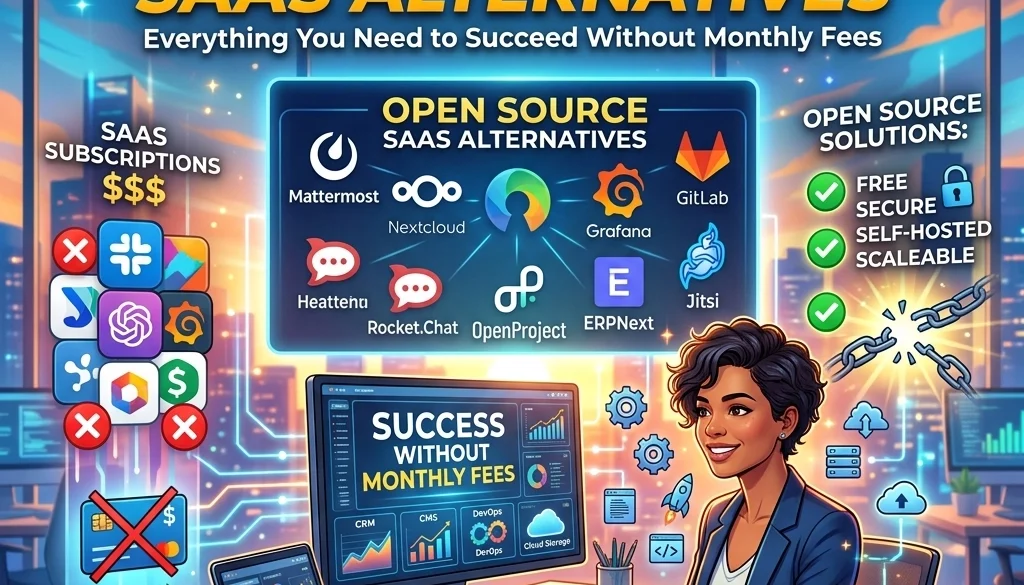
The Ultimate Guide to Open Source SaaS Alternatives: Everything You Need to Succeed Without Monthly Fees
Current Economic Context of SaaS Subscriptions
The software-as-a-service (SaaS) model functions on recurring revenue. Cumulative subscription costs for enterprise tool suites often exceed thousands of dollars per month. Data indicates that businesses frequently pay for redundant features and tiered pricing models that scale with user count.
Open source SaaS alternatives provide a method to decouple software utility from monthly fees. Transitioning to self-hosted architecture involves a shift from operational expenditure (OpEx) to initial setup time or capital investment in infrastructure. This guide documents the migration from centralized services to decentralized, self-managed environments.
Technical Requirements for Self-Hosting
Transitioning to open source tools requires a foundational understanding of server environments. Most modern open source applications utilize containerization.
VPS Setup and Management
A Virtual Private Server (VPS) is the primary requirement for hosting alternatives to SaaS tools. Providers such as AWS, Google Cloud, DigitalOcean, and Hetzner offer compute instances.
Infrastructure Checklist:
- Operating System: Linux distributions, specifically Ubuntu 22.04 or 24.04 LTS, are standard.
- Containerization: Docker and Docker Compose manage application environments and dependencies.
- Reverse Proxy: Nginx, Caddy, or Traefik handle SSL termination and traffic routing.
- Memory Requirements: A minimum of 4GB RAM is recommended for running multiple small-scale tools on a single instance.
Proper VPS setup and management involves securing the server via SSH keys, disabling password authentication, and implementing firewall rules via UFW or IPTables. For organizations requiring assistance with initial architecture, Marketrun provides custom software deployment services.

Category: Database and Backend Solutions
Cloud-based databases like Firebase and Airtable represent significant monthly costs as data volume increases.
Rowy and Nocodb (Airtable Alternatives)
Rowy is a low-code database platform. It functions as an interface for Google Firestore. It provides spreadsheet-like functionality with integrated cloud functions. Nocodb transforms existing databases (MySQL, PostgreSQL, SQL Server) into smart spreadsheets. These tools facilitate data management without the per-seat pricing of Airtable.
Pocketbase and Instant (Firebase Alternatives)
Pocketbase is a single-file backend consisting of an embedded database (SQLite) with real-time subscriptions, built-in auth, and file storage. Instant provides a graph-based database for real-time applications. These solutions are deployable on a single VPS, eliminating usage-based billing from cloud providers.
Category: Productivity and Documentation
Internal knowledge bases and project management tools are essential for operational efficiency.
Outline and Appflowy (Notion Alternatives)
Outline is a team wiki and documentation platform. It supports Markdown and integrates with Slack for notifications. Appflowy is a decentralized alternative for task management and note-taking, prioritizing data privacy.
Plane and Focalboard (Jira/Trello Alternatives)
Plane serves as an open-source project management suite. It includes cycles, modules, and views for issue tracking. Focalboard offers Kanban-style boards and is available as a standalone server or integrated into Mattermost.

Category: Communication and Collaboration
Communication platforms are often the highest per-user expense in a corporate environment.
Mattermost and Zulip (Slack Alternatives)
Mattermost provides a high-security environment for team chat. It supports file sharing and integration with existing DevOps pipelines. Zulip utilizes a thread-based model to organize conversations by topic, reducing information noise.
Jitsi (Zoom/Google Meet Alternative)
Jitsi Meet is a fully encrypted, open-source video conferencing solution. It requires no account for participants and operates within a web browser. Self-hosting Jitsi ensures that video data does not traverse third-party servers.
For companies seeking to integrate communication with automated workflows, AI-driven automations can be deployed alongside these open-source tools.
Category: Deployment and Hosting Platforms
Platform-as-a-Service (PaaS) providers like Vercel and Heroku simplify deployment but introduce vendor lock-in and high cost at scale.
Coolify and Dokku
Coolify is an open-source, self-hosted alternative to Vercel/Netlify. It manages applications, databases, and services on any Linux server through a web-based UI. Dokku is a smaller-scale PaaS that uses Docker to manage deployments via Git.
Comparison Table: PaaS vs. Self-Hosted Deployment
| Feature | Vercel/Heroku | Coolify/Dokku |
|---|---|---|
| Monthly Cost | Per-project/Per-user | Flat VPS fee |
| Control | Limited to UI | Full root access |
| Privacy | Third-party data storage | Localized data storage |
| Setup Time | Minimal | Moderate |
Marketrun offers open source deployment solutions to assist businesses in migrating from PaaS to self-hosted infrastructure.

Category: E-commerce and Business Operations
Enterprise Resource Planning (ERP) and E-commerce platforms often require high licensing fees.
Spree and ERPNext
Spree is a headless e-commerce framework built on Ruby on Rails. It allows for complete customization of the storefront and checkout logic. ERPNext is a comprehensive suite covering accounting, HR, sales, and inventory management.
Fathom and Plausible (Google Analytics Alternatives)
These tools provide privacy-focused web analytics. Unlike Google Analytics, they do not track individual user data or require cookie banners in many jurisdictions. They are lightweight and self-hostable to ensure total data ownership.
Implementation Roadmap for Eliminating SaaS Subscriptions
The transition from paid SaaS to open source alternatives follows a specific sequence.
- Inventory Audit: Identify every active SaaS subscription and its monthly cost.
- Compatibility Mapping: Match each SaaS tool to a corresponding open source alternative based on required features.
- Infrastructure Provisioning: Deploy a VPS with sufficient resources. Calculate the ROI of the transition using an AI automation ROI calculator.
- Data Migration: Export data from SaaS providers (CSV, JSON, SQL) and import it into the self-hosted instances.
- User Onboarding: Transition team members to the new interfaces.

Data Privacy and Security Considerations
Self-hosting places the responsibility of security on the organization.
- Backups: Automated off-site backups are mandatory. Tools like Rclone or Restic can sync server data to encrypted S3-compatible storage.
- Updates: Regular patching of the OS and the software containers is required to mitigate vulnerabilities.
- SSL/TLS: All self-hosted services must be served over HTTPS. Caddy or Nginx Proxy Manager can automate Let's Encrypt certificate renewals.
For businesses operating in specific regions, different regulatory requirements apply. Information for clients in the US and clients in India regarding custom software compliance is available through Marketrun.
Conclusion of Systems Transition
The use of open source SaaS alternatives reduces monthly overhead and increases technical autonomy. By managing a VPS and deploying containerized applications, an organization eliminates the dependency on third-party pricing changes and service deprecations.
The financial benefit is measurable through the reduction of recurring software line items in the corporate budget. For specialized requirements such as self-hosting Large Language Models (LLMs), the same principles of infrastructure management apply.

Documentation regarding specific technical implementations and comparative costs of software development can be found in our blog archive, including detailed guides on offshore web and mobile development.