How to Reclaim 20 Hours Every Week with Custom AI Automation Workflows
Operational Objective: Time Reclamation
The current operational standard for small and medium businesses (SMBs) involves manual processing of repetitive administrative, analytical, and communicative tasks. These tasks consume approximately 15 to 25 hours per workweek for key personnel. The implementation of custom ai automation workflows facilitates the reclamation of this time.
The primary tools utilized for this objective include n8n for orchestration and specialized ai agents for business for cognitive task execution. Systematic integration of these technologies results in a measurable reduction of manual labor hours. Information regarding foundational concepts is available at Marketrun AI Automations.
Phase 1: Workflow Identification and Documentation
Efficiency gains require a comprehensive audit of existing manual processes. Activities categorized as high-waste include data entry, email triage, meeting documentation, and report generation.
Audit Parameters
- Task Frequency: Identify actions performed daily or multiple times per week.
- Cognitive Load: Determine if the task requires simple logic or complex reasoning.
- Time Expenditure: Record the duration required for manual completion.
- Error Rate: Document the frequency of human error in existing manual workflows.
Process Mapping
Mapping entails the documentation of every step from input to output. This documentation serves as the blueprint for the digital workflow. Processes that take more than four hours per week are prioritized for automation. For guidance on identifying these processes, refer to the AI Agents and Automations Guide 2026.

Phase 2: Architecting Workflows with n8n
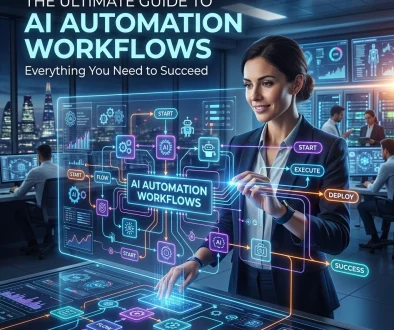
n8n serves as the primary orchestration engine. This platform allows for the connection of disparate software applications through a node-based interface.
Core Components of an n8n Workflow
- Trigger Nodes: These initiate the workflow based on specific events, such as an incoming email, a new entry in a CRM, or a scheduled time interval.
- Action Nodes: These execute specific tasks within third-party applications (e.g., Slack, Google Sheets, HubSpot).
- Logic Nodes: These provide conditional branching (if/then statements) and data transformation (filtering, merging).
- AI Nodes: These integrate Large Language Models (LLMs) directly into the workflow to handle unstructured data.
The utilize of n8n for custom software integration ensures that data flows between systems without manual intervention. Details on technical implementation are found at Marketrun Custom Software.
Phase 3: Deployment of AI Agents for Business
Standard automation follows rigid rules. Ai agents for business provide adaptive reasoning capabilities. These agents analyze context and make decisions within the workflow.
Functional Capabilities of AI Agents
- Natural Language Processing (NLP): Categorization of emails and sentiment analysis of customer feedback.
- Data Extraction: Conversion of unstructured data (PDFs, images, transcripts) into structured formats (JSON, CSV).
- Content Generation: Drafting of correspondence, reports, and marketing copy based on specific inputs.
- Decision Logic: Route tasks based on priority, urgency, and content relevance.

Specific Implementation: Lead Management and Sales
Manual lead follow-up is identified as a significant time consumer. An automated workflow replaces manual intervention from lead capture to meeting scheduling.
Workflow Sequence
- Lead Capture: Information is ingested from a website form.
- Enrichment: An AI agent searches for company data and LinkedIn profiles to append to the lead record.
- Qualification: The AI agent compares the lead data against Ideal Customer Profile (ICP) criteria.
- Communication: A personalized email is drafted and sent via a CRM integration.
- Scheduling: Integration with scheduling software automates the booking of discovery calls.
This sequence reduces the time spent on lead management by approximately 5 to 7 hours per week. Further information on lead processing is available at Marketrun AI Development.
Specific Implementation: Meeting and Communication Triage
Meeting management involves transcription, summarization, and action item extraction. These tasks are automated through high-impact workflows.
Meeting Automation Workflow
- Recording Ingestion: Audio or video files are sent to a transcription service node.
- Context Analysis: An AI agent identifies the primary topics discussed.
- Action Item Extraction: Key tasks are extracted and formatted.
- Distribution: Summaries are posted to Slack channels and action items are inserted into project management tools (e.g., Jira, Trello, Monday.com).
Manual synthesis of meeting notes typically requires 1 to 2 hours per meeting. Automation reduces this to zero manual minutes.

Specific Implementation: Data Analysis and Reporting
Manual report generation involves data extraction from multiple sources and formatting into a final document.
Automated Reporting Workflow
- Data Gathering: n8n pulls data from advertising platforms, CRMs, and financial software.
- Aggregation: Data is merged into a centralized database or spreadsheet.
- Analysis: An AI agent identifies trends, anomalies, and performance indicators.
- Formatting: A finalized report is generated in PDF or slide format and delivered to stakeholders.
The reclamation of time in reporting is estimated at 3 to 5 hours per week depending on organizational complexity. Estimated ROI can be calculated via the AI Automation ROI Calculator.
Technical Infrastructure and Hosting
The reliability of ai automation workflows depends on the underlying infrastructure. Organizations must choose between cloud-hosted solutions and self-hosting.
Self-Hosting Considerations
Self-hosting LLMs and automation platforms like n8n provides enhanced data security and cost control. This approach is optimal for businesses handling sensitive data. Information regarding this deployment model is provided at Self-Hosting LLMs 2026 Guide and Marketrun Self-Hosting LLMs.
Open Source Deployment
Utilizing open-source tools reduces licensing costs and prevents vendor lock-in. Integration services for these systems are detailed at Marketrun Open Source Deployment.

Monitoring and Optimization
Automated systems require periodic monitoring to ensure continued accuracy and performance.
Maintenance Protocol
- Log Review: Weekly inspection of n8n execution logs to identify failed nodes.
- Output Validation: Random sampling of AI agent outputs to ensure consistency with brand standards.
- Workflow Refinement: Adjustment of logic nodes to accommodate changes in business processes or software updates.
- Scaling: Implementation of additional workflows as new manual bottlenecks are identified.
Continuous optimization ensures that the reclaimed 20 hours remain reclaimed as the business scales.
Summary of Time Reclamation Potential
| Task Category | Manual Hours/Week | Automated Hours/Week | Time Reclaimed |
|---|---|---|---|
| Email & Triage | 5.0 | 0.5 | 4.5 |
| Meeting Admin | 4.0 | 0.0 | 4.0 |
| Lead Mgmt | 6.0 | 1.0 | 5.0 |
| Reporting | 4.0 | 0.5 | 3.5 |
| Data Entry | 3.0 | 0.0 | 3.0 |
| Total | 22.0 | 2.0 | 20.0 |
The transition from manual processing to ai automation workflows is a systematic requirement for operational efficiency in 2026. For organizations seeking specialized implementation, consultation is available at Marketrun Solutions.

Strategic Conclusion
The reclamation of 20 hours per week is achieved through the elimination of manual repetition. The combination of n8n orchestration and adaptive AI agents provides a robust framework for business scaling. Efficiency is no longer an optional attribute but a baseline requirement. Review technical requirements and pricing structures at Marketrun Pricing. For international operational comparisons, refer to Custom Software India vs USA Cost 2026.