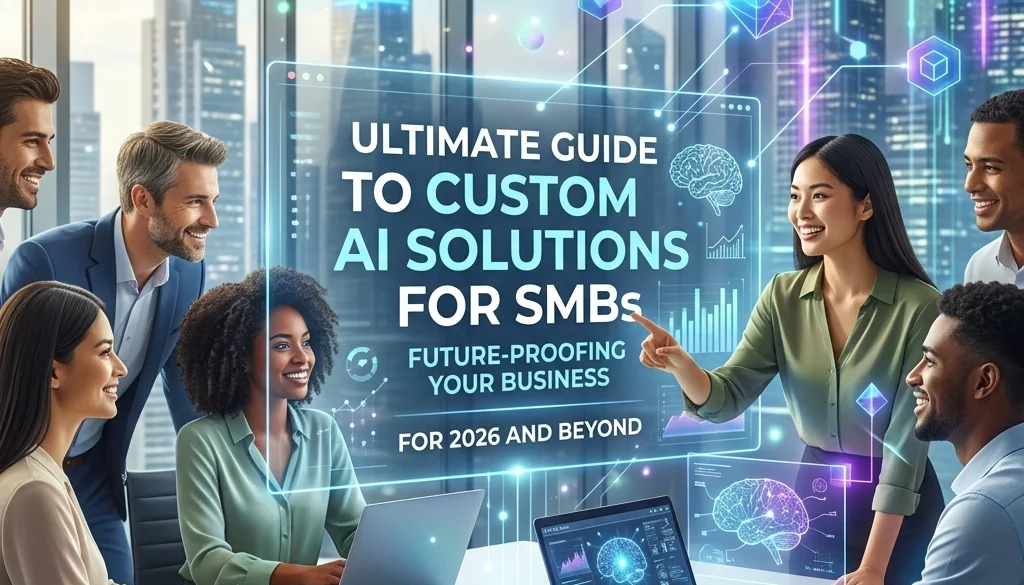
The Ultimate Guide to Custom AI Solutions for SMBs: Future-Proofing Your Business for 2026 and Beyond
2026 Market Status: The AI Requirement
As of April 2026, the integration of custom AI solutions for SMBs is no longer a speculative advantage. It is a baseline operational requirement. Small and medium-sized businesses utilizing tailored artificial intelligence frameworks are currently recording a return on investment (ROI) between 300% and 700% within a 12-to-18-month window.
The acceleration of AI adoption in the first half of the decade has resulted in a market where 93% of SMBs leveraging custom AI solutions report revenue growth. Conversely, businesses reliant on legacy manual processes face increasing overhead and decreasing market share. This guide provides a technical and operational framework for the implementation of AI agents for business and bespoke software architecture.
Core Definitions and Frameworks
Custom AI Solutions for SMBs
Custom AI solutions refer to software systems developed to address specific organizational data and workflow requirements. Unlike generalized AI tools, these solutions are built on proprietary data and integrated directly into existing technology stacks.
AI Agents for Business
AI agents are autonomous software entities designed to perform specific tasks, make decisions, and interact with other systems without continuous human intervention. In 2026, these agents serve as the primary interface for process automation.

Quantitative Impact of AI Implementation
Data from the 2025-2026 fiscal year indicates significant efficiency gains across multiple business functions. The following table delineates the primary impact areas:
| AI Automation Category | Average ROI (2026) | Primary Impact Area |
|---|---|---|
| Automated Billing & Invoice | 35% | Accounting Efficiency |
| AI Chatbots for Support | 41% | Customer Retention |
| Personalized Email Agents | 44% | Sales Productivity |
| AI-Powered Lead Scoring | 38% | Conversion Rates |
| Automated CRM Management | 33% | Data Integrity |
The typical implementation timeline to achieve a positive ROI status is 60 to 90 days. This rapid deployment is facilitated by custom software development methodologies that prioritize modular integration.

High-Impact Use Cases for 2026
1. Document Processing and Automation
Administrative labor costs are frequently cited as a primary drain on SMB profitability. Custom AI solutions now automate 92% of invoice processing tasks. A standardized implementation reduces manual entry time from approximately 28 hours per week to 2.5 hours.
- Technology: Optical Character Recognition (OCR) combined with Natural Language Processing (NLP).
- Result: Error rate reduction from 3.2% to 0.4%.
- Integration: Direct synchronization with accounting platforms like QuickBooks or Xero.
2. AI-Powered Demand Forecasting
Inventory management requires precise data to prevent capital stagnation. AI systems analyze historical sales, seasonal trends, local event data, and weather forecasts to predict demand with 85% to 95% accuracy.
- Financial Impact: Reduction in inventory costs by 42%.
- Operational Impact: 78% decrease in stockouts.
- Strategy: Implementation of predictive analytics models within custom mobile and web apps.
3. Customer Service Automation
AI agents for business handle 73% of inquiries without human intervention. This shift allows for 24/7 availability without the necessity of increased headcount.
- Efficiency: Average response time reduction from 18 hours to 12 seconds.
- Revenue Growth: 28% increase in international sales due to multi-language support and constant availability.
- Resource Allocation: Reallocation of human support staff to complex problem-solving roles.
4. Lead Scoring and Sales Acceleration
Sales cycles in 2026 are shortened by an average of 23 days through the use of AI-driven lead scoring. Systems analyze up to 47 unique data points to qualify leads instantly.
- Conversion: Increase in conversion rates from 8% to 19%.
- Productivity: 64% growth in revenue generated per sales representative.
- Automation: Use of AI agents for business to manage initial outreach and follow-up sequences.

Strategic Implementation Pathways
Custom AI Development vs. Off-the-Shelf
Generic AI tools often fail to address specific departmental bottlenecks. Custom development ensures that the AI model understands the nuances of the business's specific industry, customer base, and internal terminology.
- Scalability: Custom solutions scale with the business.
- Security: Data remains within the organizational perimeter.
- Efficiency: Removal of redundant features found in generic SaaS products.
Self-Hosting LLMs for Data Sovereignty
In 2026, data privacy is a critical regulatory concern. SMBs are increasingly opting to self-host Large Language Models (LLMs) to maintain control over sensitive information.
- Advantages: No data leakage to third-party providers, reduced latency, and long-term cost stability.
- Requirement: Specialized infrastructure or managed open source deployment.
- Guide: For detailed technical requirements, refer to the 2026 Guide to Self-Hosting LLMs.
The Offshore Advantage: India vs. USA
Budgetary constraints remain a factor for SMBs. The cost differential between domestic US development and offshore development in India continues to favor a hybrid or offshore model.
- Cost Efficiency: Development costs in India are approximately 60-70% lower than in the USA for comparable technical expertise.
- Talent Pool: High concentration of AI and machine learning engineers.
- Comparison: Detailed cost breakdowns are available in the Custom Software India vs. USA Cost Guide.

Engineering the Future: Marketrun’s Vision
The next decade of software is defined by the transition from "software as a tool" to "software as a collaborator." Marketrun focuses on building AI-native ecosystems where software does not just store data but actively processes it to achieve business objectives.
The AI Studio Model
Marketrun utilizes an "AI Studio" approach. This involves centralizing AI talent, tools, and governance to ensure that every implementation is cohesive. The objective is to move away from siloed applications and toward a unified intelligent architecture.
Automation and SEO Integration
For SMBs reliant on digital traffic, AI website creation and AI-driven SEO are essential. These systems automatically adjust content and technical parameters based on search engine algorithm shifts in real-time.
Technical Architecture of an AI-Enabled SMB
A standard future-proof architecture consists of:
- Data Ingestion Layer: Connects to CRM, ERP, and legacy databases.
- Processing Layer: Custom LLMs or specialized machine learning models.
- Agentic Layer: AI agents that execute actions based on model outputs (e.g., sending an email, updating an inventory record).
- Interface Layer: Dashboards and mobile/web applications for human oversight.

Critical Success Factors
- Identify Bottlenecks: Implementation should begin with the process that consumes the highest manual labor hours.
- Ensure Data Quality: AI performance is contingent upon the accuracy of the underlying data.
- Incremental Integration: Utilize a 60-90 day "quick win" strategy before attempting full-scale digital transformation.
- Cost Analysis: Utilize an AI automation ROI calculator to determine the feasibility of projects before commencement.
Conclusion of Status Report
The transition to AI-integrated operations is a finalized market trend. SMBs that implement custom AI solutions in 2026 secure a 340% average ROI in the first year by addressing administrative overhead, inventory waste, and customer support bottlenecks.
For organizations seeking to initiate this transition, the Marketrun pricing structure provides tiered options for various stages of AI maturity. Further technical resources and industry insights are available on the Marketrun Blog.