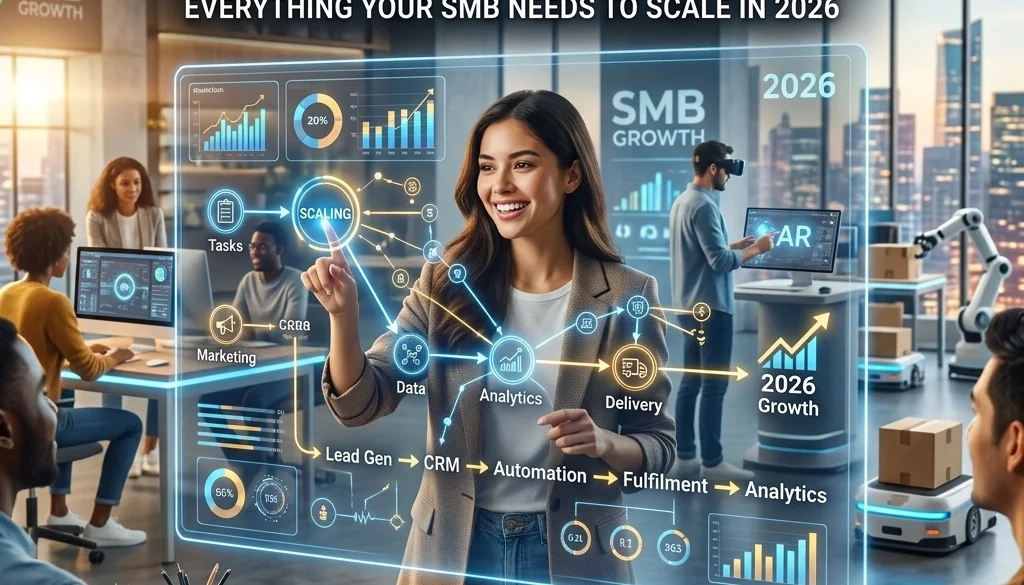
The Ultimate Guide to AI Automation Workflows: Everything Your SMB Needs to Scale in 2026
Current State of SMB Operational Efficiency
Small and Medium Businesses (SMBs) in 2026 operate in an environment where manual task execution is a primary cause of stalled growth. Statistics indicate that administrative overhead accounts for a significant portion of resource allocation. The implementation of ai automation workflows is the designated solution for optimizing these resource expenditures.
The objective of an AI-driven infrastructure is the elimination of repetitive manual processes. This transition allows human capital to be redirected toward high-level strategic decision-making. Standard implementations focus on data movement, communication, and task management.
Defining AI Automation Workflows
An automation workflow is a sequence of pre-defined tasks executed by software. When integrated with Artificial Intelligence, these workflows gain the ability to process unstructured data, make logic-based decisions, and adapt to varying inputs.
Integration Layers: n8n and Low-Code Platforms
n8n serves as a critical integration layer for modern SMBs. Unlike closed-source alternatives, n8n provides a workflow automation tool that allows for complex logic and self-hosting. This capability ensures data privacy and lowers long-term operational costs.
- Nodes: Individual functional units that perform specific actions (e.g., sending an email, querying a database).
- Triggers: Events that initiate the workflow (e.g., a new lead submission, a scheduled time).
- AI Nodes: Specialized components that interact with Large Language Models (LLMs) to analyze text, categorize sentiment, or generate responses.
 A technical diagram showing n8n workflow nodes connecting various SaaS applications through a central AI processing unit.]
The Role of AI Agents for Business
AI agents for business differ from standard automations by their level of autonomy. While a standard workflow follows a linear path, an agent can determine the best sequence of actions to achieve a goal.
Agent Capabilities
- Tool Use: Agents can access external APIs to retrieve or send data.
- Reasoning: Agents utilize LLMs to interpret complex instructions.
- Memory: Agents retain context from previous interactions to improve output accuracy.
Marketrun specializes in the deployment of these agents to optimize departmental functions. Information regarding these services is accessible via Marketrun AI Automations.
Quantifiable Time Savings: 10-20 Hours Per Week
The primary metric for success in AI implementation is the reduction of manual labor hours. For an average SMB, the following areas provide the highest yield in time reclamation.
Lead Management and Sales Outreach
Manual lead qualification is a time-intensive process. An automated workflow performs the following actions:
- Monitors incoming inquiries from web forms.
- Uses AI to score the lead based on historical data and company profile.
- Categorizes the lead as "High Priority" or "Nurture."
- Automatically drafts a personalized response in the CRM.
This specific workflow reduces manual screening time by approximately 5-7 hours per week.
Customer Support and Resolution
AI-powered agents handle Tier 1 support inquiries. These agents utilize internal documentation to provide immediate answers.
- Workflow: Ticket Reception -> Semantic Search of Knowledge Base -> Response Generation -> Human Review (Optional) -> Send.
- Impact: 20-40% reduction in support ticket volume, saving 8-10 hours of staff time.
![https://cdn.marblism.com/YIitPEYCiEU.webp marketrun-logo-gradient-blue-m.webp]
Technical Architecture of AI Workflows
Implementing ai automation workflows requires a robust technical foundation. The architecture generally consists of a trigger, a processing engine, and a destination.
Self-Hosting vs. Cloud Solutions
SMBs must choose between cloud-based SaaS providers and self-hosted instances. Self-hosting via platforms like n8n or local LLM deployments offers superior data security. Technical guidance on self-hosting is available at Marketrun Self-Hosting LLMs.
Data Orchestration Steps
- Ingestion: Collection of raw data from sources like email, Slack, or databases.
- Standardization: Converting data into a uniform format (e.g., JSON).
- AI Processing: Passing data through an LLM for extraction or transformation.
- Action: Executing the final task, such as updating a row in Marketrun Custom Software or notifying a team member.
Specialized Workflows for Scaling
To achieve scaling without linear head-count growth, SMBs must automate back-office operations.
Automated Billing and Financial Reconciliation
Invoicing often involves manual data entry and cross-referencing.
- Automation Logic: Receipt detected in email -> AI extracts vendor name, amount, and date -> Data is pushed to accounting software -> Discrepancies are flagged for human review.
- Result: Elimination of manual entry errors and reduction in administrative time.
Content and Marketing Pipelines
Marketing teams utilize ai agents for business to maintain consistency across channels.
- Workflow: Single primary content piece (e.g., a blog post) -> AI generates social media snippets, email newsletters, and summary videos -> Scheduled for publication.
- Result: Scaled marketing output with 75% less manual effort. Reference for website-specific automation: Marketrun AI Website Creation.
 A visualization of a content pipeline where a central article is automatically fragmented and distributed into various social media platforms.]
Strategic Implementation Roadmap
Success in automation is achieved through a structured approach.
Phase 1: Assessment
Identify tasks characterized by high volume and low complexity. Document the steps currently taken by human operators.
Phase 2: Tool Selection
Select the appropriate stack. For most SMBs in 2026, this includes:
- n8n for orchestration.
- OpenAI or Anthropic for AI processing.
- Marketrun Solutions for custom integrations.
Phase 3: Pilot Deployment
Deploy a single workflow, such as automated meeting summarization. This provides immediate visibility into the utility of the system.
Phase 4: Expansion and Optimization
Iterate based on performance metrics. Utilize the AI Automation ROI Calculator to determine the financial impact of each workflow.
Security and Compliance in 2026
Automated systems must comply with data protection regulations. The use of ai agents for business requires strict permissioning and audit logs.
- Encryption: All data in transit between nodes must be encrypted.
- PII Masking: Personally Identifiable Information should be redacted before being sent to third-party LLMs.
- Human-in-the-loop (HITL): Critical tasks, such as financial approvals or external communication, require a manual review step within the workflow.
 An illustration representing data security layers, showing lock icons over data streams being processed by an AI brain.]
The Marketrun Advantage
Marketrun provides the technical expertise necessary for the development and deployment of ai automation workflows. The focus is on creating custom software solutions that integrate seamlessly with existing business processes.
Current service offerings include:
For organizations seeking to optimize operations, the deployment of AI agents is no longer optional. It is the baseline for competitiveness in 2026. Detailed guides on international development considerations can be found at Custom Software India vs USA.
Final Metrics for Workflow Success
The effectiveness of an automation strategy is measured by:
- Time Reclaimed: Number of hours staff no longer spend on manual tasks.
- Error Reduction: Decrease in data entry mistakes.
- Response Latency: Speed at which customer or lead inquiries are addressed.
- Scalability Ratio: Ability to handle increased volume without increasing operational costs.
SMBs that implement these strategies report a 10-20 hour weekly reduction in administrative load per department. The transition to an automated infrastructure is the primary lever for scaling in the current fiscal year.