The Ultimate Guide to AI Agents for Business: Everything You Need to Succeed in 2026 and Beyond
Current Market Status: 2026 Baseline
The utilization of AI agents for business has reached a state of operational maturity as of April 2026. Global market valuation for agentic systems stands at $9 billion. Data indicates an annual growth rate of 46%. Projections for the 2026 fiscal year confirm that 40% of enterprise software applications contain embedded task-specific agents.
Enterprise deployments in 2026 report an average Return on Investment (ROI) of 171%. US-based enterprises report 192% ROI. These figures represent a threefold increase over traditional automation benchmarks. Implementation of custom AI solutions for SMBs is the primary driver for this growth.

AI Agent Definition and Logic
AI agents are autonomous software entities. Unlike standard Large Language Model (LLM) interfaces, agents perform actions. An agent identifies a goal, decomposes the goal into sub-tasks, and utilizes external tools to execute these tasks.
Functional Components
- Brain: The core LLM or specialized model responsible for reasoning.
- Planning: The capability to break down complex objectives into sequential steps.
- Memory: The storage of past interactions and environmental context.
- Tools: Access to external APIs, databases, and software environments.
The distinction between generative AI and agentic AI resides in the output. Generative AI produces text or media. Agentic AI produces task completion. Business entities utilize custom AI solutions for SMBs to bridge this gap.
Strategic Applications in 2026
Sales and Lead Acquisition
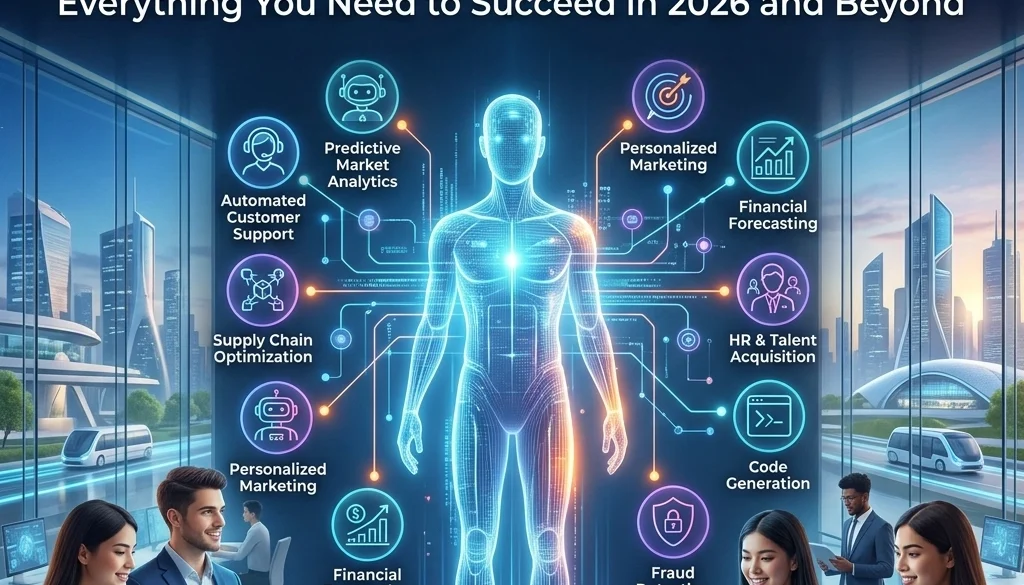
AI agents manage outbound sales processes. Agents execute lead qualification, prospect research, and outreach coordination. The 11x.ai platform and specialized AI automations facilitate these workflows. Data confirms agents handle lead scoring and meeting scheduling without human intervention.
Customer Support Operations
Agents process support tickets by accessing internal knowledge bases and order databases. Resolution of Tier 1 and Tier 2 queries is automated. Integration with CRM systems like Salesforce (via Agentforce) or Microsoft Dynamics (via Copilot Studio) is standard.
Operations and Data Management
Agents perform data extraction, report generation, and cross-platform synchronization. Specific use cases include expense processing, content management, and inventory tracking. Organizations utilize custom software to host these agents internally.

Technical Architecture for AI Agents
Implementation requires a structured technical stack. The architecture must support reasoning, connectivity, and security.
1. Model Selection and Hosting
Businesses select models based on latency and privacy requirements. Options include proprietary models (OpenAI, Anthropic) or open-source models (Llama 4, Mistral). For data privacy, self-hosting LLMs is the preferred method for 62% of mid-market firms in 2026. Details on this approach are found in the self-hosting LLMs 2026 guide.
2. Integration Protocols
Agents require access to business tools. Connection is established via:
- REST APIs: For interaction with cloud services.
- Database Connectors: For SQL/NoSQL data retrieval.
- Web Browsing: For real-time information gathering.
3. Orchestration Frameworks
Frameworks such as LangChain, CrewAI, and Microsoft Semantic Kernel manage agent logic. These frameworks coordinate multi-agent systems where specialized units collaborate on a single objective.

Platform Evaluation Matrix 2026
The selection of a platform depends on business size and technical capacity.
| Platform | Best For | Technical Requirement |
|---|---|---|
| Arahi AI | SMB Workflow Automation | Low (No-code) |
| Salesforce Agentforce | CRM-centric Operations | Medium (Configuration) |
| Microsoft Copilot Studio | Enterprise MS 365 Users | Medium (Enterprise IT) |
| Marketrun Custom Solutions | High Performance / Specialized | High (Custom Dev) |
For organizations requiring specialized outputs, AI development services provide tailored agent logic.
Implementation Roadmap
Systematic deployment follows a five-phase protocol.
Phase 1: Workflow Mapping
Identification of repetitive, high-volume tasks. Mapping of data flow between existing software systems. Interviews with stakeholders to define success metrics.
Phase 2: Infrastructure Setup
Selection of the hosting environment. For organizations prioritizing cost-efficiency, offshore development and hosting provides a viable alternative to domestic infrastructure.
Phase 3: Agent Configuration
Programming of the agent "persona" and objective function. Definition of the "toolset" available to the agent. Establishment of human-in-the-loop (HITL) triggers for high-risk decisions.
Phase 4: Security and Governance
Implementation of Role-Based Access Control (RBAC). Setup of logging and audit trails. Monitoring for model drift and hallucination rates.
Phase 5: Production Deployment
Phased rollout starting with internal workflows. Continuous optimization based on performance data. Integration of AI-driven SEO for public-facing agents.

Cost and ROI Analysis
The financial impact of AI agents for business is quantifiable. Cost components include:
- Inference Costs: Fees per token or per API call.
- Development Costs: Initial setup and integration.
- Maintenance: Periodic updates to model logic and API connections.
A comparison of costs between US-based development and offshore solutions is detailed in the custom software India vs USA cost 2026 guide. Organizations use the AI automation ROI calculator to project 24-month returns.
Security, Privacy, and Self-Hosting
Data leakage is a primary concern for 84% of IT directors in 2026. Proprietary data used to ground AI agents must remain within the organizational perimeter.
Self-hosting on private cloud infrastructure (AWS GovCloud, Azure Private Link) or on-premise hardware ensures:
- Data Sovereignty: Information does not train external models.
- Compliance: Adherence to GDPR, CCPA, and industry-specific regulations.
- Latency Control: Reduction of response times for critical operations.
Information regarding open-source deployment strategies is available for technical review.
Future Projections: Beyond 2026
The trajectory of AI agents indicates a shift toward "Agentic Ecosystems." In this state, agents from different organizations communicate directly to resolve supply chain, logistics, and financial transactions.
Hardware integration is also increasing. Agents are no longer limited to browser environments; they operate within Windows software and mobile/web applications.
Operational Summary
AI agents for business have transitioned from experimental tools to core infrastructure. Success in 2026 requires:
- High-quality internal data for grounding.
- Robust API connectivity between legacy systems and AI brains.
- Strict governance frameworks to monitor autonomous actions.
Marketrun provides the technical foundation for these systems. Entities seeking implementation support can view pricing or explore specific AI solutions.
Documentation and further technical insights are maintained on the Marketrun blog.
State: Operational.
Status: Current as of 23 April 2026.
End of Guide.