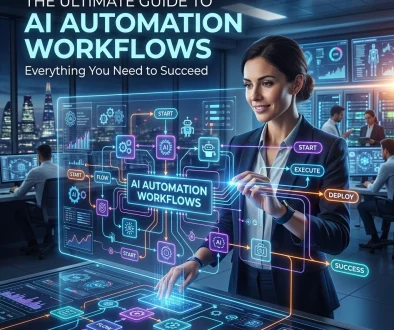
The Ultimate Guide to AI Automation Workflows: Everything You Need to Succeed
System Definition: AI Workflow Automation
AI workflow automation is the application of machine learning (ML), natural language processing (NLP), and predictive analytics to business processes. This technology handles complex, dynamic tasks that exceed the capabilities of traditional rule-based logic. Traditional automation executes predetermined sequences. AI automation interprets unstructured inputs such as emails, free text, and documents to make contextual routing decisions.
Core Technical Components
Efficient AI automation workflows utilize a combination of specialized technologies:
- Machine Learning (ML): Used for iterative performance improvement through data analysis.
- Natural Language Processing (NLP): Required for the comprehension and generation of human language.
- Robotic Process Automation (RPA): Utilized for executing repetitive, rule-based tasks across legacy interfaces.
- Deep Learning: Applied to complex pattern detection and image recognition tasks.
- Business Process Automation (BPA): The overarching orchestration of end-to-end organizational processes.

Strategic Implementation Roadmap
To automate business operations with AI, a structured methodology is required. The following stages define the implementation process.
1. Process Documentation
Every business process must be mapped before automation deployment. Documentation must include actions, handoffs, exceptions, and dependencies. Identification of time-intensive tasks involving unstructured data interpretation is the priority.
2. Workflow Identification
Workflows dominated by manual data entry or routine decision-making are selected. Processes exhibiting high error rates, significant delays, or operational inefficiencies are primary candidates for AI intervention.
3. Input Classification
Workflow inputs are categorized into two types:
- Structured Inputs: CRM fields, database records, and spreadsheets. These flow directly into downstream systems.
- Unstructured Inputs: Emails, chat logs, PDFs, and screenshots. These require AI models for interpretation and conversion into structured data.
4. Architectural Framework
A reliable AI automation workflow follows a standardized sequence:
- Trigger: Webhooks or scheduled events initiate the run.
- Preprocess: Data cleaning and formatting are executed.
- LLM Step: Formatted prompts are sent to large language models with specific output schemas.
- Tool Calls: External services such as CRMs, Slack, or databases are invoked via APIs based on model reasoning.
- Postprocess & Logging: Results are formatted and audit trails are recorded.
Advanced Integration: Connecting Disparate Systems
To automate business operations with AI across a fragmented software stack, systems must be interconnected. Disparate systems often include legacy software, cloud-based SaaS, and proprietary databases.
API Orchestration
Modern AI workflows utilize ai-automations to bridge gaps between software that lacks native integrations. AI models function as the connective tissue, extracting data from one system's output and reformatting it for another system's input requirements.
Tool Calling and Function Execution
Advanced workflows utilize function calling. The AI model identifies which external tool is required to complete a task. It then generates the necessary parameters to execute an API call to a specific software component, such as a project management tool or an accounting suite.

Comparative Analysis: Workflows vs. AI Agents
Selection between structured workflows and autonomous agents depends on predictability requirements.
- Workflows: Utilized when the process follows predictable steps and requires high reliability. This is the standard for most business operations. Detailed information is available in the ai-agents-automations-guide-2026.
- AI Agents: Utilized when the path to a solution is dynamic and requires real-time reasoning. Guardrails are necessary to maintain operational consistency.
Operational Optimization and Monitoring
Continuous improvement is a requirement for long-term AI automation success. Systems generate data that identifies performance trends and failure points.
Key Performance Indicators
- Success Rates: The percentage of executions completed without error.
- AI Accuracy: The frequency of correct data interpretation.
- Latency Patterns: The time required for each step in the workflow.
- Human Intervention Frequency: The volume of exceptions requiring manual oversight.
Human-in-the-Loop (HITL)
Complex decisions and high-stakes exceptions require human validation. The system routes ambiguous data to a human operator. The resulting manual decision is used as training data to refine the AI model for future instances.

Technical Design Choices for Scale
Scalability in ai-development requires specific design choices:
- Modular Architecture: Individual components of the workflow should be independent to allow for updates without system-wide downtime.
- Data Privacy and Governance: Workflows must adhere to privacy standards. Auditing of how AI models handle sensitive information is mandatory.
- Low-Code Integration: Deployment of low-code platforms allows business units to manage workflows with minimal IT intervention.

ROI and Financial Justification
The implementation of ai automation workflows results in measurable financial outcomes. Reduction in manual labor hours and the elimination of human error directly impact the bottom line. Organizations can utilize an ai-automation-roi-calculator to project potential savings.
Labor Efficiency
Automated systems operate continuously without fatigue. Tasks that require hours of human analysis are completed in seconds. This allows personnel to focus on high-value cognitive tasks.
Error Reduction
Manual data entry is prone to failure. AI systems follow programmed schemas and validation rules, ensuring data integrity across connected business operations.
Deployment Strategies
Deployment occurs in phases to minimize operational risk.
- Phase 1: Pilot Program. A single, high-impact workflow is automated to test the architecture.
- Phase 2: Refinement. Prompt engineering and tool configurations are adjusted based on pilot data.
- Phase 3: Expansion. Successful patterns are replicated across other departments and disparate systems.

Future Technological Trends
The trajectory of AI automation points toward several advancements:
- Predictive Automation: Systems will forecast bottlenecks and inefficiencies before they occur.
- Enhanced Generative Integration: Deep integration of generative AI will allow for more sophisticated content creation and document synthesis within standard workflows.
- Self-Hosting Options: For increased security, organizations are moving toward self-hosting-llms to keep data within private infrastructure.
System Status and Final Conclusion
The integration of AI into business workflows is a functional necessity for modern operational efficiency. By connecting disparate systems and automating business operations with AI, organizations achieve a higher state of productivity. Consistent monitoring and iterative refinement ensure the longevity and accuracy of these automated systems. Detailed service options are available via Marketrun solutions.