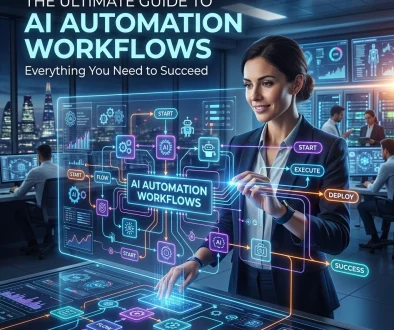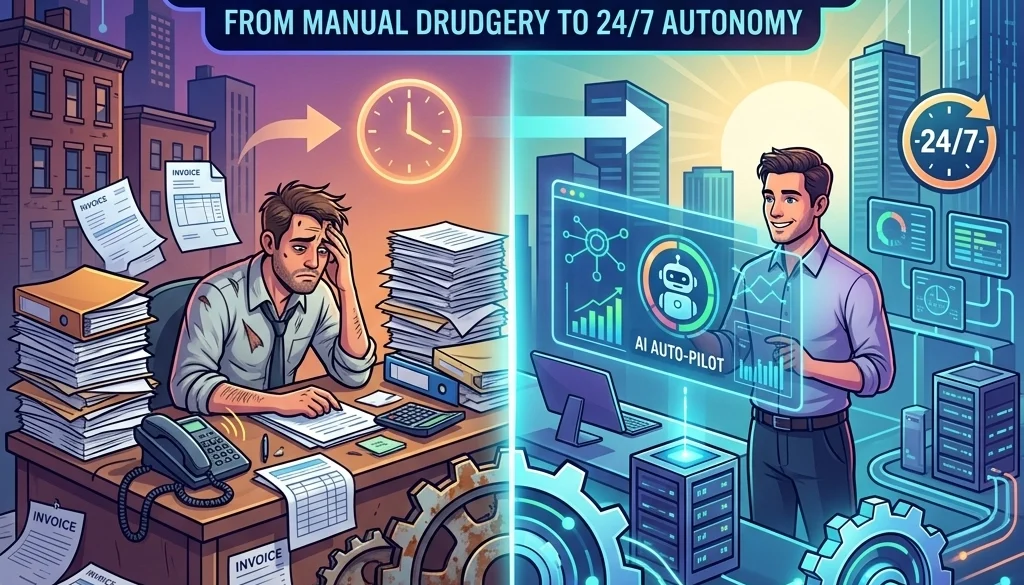
The SMB’s Guide to AI Automation Workflows: From Manual Drudgery to 24/7 Autonomy
Operational Status: The Efficiency Gap
Current data indicates that 73% of small and medium-sized businesses (SMBs) maintain reliance on manual processes for core operational sequences. These sequences typically involve lead management, financial documentation, and customer communications. Manual dependency results in a measurable drain on resources.
The implementation of ai automation workflows addresses this deficit. Analysis shows that businesses transitioning to automated systems reclaim approximately 10 to 20 hours per week per employee. This temporal reallocation allows for personnel deployment to high-value cognitive tasks. Operational costs are reduced by an average of 30% through the elimination of human error and the establishment of 24/7 service availability.

System Architecture: Framework for Autonomy
The transition from manual labor to autonomy requires a structured framework. AI agents for business serve as the primary execution layer within this architecture. Unlike legacy software, these agents possess the capability to process unstructured data, make conditional decisions, and interface with multiple software environments simultaneously.
Marketrun provides specialized AI Automations to bridge the gap between static software and autonomous operations.
Key Components of an Automation Ecosystem:
- Triggers: System events (e.g., inbound email, form submission, webhook) that initiate a workflow.
- Orchestration Layer: The logic engine (e.g., n8n) that routes data between applications.
- Inference Layer: Large Language Models (LLMs) that interpret intent and generate responses.
- Actions: The final output (e.g., database update, calendar booking, invoice generation).

Core Workflow: Lead Qualification and Routing
Manual lead qualification results in delayed response times and lost revenue opportunities. The automated lead qualification workflow operates on a 24/7 basis to ensure immediate engagement.
Process Specifications:
- Trigger: A prospect submits a form on a digital property.
- Analysis: An AI agent parses the input data. The agent evaluates the prospect against defined Ideal Customer Profile (ICP) criteria.
- Action:
- Qualified Leads: The system notifies the sales team via Slack and schedules a meeting on the relevant calendar.
- Unqualified Leads: The system routes the contact to a nurture sequence or provides a sterile rejection notification.
Performance data suggests that immediate AI-driven qualification increases conversion rates by ensuring that high-intent leads are prioritized without human intervention.
Core Workflow: Autonomous Appointment Scheduling
Scheduling involves significant back-and-forth communication. This is categorized as low-value cognitive labor.
Process Specifications:
- System Integration: Connection to Google Calendar or Outlook via n8n.
- Agent Capability: The AI agent utilizes natural language processing to understand availability preferences expressed in emails or chat messages.
- Execution: The workflow checks real-time availability, proposes slots, and confirms the booking once the user selects a time.
The integration of ai agents for business into scheduling reduces no-show rates by sending automated, context-aware reminders.
Core Workflow: Financial Operations and Invoice Management
Manual invoice tracking is prone to error and delayed cash flow. Automated financial workflows ensure consistency in accounts receivable.
Process Specifications:
- Monitoring: The system scans accounting databases for unpaid invoices past the 30-day or 60-day threshold.
- Interaction: The AI agent generates a polite but firm reminder. It incorporates the specific invoice details and payment links.
- Outcome: Payment status is updated automatically upon transaction detection.
Automating these sequences eliminates the administrative burden of manual follow-ups and stabilizes cash flow cycles.

Core Workflow: Reputation Management and Review Response
Customer feedback requires timely acknowledgement to maintain brand sentiment. Manual response cycles are often slow or inconsistent.
Process Specifications:
- Detection: A webhook triggers when a new review is posted on Google Business, Yelp, or social platforms.
- Evaluation: An AI agent performs sentiment analysis.
- Response Generation:
- Positive Reviews: The agent generates a unique thank-you message.
- Negative Reviews: The agent categorizes the complaint and drafts a professional response while alerting a human manager for intervention.
This ensures a 100% response rate, which positively influences search engine optimization (SEO) and customer trust metrics.
Technological Stack: n8n and AI Agents
The selection of the technological stack determines the scalability of the ai automation workflows.
n8n: The Orchestration Choice
n8n is a fair-code workflow automation tool that allows for complex logic branching. It supports over 700 integrations and offers self-hosting options for businesses with high data security requirements.
AI Inference
For high-level reasoning, models such as Claude 4.6 or GPT-4o are utilized. These models extract structured data from unstructured text with high accuracy. For organizations requiring total data sovereignty, Self-Hosting LLMs is the recommended protocol to ensure that proprietary data never leaves the internal infrastructure.
Integration Protocol:
- Node Configuration: Connect source applications (CRM, Email, Database).
- Logic Mapping: Define the "If/Then" parameters for data movement.
- Prompt Engineering: Define the system instructions for the AI agent to ensure output alignment with business objectives.
- Error Handling: Implement "Wait" nodes or "Error" branches to prevent workflow failure during API downtime.
Implementation Protocol: The 4-Step Roadmap
Deployment of automation follows a standardized sequence to minimize operational disruption.
Phase 1: Process Mapping
Document every step of a current manual task. Identify the exact data points required for the task to be completed. Identify the software tools currently in use.
Phase 2: Bottleneck Identification
Analyze the mapped processes for frequency and duration. Prioritize tasks that occur daily and require more than 30 minutes of manual labor.
Phase 3: Pilot Deployment
Build a single workflow (e.g., Lead Qualification). Run the workflow in "Testing Mode" to verify accuracy without live execution. Once validated, activate the workflow for a 30-day observation period.
Phase 4: Full Autonomy
Expand the automation to secondary processes. Implement centralized monitoring to track the health and output of all active AI agents.

Efficiency Metrics and ROI Tracking
The performance of ai automation workflows is measured through specific Key Performance Indicators (KPIs).
- Labor Hours Reclaimed: Total time previously spent on manual tasks minus the time spent monitoring the automation.
- Lead Response Time: The duration between lead generation and initial contact.
- Error Rate: Frequency of data entry errors compared to historical manual benchmarks.
- Operational Cost Reduction: Comparison of software subscription costs vs. previous labor costs for the same tasks.
Businesses can utilize the AI Automation ROI Calculator to quantify the financial impact of these deployments.
Marketrun Support and Development
SMBs often lack the internal technical resources to build and maintain complex automation ecosystems. Marketrun provides the necessary technical infrastructure for deployment and management.
Available services include:
- Custom AI Agent Development: Design and deployment of bespoke agents for specific industry needs.
- Workflow Maintenance: Ongoing monitoring and optimization of orchestration layers.
- Infrastructure Hosting: Management of self-hosted LLMs and automation platforms for data security.
For comprehensive technical assistance, review our Full Solutions.
Summary of Findings
AI automation is no longer a discretionary upgrade. It is a structural requirement for SMBs to maintain competitiveness. By implementing automated workflows via tools like n8n and AI agents, businesses shift from a state of manual drudgery to a state of 24/7 operational autonomy. The result is a scalable, error-resistant organization capable of higher output with existing resources.
Operational transition is recommended to begin with high-frequency, low-complexity tasks before scaling to end-to-end business process automation. For more information on current trends, visit the Marketrun Blog.