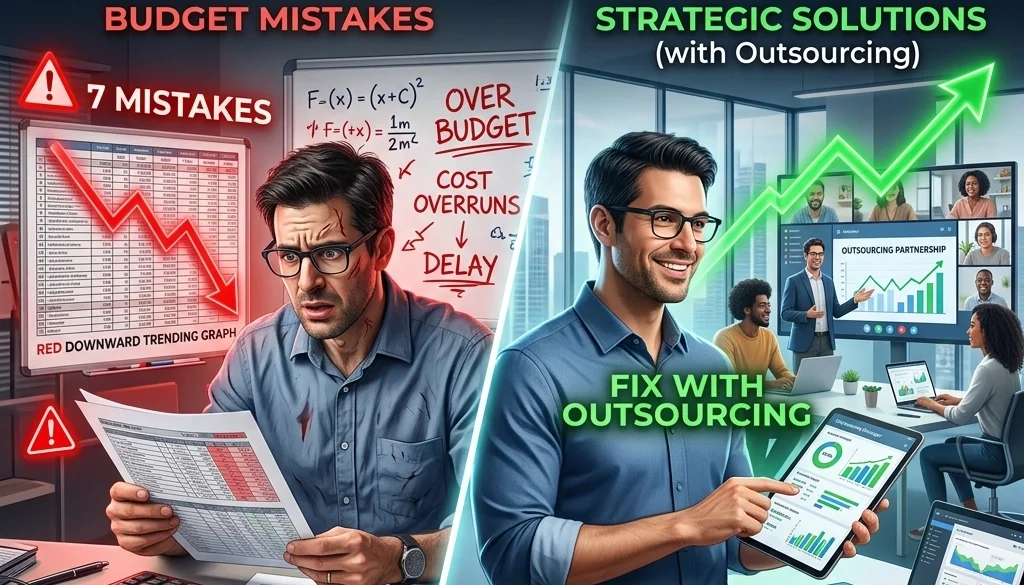
7 Mistakes You’re Making With Your Engineering Budget (And How to Fix Them with Strategic Outsourcing)
Engineering Budget Status: 2026 Analysis
Engineering departments currently face increased pressure to deliver complex features while maintaining fiscal discipline. The allocation of financial resources often suffers from historical biases and systemic inefficiencies. Strategic outsourcing provides a mechanism for capital optimization. Failure to address budgetary errors results in diminished ROI and slowed product development.
Mistake 1: Regional Cost Arbitrage Neglect
A primary error in engineering budget management is the continued reliance on high-cost talent markets for standardized development tasks. In 2026, the discrepancy between Western and Eastern labor markets remains significant.
- US/UK Agency Rates: Senior software engineers in San Francisco, New York, or London command hourly rates between $150 and $250.
- Offshore Engineering Rates: Equivalent senior talent in India is accessible at $40 to $70 per hour.
The failure to utilize offshore engineering results in a 60-75% premium on labor costs without a proportional increase in output quality. Organizations maintaining purely domestic teams for custom software development services experience rapid budget depletion during the scaling phase.

Mistake 2: Fixed Overhead Rigidity
Maintaining a large, permanent in-house engineering team converts a significant portion of the budget into fixed costs. These include:
- Salaries and bonuses.
- Healthcare and benefits.
- Office space and infrastructure.
- Recruitment and onboarding expenses.
When project demands fluctuate, fixed overhead creates financial drag. Strategic outsourcing allows for a transition to a variable cost model. Resource capacity is adjusted based on immediate project requirements. This elasticity ensures that capital is only deployed when active development is occurring. This approach is further detailed in the custom software India vs USA cost 2026 guide.
Mistake 3: Unmanaged Technical Debt Accumulation
Budgeting solely for new feature development ignores the long-term cost of maintenance and technical debt. Research indicates that up to 40% of an engineering budget is consumed by maintaining legacy codebases.
Failure to allocate specific funds for code refactoring and infrastructure updates leads to:
- Increased time-to-market for new features.
- Higher failure rates in production.
- Lower developer morale and retention.
Strategic outsourcing partners can be utilized specifically for maintenance tasks and open source deployment, allowing internal teams to focus on core product innovation while keeping the primary codebase optimized.
Mistake 4: Requirement Definition Inadequacy
Vague project specifications result in "scope creep" and unplanned expenditures. Miscommunication between stakeholders and engineering teams is a frequent source of budget overruns.
Factual observations indicate:
- Incomplete requirements lead to a 30% increase in development time.
- Rework due to misunderstood specs accounts for significant capital loss.
The fix involves rigorous documentation and the adoption of a modular development approach. Utilizing cost-effective software engineering providers requires high-fidelity documentation, which inherently forces better internal planning and reduces waste.

Mistake 5: Management Layer Proliferation
Excessive middle management within engineering organizations creates communication bottlenecks and increases the cost-per-line-of-code. Each additional layer of management adds overhead without contributing to the technical output.
Strategic outsourcing eliminates the need for extensive internal management of every individual contributor. Professional outsourcing firms provide their own project management and team leads. This reduces the internal management burden, allowing the CTO and senior architects to focus on high-level strategy rather than daily task tracking. Organizations can calculate these efficiencies using an AI automation ROI calculator.
Mistake 6: Manual Workflow Over-Reliance
In 2026, the failure to integrate AI-assisted development tools and automated testing into the engineering workflow is a budgetary mistake. Manual processes for deployment, testing, and basic code generation are no longer cost-effective.
Cost reductions are achieved through:
- AI-driven automations for CI/CD pipelines.
- Automated unit and integration testing.
- LLM-assisted coding for boilerplate and repetitive tasks.
Engineering budgets that do not account for AI development tools are inefficient compared to competitors who leverage these technologies to increase developer velocity.
Mistake 7: Selection Based Solely on Lowest Price
While cost reduction is a primary goal, selecting an outsourcing partner based exclusively on the lowest hourly rate often results in project failure. This is known as the "Cheap Labor Fallacy."
Indicators of a poor low-cost selection include:
- High turnover of assigned developers.
- Lack of specialized domain expertise (e.g., AI or mobile/web apps).
- Poor communication and time-zone misalignment.
Strategic outsourcing focuses on the "value-to-cost" ratio. Senior Indian talent at 25-40% of the cost of a US developer provides high value. A junior developer in a low-cost market at 10% of the cost may provide negative value due to the management and correction required.

Strategic Outsourcing as a Budget Corrective
Transitioning from a traditional domestic-only engineering model to a strategic offshore model addresses the aforementioned mistakes. Marketrun provides a framework for this transition.
Comparative Cost Analysis (Standardized Units)
| Role | US/UK Rate (Hourly) | India Senior Rate (Hourly) | Potential Savings |
|---|---|---|---|
| Senior Full-Stack Engineer | $180 | $55 | 69% |
| AI/ML Specialist | $250 | $75 | 70% |
| QA Automation Engineer | $130 | $40 | 69% |
| Project Manager | $160 | $50 | 68% |
Data based on 2026 market averages for senior-level talent.
Implementation Steps for Budget Optimization
- Audit Current Spend: Identify fixed vs. variable costs. Determine the percentage of the budget currently directed toward maintenance vs. innovation.
- Identify Outsourcing Targets: Select non-core components or resource-intensive projects for offshore web and mobile app development.
- Standardize Documentation: Create precise technical requirements to minimize rework.
- Engage Senior Offshore Talent: Partner with firms like Marketrun that provide vetted, senior-level engineers rather than generalist labor pools.
- Integrate AI Tools: Ensure the outsourced team utilizes modern AI-assisted development workflows to maximize hourly output.
- Monitor ROI: Use metrics such as sprint velocity, code quality scores, and total cost of ownership to evaluate the partnership.

Conclusion: Factual Outcome of Strategic Adjustment
The application of strategic outsourcing to engineering budgets results in a measurable reduction in capital expenditure. By addressing regional price disparities, fixed overhead, and technical debt, organizations can redirect funds toward product growth and market expansion. Senior engineering talent in India, combined with AI and custom software development expertise, enables a 60-75% cost reduction while maintaining or exceeding domestic quality standards.
Organizations seeking to implement these changes can review Marketrun's pricing models to establish a baseline for budget restructuring. Continued adherence to localized, high-cost hiring models in 2026 is a demonstrable financial inefficiency.