The Proven Framework to Automate Business Operations with AI and Save 20 Hours a Week

Operational Overview: AI-Driven Efficiency
Business operations in 2026 necessitate the reduction of manual intervention to maintain competitive margins. The implementation of artificial intelligence within operational workflows targets the elimination of repetitive administrative tasks. A systematic framework is utilized to identify, develop, and deploy automated solutions. This documentation outlines the methodology required to automate business operations with ai and achieve a reduction of 20 manual hours per work week.
Operational efficiency is defined by the ratio of output value to manual input. High-density manual tasks, specifically those involving data entry, document review, and multi-system synchronization, are primary candidates for automation. The integration of AI agents and custom software allows for the execution of complex logic previously reserved for human operators.
The Tri-Component Automation Framework
Effective automation rests on three technical pillars: Robotic Process Automation (RPA), Artificial Intelligence (AI), and Data-driven Process Automation (DPA).
- Robotic Process Automation (RPA): Execution of rule-based, repetitive tasks through user interface interactions.
- Artificial Intelligence (AI): Application of Large Language Models (LLMs) and Machine Learning (ML) for unstructured data processing and decision-making.
- Data-driven Process Automation (DPA): Management of end-to-end processes using data triggers to coordinate between disparate software systems.
The convergence of these technologies, often referred to as hyperautomation, enables the transition from simple task automation to complex operational autonomy. Information regarding specific automation solutions is available at Marketrun AI Automations.

Seven-Step Implementation Methodology
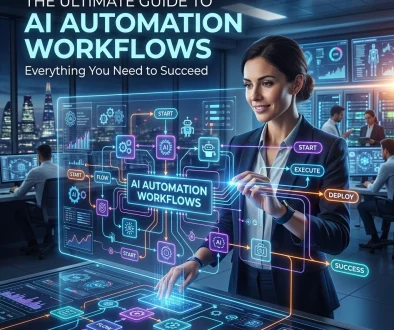
A structured approach ensures the stability and scalability of ai automation workflows. The following seven steps represent the standard deployment cycle.
1. Workflow Inventory and Mapping
Processes are documented using Business Process Model and Notation (BPMN). Each step is categorized by complexity, frequency, and duration. Processes with high frequency and low subjective judgment are prioritized.
2. Feasibility and ROI Analysis
Candidates for automation are evaluated against technical feasibility and potential Return on Investment (ROI). Calculation of time savings involves multiplying the weekly frequency of the task by the manual duration. Resources for calculating these metrics are found at the AI Automation ROI Calculator.
3. System Integration Architecture
Disparate systems: such as CRM, ERP, and communication platforms: are connected through API layers or middleware. This step resolves the "silo" effect where data is trapped in isolated environments.
4. Prototyping and Logic Definition
A minimum viable automation (MVA) is constructed. Logic flows are defined for LLM prompts to ensure consistent output quality. For customized requirements, Marketrun Custom Software provides the necessary infrastructure.
5. Implementation of Safeguards
Human-in-the-loop (HITL) checkpoints are integrated. AI systems are programmed to flag anomalies or low-confidence outputs for manual review, preventing error propagation.
6. Deployment and Monitoring
The automated workflow is launched in a production environment. Real-time monitoring tracks execution success rates and latency.
7. Iterative Optimization
Feedback loops are utilized to refine AI prompts and process logic. Continuous improvement cycles ensure the system adapts to changes in business requirements.
Connecting Disparate Systems: Data Synchronization
The primary obstacle to 20-hour weekly savings is the lack of interoperability between legacy software and modern AI tools. Disparate systems are unified through three primary methods:
Middleware Integration
Platforms such as n8n or Zapier act as translators between different software. These tools provide pre-built connectors for over 6,000 applications, allowing data to flow from a lead capture form directly into a database and then into an AI analysis engine without manual exports.
Custom API Development
When pre-built connectors are unavailable, custom API endpoints are engineered. This allows for direct communication between proprietary business software and AI models. Professional guidance on custom development is located at Marketrun AI Development.
Webhook Utilization
Webhooks provide real-time data notifications. When an event occurs in System A, a webhook sends the data immediately to the AI workflow, ensuring zero-latency operational updates.

Advanced AI Automation Workflows
Advanced workflows utilize AI agents to perform cognitive tasks. Unlike standard RPA, which follows a fixed path, AI agents can determine the best sequence of actions to achieve a specific goal.
Intelligent Document Processing (IDP)
IDP utilizes computer vision and LLMs to extract structured data from unstructured sources such as PDF invoices, handwritten notes, and legal contracts. This eliminates manual data entry.
Automated Communication Management
AI agents categorize incoming emails, draft responses based on internal knowledge bases, and update CRM records. This process is detailed in the AI Agents and Automations Guide 2026.
Predictive Operations
Machine learning models analyze historical data to predict inventory needs or maintenance requirements. Automation is then triggered to execute procurement or service requests before operational bottlenecks occur.
Data Privacy and Infrastructure
The use of AI in business operations necessitates strict data security protocols. For organizations handling sensitive information, third-party AI providers may present a risk.
Self-Hosting LLMs
Privacy is maintained by hosting Large Language Models on private infrastructure. This ensures that business data does not leave the internal network and is not used for training external models. Technical specifications for this setup are found at Self-Hosting LLMs 2026 Guide and Marketrun Self-Hosting.
Open Source Deployment
Open-source models offer transparency and cost efficiency. Deploying these models within a managed environment provides the benefits of AI without the recurring subscription costs associated with proprietary platforms. Explore Marketrun Open Source Deployment for implementation details.

Case Study: Quantifiable Time Savings
A comparative analysis of manual vs. automated operations illustrates the 20-hour saving potential.
- Task: Management Report Preparation
- Manual Duration: 5 hours/week.
- Automated Duration: 10 minutes/week.
- Mechanism: Data aggregation from ERP via API, AI synthesis of trends, automated PDF generation.
- Task: Customer Support Sorting and Routing
- Manual Duration: 10 hours/week.
- Automated Duration: 0 hours/week.
- Mechanism: AI Agent sentiment analysis and intent classification with automatic ticketing.
- Task: Invoice Reconciliation
- Manual Duration: 7 hours/week.
- Automated Duration: 30 minutes/week.
- Mechanism: IDP extraction and cross-referencing with purchase orders.
Total time reduction in this scenario exceeds 21 hours per week.
Scalability and Future-Proofing
Automation is not a static installation but an evolving system. As business volume increases, automated workflows scale without a proportional increase in headcount or cost. Organizations utilizing custom mobile and web applications can integrate AI directly into their user interfaces for seamless data collection. Information on these integrations is available at Marketrun Mobile and Web Apps.
For enterprises operating across multiple regions, specialized support is provided for regional requirements, such as those listed for US Clients and India Clients.
Technical Requirements and Maintenance
Maintaining 20-hour weekly savings requires ongoing system health checks.
- API Version Control: Regular updates to ensure compatibility between systems.
- Prompt Engineering: Periodic refinement of AI instructions to improve accuracy.
- Error Logging: Centralized tracking of all automated failures for rapid resolution.
The transition to an automated operational model involves initial technical investment followed by significant long-term reduction in operational expenditure (OPEX). For a comprehensive list of pricing models and service packages, refer to Marketrun Pricing.
The frameworks described are verified methods for achieving operational autonomy. Systematic application of AI and system integration results in the permanent reclamation of manual labor hours.