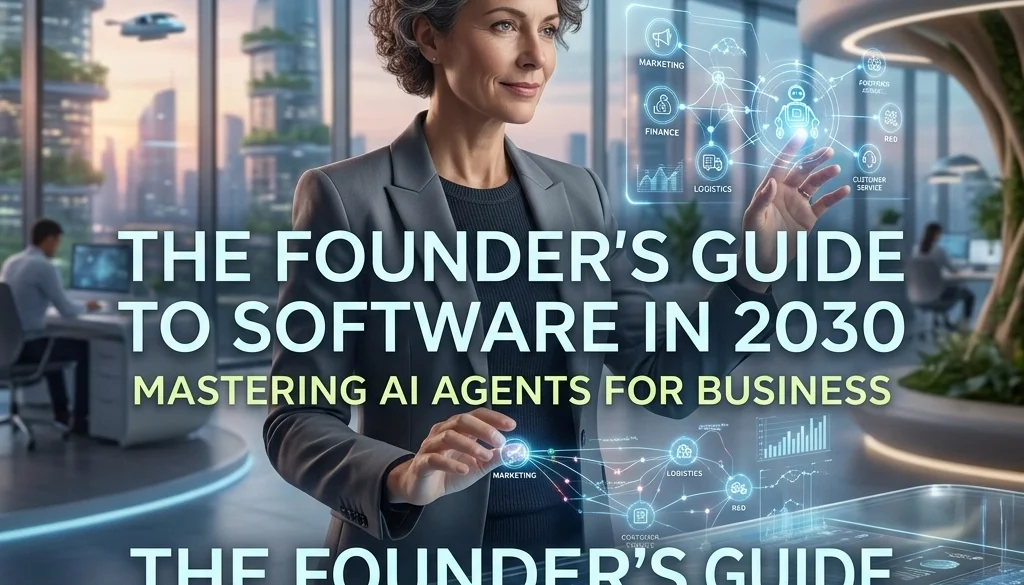
The Founder’s Guide to Software in 2030: Mastering AI Agents for Business
Software Landscape Status: 2030
The software environment in 2030 is defined by the transition from passive tools to autonomous agentic systems. Traditional SaaS models characterized by per-seat licensing and manual data entry are deprecated. Current operational standards prioritize ai agents for business that execute complex workflows without human intervention. The distinction between "using software" and "managing an autonomous workforce" has merged into a single organizational function.
The adoption of custom ai solutions for smbs is no longer elective. Competitive parity requires the integration of specialized models that understand unique business logic, customer data, and industry regulations. Marketrun provides the infrastructure necessary for this transition via custom software development.
Architecture of AI Agents for Business
Definition and Functionality
AI agents are autonomous software entities programmed to achieve specific objectives. Unlike 2024-era chatbots, 2030 agents possess agency, long-term memory, and tool-use capabilities. These systems interact with APIs, manage databases, and coordinate with other agents to complete multi-step business processes.
Core Components
- Reasoning Engine: Large Language Models (LLMs) provide the logic layer.
- Memory Systems: Vector databases and knowledge graphs store historical context.
- Tool Integration: Connectors to financial systems, CRMs, and supply chain management tools.
- Security Protocols: Permission-based access controls to prevent unauthorized data exfiltration.
The deployment of these components allows for ai automations that replace manual middle-management tasks.

Strategic Implementation: Custom AI Solutions for SMBs
Shift from Generic to Specialized
General-purpose AI models lack the specificity required for high-stakes business decisions. SMBs in 2030 utilize fine-tuned models trained on proprietary datasets. This specialization ensures accuracy and maintains competitive advantages that are not reproducible by competitors using public models.
Vertical Integration
Custom solutions are integrated directly into the core business stack. This prevents the "data silo" effect common in early-stage AI adoption. Efficient implementation involves:
- Data audit and preparation.
- Model selection (Open Source vs. Proprietary).
- Deployment via ai development services.
- Continuous monitoring and reinforcement learning.
Infrastructure and Self-Hosting Protocols
The Move to Private Cloud
Data privacy regulations and cost-efficiency requirements have shifted the industry toward self-hosting. Organizations now deploy LLMs on private infrastructure to maintain control over sensitive intellectual property. This eliminates dependency on third-party API providers and reduces latency.
Technical Requirements for Self-Hosting
- Hardware: High-density GPU clusters or specialized AI accelerators.
- Software: Orchestration layers for model serving and scaling.
- Security: Air-gapped environments for critical business logic.
Guidance on self-hosting llms is essential for founders aiming to minimize long-term operational costs and maximize data security.

The Economic Impact of Autonomous Engineering
Resource Allocation
In 2030, capital is redirected from manual labor to computational power. The cost of performing a task is measured in tokens rather than man-hours. This shift allows SMBs to scale operations without a proportional increase in headcount.
Case Study: Workflow Efficiency
Organizations utilizing autonomous agents report:
- 90% reduction in response time for customer inquiries.
- 75% decrease in error rates for financial reporting.
- 100% availability for routine administrative functions.
Founders must analyze the ROI of these systems using specialized tools such as an ai automation roi calculator.
Evolution of Web and Mobile Presence
Agent-First Interfaces
Websites in 2030 are not static brochures. They are interfaces designed for both human users and external AI agents. SEO has evolved into AIO (AI Optimization), where content is structured to be indexed and utilized by autonomous search agents.
Development Standards
Modern applications prioritize API-first design to facilitate agent interaction. Mobile and web apps developed in this era function as nodes within a larger agentic ecosystem. Features include:
- Natural language navigation.
- Predictive user intent modeling.
- Seamless cross-platform data synchronization.
For India-based operations, specialized localized strategies are applied through Marketrun India services, while US-based founders utilize Marketrun US solutions.

Risk Management and Ethics
Hallucination Mitigation
Autonomous systems require rigorous validation layers. Multi-agent "critics" are employed to review the output of "creator" agents, ensuring factual accuracy before execution.
Data Sovereignty
Proprietary data is the primary asset of the 2030 enterprise. Founders must implement strict governance frameworks to ensure that AI training processes do not inadvertently leak trade secrets. Utilizing open source deployment strategies provides the transparency needed for these audits.
The Role of the Founder in 2030
From Operator to Architect
The founder's role has transitioned from managing people to designing systems. Success is determined by the ability to orchestrate a network of AI agents and custom software. Strategic focus is placed on:
- Defining high-level objectives.
- Configuring agent parameters.
- Monitoring system health.
- Managing human-in-the-loop interventions.
Skill Acquisition
Founders require a fundamental understanding of prompt engineering, data architecture, and algorithmic governance. The technical barrier to entry has lowered, but the strategic complexity has increased.
Transition Roadmap for SMBs
To reach the 2030 operational standard, SMBs must follow a structured transition:
- Audit: Identify repetitive tasks suitable for automation.
- Experimentation: Deploy pilot agents in low-risk environments. Refer to the ai agents and automations guide for initial frameworks.
- Scaling: Integrate validated agents into core business processes.
- Optimization: Continuous refinement of models based on performance data.
Conclusion of Current Status
The 2030 software landscape rewards organizations that embrace autonomy and specialization. AI agents for business are the primary drivers of productivity, and custom ai solutions for smbs provide the necessary differentiation in a crowded market. Marketrun facilitates this transition by providing the engineering expertise required to build, deploy, and maintain these systems.
Detailed pricing for implementation is available at marketrun.io/pricing. For further technical documentation, consult the Marketrun blog.