How to Save 20 Hours a Week with Custom AI Automation Workflows
Status: Operational Inefficiency in Small and Medium Businesses (SMBs)
Time expenditure data indicates that internal teams in SMB environments allocate a significant percentage of hours to manual, repetitive administrative tasks. Research identifies that these tasks include email sorting, data entry, calendar management, and lead qualification. The implementation of custom ai automation workflows addresses these inefficiencies by delegating logical sequences to software agents.
The target objective is the recovery of 20 labor hours per week per personnel unit. This objective is achieved through the integration of ai agents for business and low-code automation platforms like n8n.
AI Automation Workflows: Technical Definition
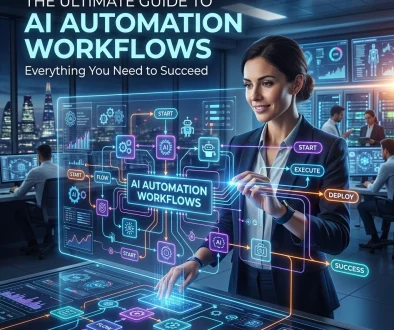
An AI automation workflow is a sequence of connected tasks where Large Language Models (LLMs) perform decision-making functions at specific nodes. Unlike traditional automation, which follows rigid "if-this-then-that" logic, AI-integrated workflows process unstructured data, interpret intent, and generate context-aware outputs.
System Components
- Triggers: Events that initiate the workflow (e.g., receipt of email, form submission, scheduled interval).
- Processors (AI Agents): LLM-based modules that analyze text, extract data, or generate responses.
- Actions: The final output (e.g., updating a CRM, sending a notification, generating a document).

Core Tool Analysis: n8n and AI Agents
Marketrun utilizes n8n for the orchestration of complex workflows. n8n is an extendable workflow automation tool that allows for the hosting of nodes that interact with external APIs and internal databases.
Functional Capabilities of n8n for AI
- Self-Hosting: Ensures data privacy and compliance by keeping data within controlled environments. Detailed information on self-hosting LLMs is available for high-security requirements.
- Branching Logic: Facilitates complex decision trees where AI agents determine the path of execution.
- Custom Node Development: Allows for the creation of specific logic to handle proprietary business data.
AI Agents for Business
AI agents are specialized software instances configured to perform specific roles. These agents utilize tools, memory, and reasoning to complete assignments.
- Role-Specific Agents: Configured for sales, customer support, or administrative operations.
- Tool Integration: Agents access calendars, email servers, and project management software to execute tasks.
For a comprehensive analysis, refer to the AI agents and automations guide 2026.
Workflow 1: Email Triage and Response (Efficiency Gain: 5 Hours/Week)
Manual inbox management consumes approximately 25% of the average workday. An automated AI triage system executes the following steps:
- Ingestion: The system monitors the IMAP server for new messages.
- Analysis: An AI agent classifies the email based on intent (e.g., Support, Sales, Billing, Spam).
- Extraction: Relevant data (dates, amounts, customer IDs) is extracted from the message body.
- Drafting: The agent generates a draft response based on historical data and company knowledge bases.
- Status Update: High-priority items are flagged in internal communication channels.
Implementation of this system results in a reduction of inbox dwelling time and ensures immediate response to critical inquiries. Marketrun provides custom software solutions to facilitate these integrations.
Workflow 2: Automated Lead Qualification (Efficiency Gain: 4 Hours/Week)
The identification of high-value prospects is automated through AI agents that cross-reference inbound leads with ideal customer profiles.
Process Sequence
- Inbound Capture: Data is received via web forms or API calls.
- Data Enrichment: AI agents search external databases and social profiles to populate missing lead information.
- Scoring: Leads are assigned a numerical value based on company size, industry, and expressed intent.
- Routing: Qualified leads are automatically inserted into the CRM and assigned to a sales representative. Unqualified leads are placed in a long-term nurture sequence.
This automation ensures that sales personnel focus exclusively on conversion activities rather than administrative data gathering.

Workflow 3: Document Processing and Data Entry (Efficiency Gain: 5 Hours/Week)
The extraction of data from unstructured documents (PDFs, images, contracts) is a primary source of labor friction. Custom AI workflows utilize Optical Character Recognition (OCR) combined with LLMs to process these files.
Technical Implementation
- Storage Monitoring: Workflows monitor folders in Google Drive, Dropbox, or local servers.
- Content Analysis: AI identifies the document type (e.g., invoice vs. contract).
- Structured Output: Data is converted into JSON or CSV formats.
- System Synchronization: Extracted data is pushed to accounting software or internal databases.
The elimination of manual data entry reduces human error rates to near zero. Businesses interested in these outcomes can explore AI automations for specific departmental needs.
Workflow 4: Appointment Scheduling and Management (Efficiency Gain: 3 Hours/Week)
Natural language scheduling agents eliminate the requirement for back-and-forth email communication.
- Input: A request for a meeting is received.
- Availability Check: The AI agent queries the user's calendar via API.
- Constraint Application: The agent applies logic regarding buffer times, time zones, and priority levels.
- Confirmation: The agent sends a calendar invite and updates the CRM record.
This system operates 24/7, facilitating global coordination without manual intervention.
Workflow 5: Meeting Documentation and Action Item Tracking (Efficiency Gain: 3 Hours/Week)
Post-meeting administration is automated through transcription and summarization workflows.
- Transcription: Audio/Video files are processed into text.
- Summarization: An AI agent generates a concise summary of the discussion.
- Task Creation: Action items are identified and automatically created in project management tools like ClickUp or Jira.
- Distribution: Meeting notes are emailed to all participants immediately after the session concludes.

Implementation Framework: 4-Week Deployment Cycle
The transition to an automated state is conducted in four distinct phases.
Week 1: Audit and Documentation
The current time allocation of the workforce is measured. Repetitive tasks with high frequency and low complexity are identified as primary candidates for automation.
Week 2: Infrastructure Configuration
Deployment of the automation platform (e.g., n8n) and connection of necessary APIs. If the organization requires offshore assistance for development, the offshore web and mobile apps guide provides context on resource allocation.
Week 3: Agent Development and Testing
AI agents are programmed with specific prompts and data access. Workflows are tested in a sandbox environment to ensure logic accuracy and data integrity.
Week 4: Deployment and Monitoring
Systems are moved to production. Performance is monitored against the baseline metrics established in Week 1. ROI is calculated based on recovered hours. The AI automation ROI calculator can be used for financial modeling.
Quantitative Analysis of Time Recovery
| Workflow Category | Hours Saved (Per Week) | Annual Recovery (52 Weeks) |
|---|---|---|
| Email Triage | 5 | 260 |
| Lead Qualification | 4 | 208 |
| Document Processing | 5 | 260 |
| Scheduling | 3 | 156 |
| Meeting Admin | 3 | 156 |
| Total | 20 | 1,040 |
The data indicates that a single employee utilizing these workflows recovers over 1,000 hours per year. This time is reallocated to high-value strategic initiatives and revenue-generating activities.
System Maintenance and Scalability
Automated systems require periodic evaluation. As business requirements evolve, AI agent prompts and workflow logic must be updated. Marketrun offers ongoing support and AI development to ensure that systems remain aligned with corporate objectives.
Scaling involves the replication of successful workflows across different departments. A successful implementation in the sales department serves as a template for operations, HR, and finance.
Conclusion: Current State Assessment
The integration of custom AI automation workflows is a prerequisite for competitive operations in the 2026 business landscape. The transition from manual processes to AI-driven systems results in measurable increases in output and significant reductions in operational overhead.
For organizations seeking to initiate this transition, the solutions page provides a comprehensive list of available services.

Status: Systems online. Efficiency optimized.
Provider: Marketrun
Service: AI and Custom Software Development