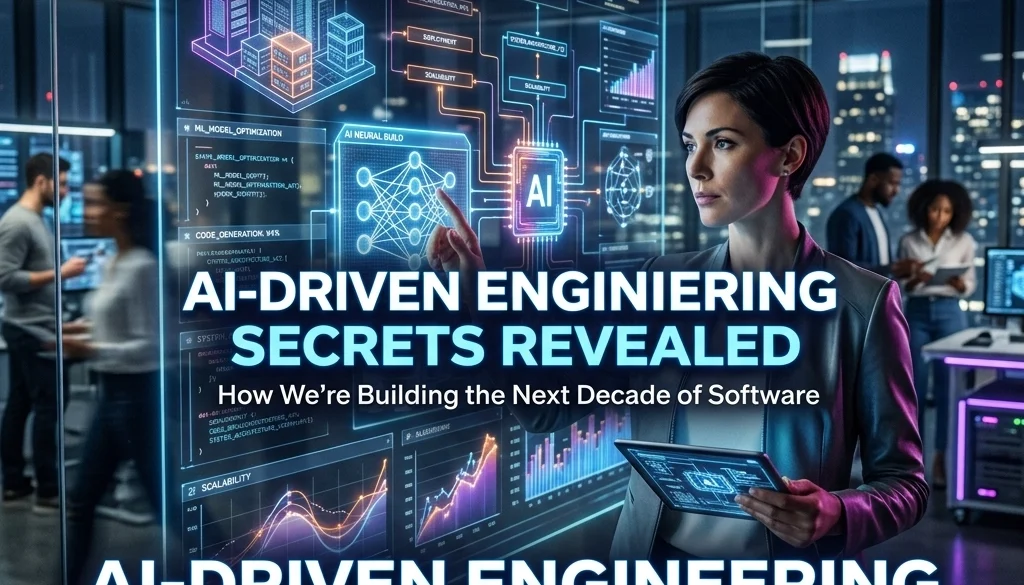
AI-Driven Engineering Secrets Revealed: How We’re Building the Next Decade of Software
Structural Transformation in Software Production
The methodology for software engineering is undergoing a fundamental transition. The previous decade focused on manual syntax entry and individual line-by-line code construction. The current trajectory prioritizes architectural oversight and systemic orchestration through Artificial Intelligence.
Engineering roles are shifting from writers of code to directors of autonomous systems. This change is driven by the capacity of Large Language Models (LLMs) to generate significant portions of functional code based on structured requirements. The primary objective for engineering teams at Marketrun is the decomposition of complex business problems into discrete, well-defined tasks that AI systems can execute.
The Shift from Execution to Specification
Modern software development relies on the accuracy of specification rather than the speed of typing.
- Manual Phase: Humans write logic, debug syntax, and manage state transitions.
- AI-Augmented Phase: AI generates boilerplate and standard functions; humans review and integrate.
- AI-Directed Phase: AI executes entire modules based on high-level architectural constraints and business logic definitions.
This evolution allows for a higher volume of output with reduced temporal investment. By utilizing custom AI solutions for SMBs, organizations can now access enterprise-grade software capabilities at a fraction of traditional costs.
AI Agents for Business: Operational Autonomy
The deployment of ai agents for business represents the next phase of corporate automation. Unlike static scripts, AI agents possess the capacity to interpret context, handle edge cases, and interact with multiple software interfaces to complete end-to-end workflows.

Functional Capabilities of AI Agents
- Autonomous Decision Making: Agents analyze incoming data streams and select appropriate actions based on predefined business rules.
- Multi-Tool Integration: Agents utilize APIs to move data between CRM systems, financial databases, and communication platforms.
- Continuous Operation: Systems operate 24/7 without performance degradation, ensuring constant monitoring and response.
AI agents for business are currently being utilized to manage customer support, lead qualification, and internal data reconciliation. Marketrun provides the infrastructure to deploy these agents through ai-automations.
Custom AI Solutions for SMBs
Small and Medium Businesses (SMBs) often lack the infrastructure to maintain large-scale engineering departments. Custom AI solutions for SMBs bridge this gap by providing tailored software that addresses specific operational inefficiencies.
Tailored Development Framework
- Requirement Identification: Isolation of high-friction manual processes within the business unit.
- Model Selection: Determining the optimal LLM or specialized model based on data sensitivity and computational requirements.
- Integration: Connecting AI modules to existing legacy systems or building new mobile and web apps.
The focus is on ROI. By implementing custom software, SMBs can achieve scalability that was previously restricted to large corporations. Cost efficiency is further enhanced by utilizing offshore development models.
AIOps: Automation and System Reliability
Operations management is transitioning to AIOps (Artificial Intelligence for IT Operations). This involves the integration of AI-driven platforms to monitor production environments and resolve incidents without human intervention.

Statistical Performance of AIOps
Based on industry research and internal implementation data:
- 30% Automatic Resolution: Incidents resolved via AI-based causation analysis and self-healing protocols.
- 30% Pure Automation: Routine maintenance and scaling tasks handled by automated scripts.
- 40% Edge Case Identification: Complex issues flagged for human expert review, reducing noise for engineering teams.
This distribution allows engineering teams to scale infrastructure without proportional increases in headcount. Real-time data collection from metrics, logs, and diagnostic reports informs the AI's decision-making process.
Self-Hosting LLMs and Data Sovereignty
As AI becomes central to software engineering, data privacy and security are paramount. Many organizations are moving away from public API dependencies toward self-hosting LLMs.
Advantages of Local LLM Deployment
- Security: Proprietary code and sensitive business data remain within the company’s controlled infrastructure.
- Latencey: Reduction in network overhead by processing requests on local or private cloud hardware.
- Cost Control: Elimination of per-token pricing models in favor of fixed infrastructure costs.
Marketrun assists organizations in the transition to open source deployment and the setup of private LLM environments to ensure compliance with global data regulations. Detailed guidance on this transition is available in the self-hosting guide.
Process Redesign and Human-AI Collaboration
The integration of AI into engineering requires a redesign of the software development life cycle (SDLC). The focus is on a hybrid model where human expertise provides the strategic direction and AI provides the tactical execution.
Kaizen-Based Implementation
Marketrun follows a principle of continuous improvement:
- Synthetic Data Generation: Using generative models to create test cases when real-world data is sparse.
- Expert Oversight: Human engineers conduct high-level architectural reviews and ethical audits.
- Distributed Responsibility: Leadership distributes the management of AI tools across the entire engineering department rather than centralizing it.
This collaborative approach ensures that the software produced is robust, secure, and aligned with long-term business goals.
The Future State of Engineering
The next decade of software will be characterized by "low-code" for humans but "high-complexity" for machines. Engineering will focus on the creation of systems that can build other systems.
Predictive Trends for 2026-2030
- Near-Zero Marginal Cost of Feature Production: AI will reduce the cost of adding new software features to near-zero levels.
- Universal API Connectivity: Every software component will be designed for agentic interaction by default.
- Autonomous Maintenance: Software will self-patch and self-optimize based on performance telemetry.
Marketrun is positioned at the intersection of these trends, offering solutions that allow businesses to adopt these technologies today. Whether through AI website creation or complex Windows software, the engineering foundation is now AI-first.
Strategic Action Plan for Businesses
To remain competitive in the next decade, organizations must implement the following steps:
- Audit Current Workflows: Identify repetitive tasks suitable for ai agents for business.
- Evaluate Infrastructure: Determine the feasibility of self-hosting LLMs for sensitive data.
- Invest in Custom AI: Move away from generic tools toward custom AI solutions for SMBs that offer specific competitive advantages.
- Scale via Offshore Models: Utilize global talent pools for cost-effective development through Marketrun’s India or US-based services.
The transition to AI-driven engineering is not merely an upgrade; it is a replacement of the traditional software development paradigm. Marketrun provides the expertise and technology to navigate this shift efficiently. For more information on pricing and engagement models, visit the pricing page.