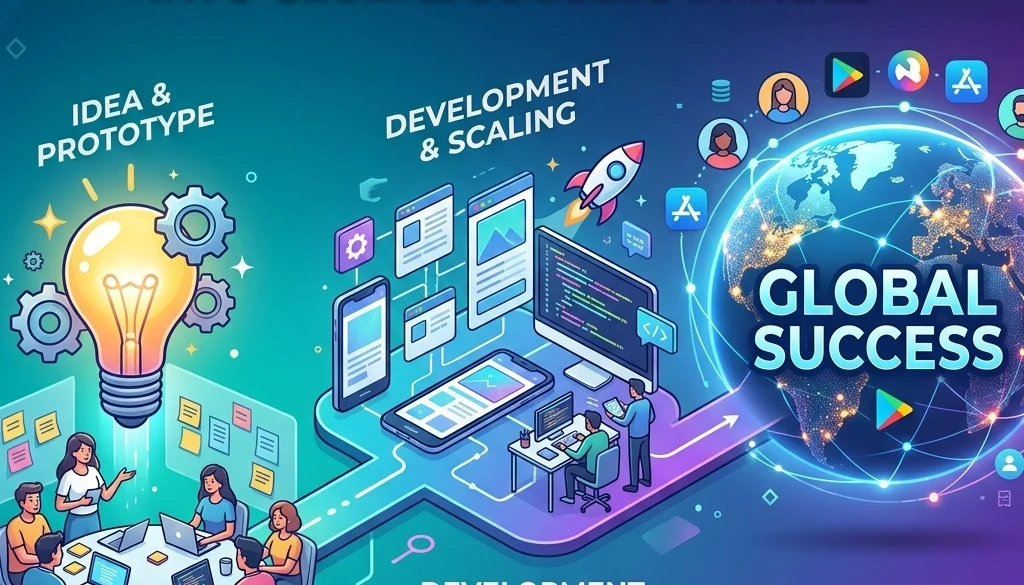
Application Development 101: How We Turned Startup Ideas into Global Success Stories
Systematic Overview: Application Development Phases
The transition from a conceptual startup framework to a functional global product requires a structured methodology. Application development is defined as the process of designing, building, and maintaining software for specific business functions or end-user needs. In the context of startup scaling, this process involves the conversion of high-level ideas into production-ready assets.
At Marketrun, the procedure follows a rigid lifecycle designed to mitigate risk and maximize technical efficiency. This lifecycle encompasses initial research, technological selection, architectural design, engineering, and final deployment. Each phase is a prerequisite for subsequent actions.
1. Conceptual Analysis and Requirement Documentation
The initial phase of application development involves the identification of core objectives. A startup idea is processed through a feasibility assessment. This assessment evaluates market saturation, technical viability, and resource allocation requirements.
Key components during this stage include:
- Requirement Elicitation: Defining the functional and non-functional requirements of the software.
- Market Positioning: Analyzing the digital landscape to ensure the website development or mobile application offers a unique value proposition.
- Project Scoping: Establishing the boundaries of the Minimum Viable Product (MVP) to prevent feature creep.

2. Infrastructure Selection and Strategic Planning
Choosing the appropriate tech stack is a critical determinant of long-term scalability. Startups require architectures that support rapid user acquisition without systemic failure.
Web Development vs. Mobile Development
Decisions are categorized by platform accessibility. Website development focuses on cross-browser compatibility and responsive design for accessibility via URLs. Mobile development focuses on platform-specific performance (iOS and Android). For many startups, a hybrid approach is implemented via mobile and web apps.
Technological selection involves:
- Backend Frameworks: Node.js, Python, or Go for data processing and API management.
- Frontend Frameworks: React, Vue, or Angular for user interface rendering.
- Database Management: SQL for structured relational data or NoSQL for flexible data scaling.
For detailed cost analysis between regional development hubs, refer to the India vs USA cost guide 2026.
3. Systematic Design: UI/UX Engineering
User Interface (UI) and User Experience (UX) engineering are treated as technical disciplines rather than purely aesthetic exercises. The objective is to facilitate the shortest path between user intent and task completion.

The design phase includes:
- Wireframing: Low-fidelity blueprints of the application structure.
- Prototyping: Interactive models used to validate user flows before engineering begins.
- Design Systems: Standardized components (buttons, typography, color palettes) to ensure consistency across custom software modules.
4. Technical Implementation: The Engineering Phase
The engineering phase is where code is written and integrated. This stage is governed by Agile methodologies, allowing for iterative updates and continuous integration. Application development at this stage is divided into frontend and backend operations.
Frontend Engineering
This involves the implementation of the visual and interactive elements that users engage with directly. It requires precise execution of the design system using modern languages and frameworks.
Backend Engineering
The backend serves as the engine of the application. It handles data storage, security protocols, and business logic. Integration with AI and automations often occurs here to enhance functional capabilities.

Integration of Artificial Intelligence
In 2026, many global success stories utilize AI to optimize operations. This includes the deployment of AI agents for customer support or predictive analytics. Marketrun facilitates this through specialized AI development pipelines.
5. Quality Assurance and Testing Protocols
Software reliability is verified through rigorous testing protocols. No application is moved to a production environment without passing a series of automated and manual checks.
Testing categories include:
- Unit Testing: Validating individual components for correct functionality.
- Integration Testing: Ensuring different modules work together without conflict.
- User Acceptance Testing (UAT): Verifying that the product meets the initial business requirements defined in Phase 1.
- Security Audits: Identifying vulnerabilities to protect user data and comply with global regulations.
6. Deployment and Production Management
Deployment marks the transition from a local development environment to a live server accessible by the global market. This stage requires robust DevOps practices to ensure uptime and performance.

Post-deployment actions involve:
- Cloud Hosting: Utilizing AWS, Google Cloud, or Azure for scalable infrastructure.
- Performance Monitoring: Continuous tracking of load times and error rates.
- Database Scaling: Adjusting resources based on real-time traffic data.
For startups looking to manage costs, open source deployment or self-hosting LLMs are viable alternatives to proprietary cloud services.
Transforming Ideas into Success Stories: The Marketrun Method
The success of a startup is frequently tied to its ability to execute technical tasks efficiently. Marketrun provides the infrastructure and expertise to facilitate this execution across various sectors.
Custom Software Solutions
Standardized software often fails to meet the specific needs of a disruptive startup. Custom software development allows for the creation of unique features that provide a competitive advantage in the global market.
Website Development for Global Reach
A high-performance website serves as the primary interface for international clients. Website development at Marketrun prioritizes SEO, speed, and conversion optimization to ensure startup ideas are visible and functional worldwide.
Financial Efficiency in Development
Cost management is a primary concern for startups. Efficient resource allocation is achieved by selecting the right development model. Information regarding project investment can be found on the Marketrun pricing page.
Summary of Technical Parameters
| Phase | Primary Objective | Key Output |
|---|---|---|
| Conceptualization | Validation | Project Roadmap |
| Tech Selection | Scalability | Stack Architecture |
| Design | Usability | High-Fidelity Prototypes |
| Development | Functionality | Source Code / MVP |
| Testing | Reliability | Bug-Free Build |
| Deployment | Accessibility | Live Product |
Conclusion: Sustainable Growth Patterns
The journey from idea to a global success story is not a linear event but a continuous cycle of development and refinement. Successful startups utilize data-driven insights to iterate on their applications post-launch.
By following a structured application development lifecycle, startups can minimize technical debt and maximize the probability of market adoption. Whether the focus is on AI-driven automations or robust mobile-web applications, the underlying principles of engineering excellence remain constant.
For more information on modern software strategies, visit the Marketrun Blog.