5 Steps How to Automate Business Operations with AI (Easy Guide for SMBs)
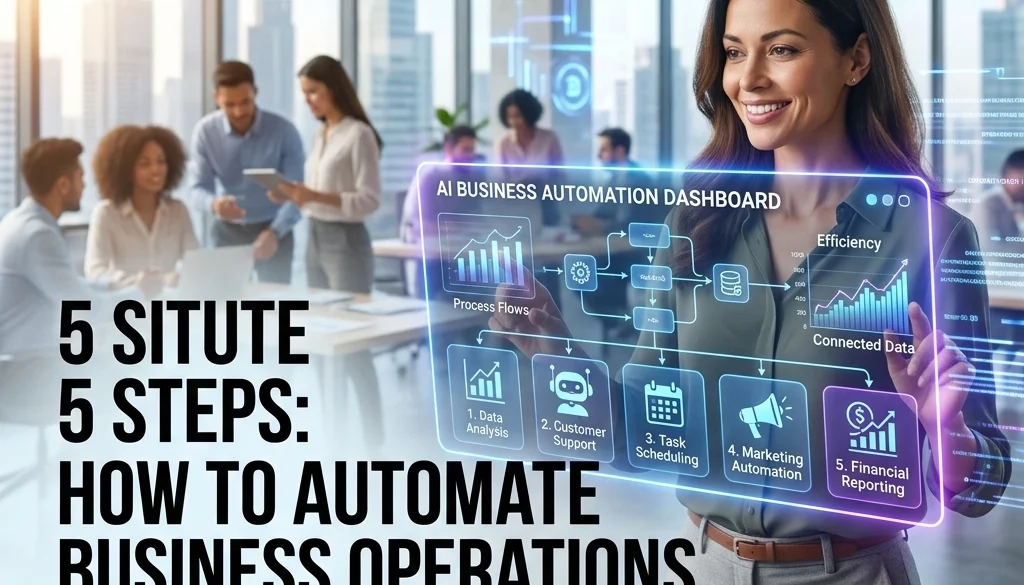
Step 1: Identification of High-Volume Process Targets
Identification involves auditing current operational workflows. The objective is the selection of tasks characterized by high frequency and low variation. To automate business operations with AI, data must be collected on the following parameters:
- Task execution frequency (Daily/Weekly/Monthly)
- Time duration per execution unit
- Error rates within manual processing
- Number of human touchpoints required per cycle
Processes meeting the criteria for automation include lead qualification, data entry, customer support ticket sorting, and invoice reconciliation. Revenue-impacting tasks are prioritized. Marketrun provides AI automation solutions for the assessment of these operational bottlenecks.
Data Collection Requirements:
- Log of all manual data entry points.
- Calculation of total labor hours allocated to repetitive functions.
- List of software applications currently utilized in the workflow.
Step 2: Scope Definition and Business Case Construction
Scope definition establishes the boundaries of the automation project. A business case is constructed to determine the Return on Investment (ROI). Metrics for evaluation include labor cost reduction and throughput increase.

ROI Parameters:
- Cost Savings: Calculation of hourly rate multiplied by hours saved.
- Accuracy Improvement: Reduction in costs associated with manual error correction.
- Scalability: Ability of the system to handle increased volume without additional headcount.
The AI automation ROI calculator provides a framework for these calculations. Project scope is limited to a single department or sub-process to ensure manageable deployment.
Step 3: Mapping AI Automation Workflows
Mapping creates a schematic of the "As-Is" process and the "To-Be" automated state. Every decision point is documented. AI automation workflows require the identification of triggers, actions, and data transformations.
Workflow Components:
- Trigger: Event that initiates the process (e.g., receipt of email, database update).
- Processing Logic: AI model intervention (e.g., Large Language Model classification, sentiment analysis).
- Action: Output generated (e.g., CRM update, automated reply, file generation).
Technical documentation for these workflows is accessible at AI agents and automations guide. Standardized mapping prevents logic errors during the development phase.
Step 4: Phased Technical Deployment
Deployment is executed in three distinct stages to mitigate operational risk.
Stage 1: Pilot Phase
The automation is deployed in a sandbox environment. Test data consists of historical records. System outputs are compared against known correct results. Discrepancies are logged for model refinement.
Stage 2: Monitored Live Deployment
The system processes real-time data. Human oversight is mandatory for every output. Validations are recorded. AI confidence scores are monitored.
Stage 3: Autonomous Operation
Human intervention is removed for cases where the AI confidence score exceeds a predefined threshold (e.g., 95%). Exception handling protocols are established for low-confidence outputs.

Step 5: Continuous Performance Monitoring and Optimization
Post-deployment, the system is subjected to continuous monitoring. Performance data is aggregated into weekly reports.
Monitoring Metrics:
- System Latency: Time elapsed from trigger to completion.
- Model Accuracy: Percentage of correct outputs verified by periodic manual audit.
- Failure Rate: Number of exceptions requiring human intervention.
- Resource Utilization: Compute costs associated with AI model calls.
Optimization involves retraining models with new data or adjusting logic gates within the AI automation workflows. Organizations utilizing custom software implement automated feedback loops for system improvement.
Advanced Automation: Connecting Disparate Systems
Advanced automation requires the integration of non-communicating software stacks. Siloed data is unified to enable end-to-end processing.
Integration Methods:
- Application Programming Interfaces (APIs): Direct communication between software platforms for data exchange.
- Webhooks: Real-time data pushes from one system to another upon specific events.
- Middleware Platforms: Intermediate layers that translate data formats between incompatible systems.
- Custom ETL (Extract, Transform, Load) Pipelines: Scheduled processes for data migration and normalization.
Automating business operations with AI across disparate systems eliminates manual data migration. Example: Connecting a legacy ERP system to a modern AI-driven CRM.
Connectivity Requirements:
- Identification of endpoint URLs.
- Authentication protocol verification (OAuth2, API Keys).
- Data schema mapping (JSON, XML, CSV).
Technical assistance for system integration is available through Marketrun AI development services.
Infrastructure Considerations for SMBs
SMBs must select an infrastructure model based on security requirements and budget.
Infrastructure Models:
- Cloud-Based AI: Low initial cost, high scalability, external data processing.
- Self-Hosted LLMs: High data privacy, fixed compute costs, internal maintenance requirements.
Details regarding self-hosting are documented in the Self-hosting LLMs 2026 guide. Hardware specifications must align with model size and request volume.
Summary of Implementation Status
- Project Initialization: Identification of tasks (Complete).
- Scope Alignment: ROI calculation (Complete).
- Workflow Design: Logic mapping (Complete).
- Implementation: Phased deployment (In Progress).
- Maintenance: KPI tracking (Scheduled).
Effective automation reduces operational friction and reallocates human resources to high-value strategic tasks.

For further technical specifications or deployment support, visit marketrun.io.