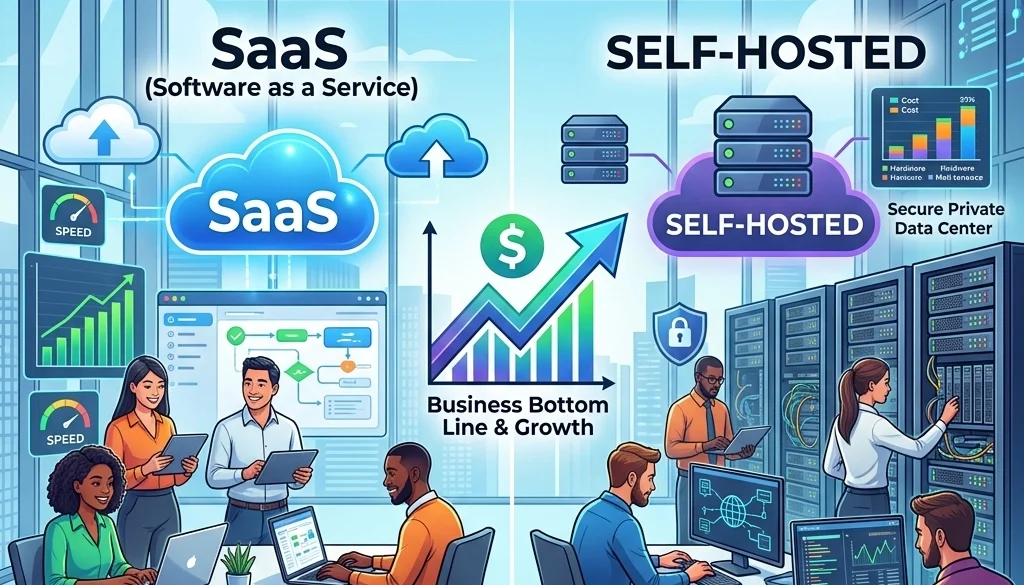
SaaS vs. Self-Hosted: Which Is Better For Your Business Bottom Line?
Economic Assessment of Software Deployment Models
The selection between Software-as-a-Service (SaaS) and self-hosted infrastructure constitutes a primary financial decision for modern enterprises. Direct expenditures, long-term scalability, and operational overhead are the core variables. This analysis evaluates the fiscal implications of both models to determine the optimal path for business profitability.
SaaS: The Subscription Economy and Cost Trajectories
SaaS models operate on a recurring revenue basis. Access is granted via monthly or annual seat-based or usage-based fees.
Financial Characteristics of SaaS
- Initial Capital Expenditure (CAPEX): Minimal. Subscriptions allow for immediate deployment without hardware investment.
- Operating Expenditure (OPEX): High and recurring. Fees remain constant or increase over the lifecycle of the product.
- Scalability Costs: Nonlinear. Most SaaS providers increase pricing tiers based on user count, contact volume, or data processing limits.
- Maintenance Costs: Externalized. The provider manages updates, security patches, and infrastructure stability.
The Hidden Inflation of SaaS
SaaS sprawl occurs when multiple departmental subscriptions overlap. Research indicates that the average mid-market company utilizes over 100 SaaS applications. When seat prices increase or usage thresholds are met, the bottom line is impacted by "subscription creep." For a 50-person team, a standard stack involving CRM, Project Management, and Communication tools can exceed $15,000 monthly.
Self-Hosted: The Blueprint for Infrastructure Ownership
Self-hosting involves deploying software on private or rented servers (Virtual Private Servers – VPS). This model utilizes open source SaaS alternatives to replicate the functionality of proprietary tools without recurring license fees.
Financial Characteristics of Self-Hosting
- Initial CAPEX/Setup: Higher. Requires time for deployment and initial configuration.
- Operating Expenditure: Low. Costs are limited to VPS hosting fees and occasional maintenance.
- Scalability Costs: Predictable. Scaling typically involves upgrading server resources (CPU, RAM) rather than paying per additional user.
- Maintenance Costs: Internalized. Requires technical resources for updates and security management.

Comparative Total Cost of Ownership (TCO)
The Total Cost of Ownership (TCO) measures the sum of all costs associated with software over a three-to-five-year period.
| Cost Component | SaaS (3-Year Period) | Self-Hosted (3-Year Period) |
|---|---|---|
| Licensing/Subscription | $54,000 ($1,500/mo) | $0 (Open Source) |
| Infrastructure/Hosting | Included | $3,600 ($100/mo VPS) |
| Setup & Configuration | $0 | $5,000 (One-time) |
| Maintenance Labor | $0 | $7,200 ($200/mo average) |
| Total TCO | $54,000 | $15,800 |
Data indicates a potential cost reduction of 70% when transitioning from SaaS to self-hosted environments for core business functions. These savings are redirected to product development or custom software initiatives.

Open Source SaaS Alternatives: The Replacement Strategy
Eliminating SaaS subscriptions requires identifying functional equivalents within the open-source ecosystem. The following tools represent high-stability alternatives for common business needs:
- Project Management: Replace Asana or Monday.com with Planka or OpenProject.
- Customer Relationship Management (CRM): Replace Salesforce or HubSpot with ERPNext or SuiteCRM.
- Marketing Automation: Replace Mailchimp or Klaviyo with Mautic.
- Workflow Automation: Replace Zapier or Make with n8n or Activepieces.
- Analytics: Replace Google Analytics with Matomo or Plausible.
- Communication: Replace Slack with Mattermost or Rocket.Chat.
- Knowledge Base: Replace Notion or Confluence with BookStack or Outline.
The deployment of these tools on a centralized infrastructure allows for integrated data management and lower latency between services. Marketrun specializes in open source deployment to facilitate this transition.
VPS Setup and Management Protocols
Transitioning to a self-hosted model necessitates a robust approach to VPS setup and management.
Server Selection
Choosing a provider impacts both performance and cost. Primary options include:
- DigitalOcean/Linode: Optimized for simplicity and predictable pricing.
- Hetzner: Provides high-performance hardware at lower price points, primarily in Europe.
- AWS/Google Cloud: Suitable for enterprise-grade high availability but requires complex management.
Deployment Automation
Manual server configuration is inefficient. The use of Docker and Docker Compose is recommended for containerization. Containerization ensures that software environments remain consistent across different VPS providers and simplifies the migration process.
Security Implementation
Security is the primary operational risk in self-hosting. Mandatory protocols include:
- SSH Key Authentication: Disabling password-based logins.
- Automated Backups: Daily snapshots stored on off-site object storage (e.g., S3).
- Firewall Configuration (UFW): Restricting traffic to essential ports.
- SSL/TLS Certificates: Automated renewal via Let's Encrypt.
For organizations requiring advanced AI capabilities without the high cost of API calls, self-hosting LLMs provides a method to maintain data privacy while optimizing compute costs.

Strategic Decision Matrix: SaaS vs. Self-Hosted
The decision is dictated by the specific needs of the business entity.
Choose SaaS When:
- Speed to market is the primary objective: SaaS allows for deployment in minutes.
- Internal technical resources are unavailable: The cost of hiring a DevOps engineer may exceed the cost of SaaS subscriptions for small teams.
- The tool is non-critical: Low-usage tools do not justify the maintenance overhead of self-hosting.
Choose Self-Hosted When:
- Data sovereignty is required: Legal or regulatory requirements (GDPR, HIPAA) may necessitate full control over data storage.
- User count is high: If the business scales to hundreds of users, per-seat SaaS pricing becomes a significant financial burden.
- Customization is essential: Open-source software allows for direct modification of the codebase to suit specific AI automations.
- Long-term profitability is the focus: The TCO advantage of self-hosting compounds over time.
Labor and Maintenance: The "Hidden" Cost
Critics of self-hosting cite the cost of labor. A self-hosted instance requires:
- Software Updates: Monthly review of new releases and security patches.
- Resource Monitoring: Ensuring CPU and RAM usage remains within acceptable limits.
- Troubleshooting: Resolving downtime or configuration errors.
For many businesses, the solution is a hybrid model. Partnering with a specialized provider for custom software development and infrastructure management can mitigate these risks while retaining the cost benefits of self-hosting.

The ROI of Transitioning
The Return on Investment (ROI) of moving from SaaS to self-hosted infrastructure is calculated by dividing the net savings by the cost of transition.
ROI = (SaaS Costs – Self-Hosted Costs) / Initial Transition Investment
For a company spending $50,000 annually on SaaS, a $10,000 investment in self-hosted infrastructure that reduces annual costs to $5,000 results in a first-year ROI of 350%. Subsequent years yield 100% savings on the eliminated subscription fees. Further analysis on ROI can be found in our AI automation ROI calculator.
Risk Mitigation in Self-Hosting
Risk is managed through redundancy and professional oversight.
- Redundancy: Utilizing load balancers and multi-region backups ensures that hardware failure does not lead to data loss.
- Managed Services: Utilizing managed database services (e.g., Managed PostgreSQL) can offload the most complex part of self-hosting while still reducing costs compared to full SaaS suites.
- Staging Environments: Testing updates in a non-production environment prevents service interruptions.
Conclusion on Bottom-Line Impact
SaaS provides convenience at a premium price. Self-hosting provides ownership and cost-efficiency at the cost of operational responsibility. For businesses seeking to optimize their bottom line in 2026, the blueprint involves a strategic shift toward open-source alternatives and robust VPS management.
Reducing the "SaaS tax" allows capital to be reinvested into core growth areas. Whether through mobile and web apps or advanced AI development, owning the infrastructure is a fundamental step toward long-term financial sustainability.
Further insights into technical implementation and offshore cost advantages can be found in our guide on custom software cost comparisons.