How to Integrate Your Entire Tech Stack with n8n to Automate Business Operations with AI
Operational Overview
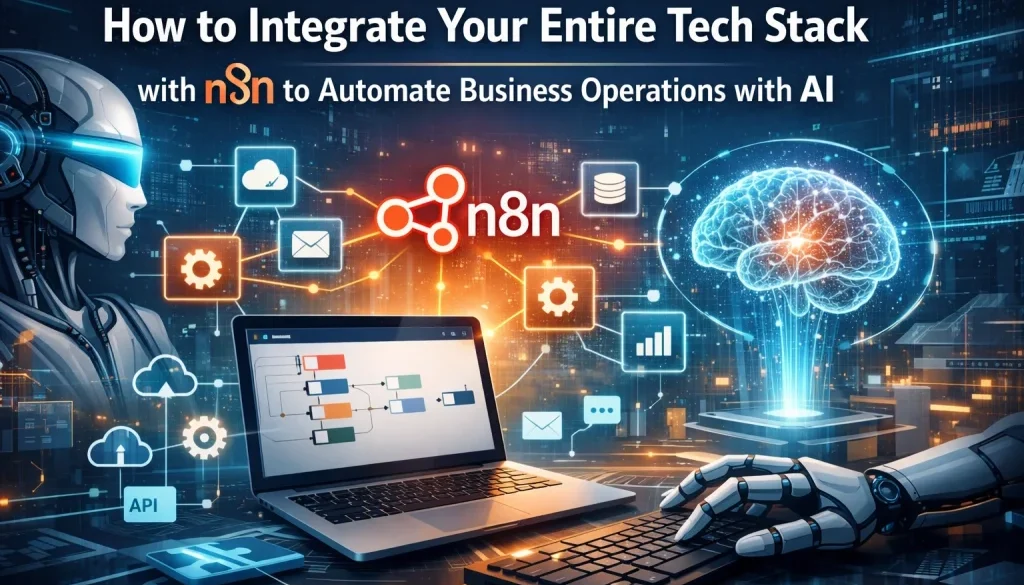
n8n functions as an extendable workflow automation tool. It connects software applications through a node-based architecture. To automate business operations with AI, the system utilizes integrated nodes to transfer data between third-party services and Large Language Models (LLMs). Integration facilitates the movement of information across fragmented systems without manual intervention.
Core Integration Mechanisms
The platform supports communication with over 1,100 external services. Integration is achieved through three primary methods:
Pre-built Nodes
Pre-configured nodes exist for common SaaS platforms. These nodes contain the necessary API parameters for specific actions such as record creation, data retrieval, and status updates. Utilizing these nodes reduces the requirement for manual code.
HTTP Request Nodes
For systems without native nodes, the HTTP Request node allows for connections to any RESTful API. This method requires the specification of authentication headers, request methods (GET, POST, PUT, DELETE), and body parameters. It enables the inclusion of legacy software and proprietary internal tools into the tech stack.
Webhook Triggers
Webhooks allow external systems to push data to n8n in real-time. An event in a CRM or an e-commerce platform triggers the execution of a workflow immediately upon occurrence. This creates event-driven ai automation workflows.

AI Model Implementation
The integration of artificial intelligence within n8n involves the use of specialized AI nodes. These nodes connect the workflow to external AI providers.
Model Selection
Workflows support various LLMs including OpenAI, Anthropic, and Google Gemini. The choice of model depends on the required reasoning capability, context window size, and cost parameters. For entities requiring data sovereignty, the platform facilitates the use of local models via self-hosting LLMs.
Prompt Engineering and Context
AI nodes receive input from preceding nodes in the workflow. This input is formatted into prompts. Context is provided by querying internal databases or documents, a process known as Retrieval-Augmented Generation (RAG). n8n nodes for vector stores (such as Pinecone or Milvus) allow the system to retrieve relevant facts before generating a response.
Output Parsing
AI-generated text is parsed into structured data formats, typically JSON. This allows subsequent nodes to use specific attributes of the AI's response to perform actions, such as updating a database field or sending a notification.
Methodology for System-Wide Integration
Integrating a tech stack requires a systematic approach to ensure data consistency and process reliability.
- System Audit: Identification of all software currently in use. Documentation of API availability for each tool.
- Data Mapping: Definition of how data flows from one system to another. Identification of the source of truth for specific data points.
- Credential Management: Secure storage of API keys and OAuth tokens within the n8n credential vault.
- Workflow Construction: Building the sequence of nodes. Implementing error handling branches to manage API timeouts or failures.
- Testing: Execution of workflows in a staging environment to verify data integrity.
- Deployment: Transitioning workflows to production status with active monitoring.
For organizations managing complex requirements, custom software development ensures that bespoke integrations meet specific operational needs.

Business Function Applications
Automating business operations with AI applies to multiple departments within a corporate structure.
Sales and Lead Management
Incoming leads from web forms are captured via webhooks. The data is processed by an AI node to score the lead based on historical conversion data. Leads with high scores are inserted into the CRM and assigned to a sales representative. Low-score leads are placed into an automated nurture sequence. This reduces manual lead triaging.
Customer Support Automation
Support tickets are received via email or chat. An AI agent analyzes the sentiment and category of the ticket. If the query is standard, the AI generates a draft response based on documentation. If the query is complex, it is routed to the appropriate technical department. Status updates are synchronized across the helpdesk and the internal project management tool.
Finance and Operations
Invoices received as PDF attachments are processed using Optical Character Recognition (OCR) and AI. Data points such as invoice number, date, and total amount are extracted and verified against purchase orders. Validated data is pushed to accounting software. Discrepancies trigger a notification to the procurement team.
The financial efficiency of such systems can be reviewed through an AI automation ROI calculator.
Data Transformation and Logic
Workflows often require data transformation between the output of one system and the input of another.
- Code Nodes: Used for complex data manipulation using JavaScript or Python.
- Switch Nodes: Direct the workflow path based on specific conditions or data values.
- Merge Nodes: Combine data streams from multiple sources into a single object.
- Wait Nodes: Pause execution for a set duration or until an external event occurs.
These logic components ensure that ai automation workflows remain functional despite variations in data input.

Security and Compliance
Integrating an entire tech stack involves the handling of sensitive business data.
- Encryption: Data at rest and in transit must be encrypted. n8n provides encrypted credential storage.
- Self-Hosting: Deployment on internal servers or private clouds prevents data from leaving the controlled environment. This is a primary consideration for India vs USA cost and compliance.
- Role-Based Access Control (RBAC): Limits the ability to modify or view workflows to authorized personnel only.
- Audit Logs: Recording of every workflow execution for forensic analysis and compliance reporting.
Monitoring and Maintenance
Automation systems require ongoing oversight to maintain operational continuity.
- Execution Logs: Detailed records of every node execution facilitate troubleshooting.
- Error Hooks: Specialized workflows that trigger only when another workflow fails. These send alerts to DevOps teams via Slack or Email.
- Version Control: Integration with Git allows for the tracking of changes to workflow definitions and provides a mechanism for rollback.
Deployment Strategies
n8n can be deployed in various environments depending on the scale and technical requirements of the business.
n8n Cloud
A managed service where the infrastructure is maintained by the provider. This allows for rapid deployment without server management.
Self-Hosted (Docker/NPM)
Installation on private infrastructure. This provides maximum control over data and resource allocation. It is often utilized by companies with strict privacy requirements or those using offshore web and mobile app development strategies for cost optimization.

Technical Specifications for AI Nodes
AI nodes in n8n are classified into four main types:
- AI Agent: A node that can use multiple "tools" (other nodes) to achieve a goal. It makes iterative decisions on which step to take next.
- Chain: A fixed sequence of actions involving an LLM.
- Memory: Stores previous interactions to provide context in conversational workflows.
- Vector Store: Interfaces for searching high-dimensional data, used for retrieving relevant facts for the AI.
These components enable the creation of sophisticated AI development projects that go beyond simple text generation.
Conclusion of System Integration
The integration of a tech stack with n8n centralizes business logic. By connecting CRMs, databases, and AI models into unified workflows, a business reduces operational friction. The use of AI ensures that the automation can handle unstructured data and make decisions based on defined parameters. This technical framework provides a scalable foundation for modern business operations. For further information on pricing and implementation, visit the pricing page.