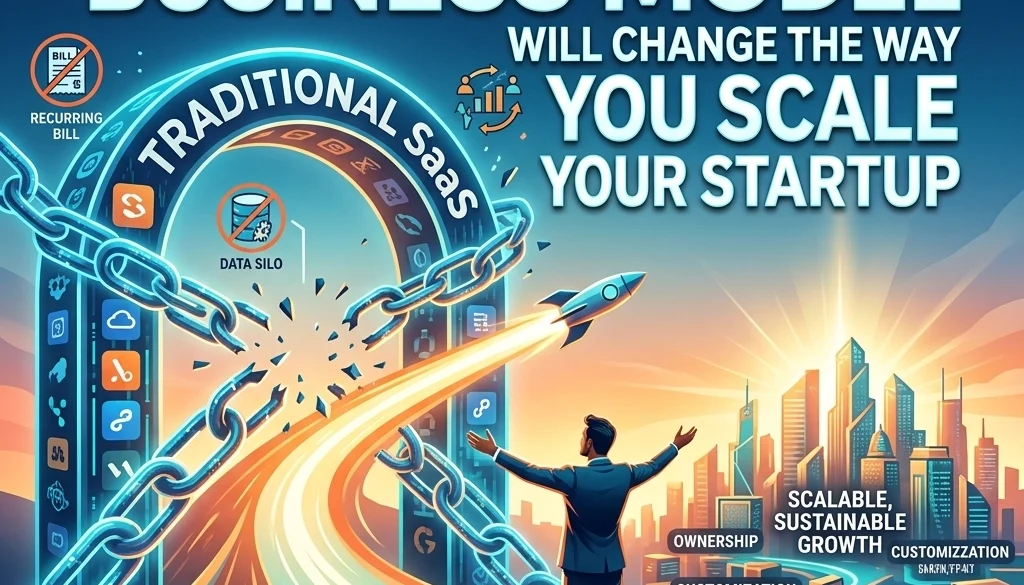
Why the SaaS-Free Business Model Will Change the Way You Scale Your Startup
Identification of the SaaS Expenditure Problem
Startups operate within financial constraints. Capital allocation is a primary concern for management. A significant portion of capital is directed toward software-as-a-service (SaaS) subscriptions. These services facilitate operations but create recurring financial liabilities.
The standard SaaS model utilizes per-user or usage-based pricing. As a startup scales, the number of employees increases. Consequently, the monthly cost for communication, project management, and CRM tools increases linearly. This relationship between growth and expenditure creates a scaling penalty. Data is stored on third-party servers. Access is contingent upon continuous payment. Cessation of payment results in the loss of operational tools and data accessibility.
Definition of the SaaS-Free Business Model
The SaaS-Free business model involves the replacement of subscription-based software with self-hosted alternatives. These alternatives are typically open-source. The software is deployed on infrastructure owned or leased by the company.
Infrastructure consists of Virtual Private Servers (VPS) or dedicated hardware. The startup maintains control over the software environment. Updates, security configurations, and data storage are managed internally. This model shifts costs from operational expenditure (OpEx) to a more predictable infrastructure cost.

Technical Infrastructure: VPS Setup and Management
Implementation of a SaaS-Free model requires a technical foundation. A Virtual Private Server (VPS) is the standard unit of deployment. Providers such as DigitalOcean, Hetzner, or AWS offer VPS instances.
Server Provisioning
A server is provisioned with a Linux distribution. Ubuntu 22.04 or 24.04 are common choices for stability. Security protocols are established immediately upon deployment. This includes the configuration of an Uncomplicated Firewall (UFW) and the disabling of root password authentication in favor of SSH keys.
Containerization via Docker
Standardization of software deployment is achieved through containerization. Docker and Docker Compose allow for the isolation of applications. Each open-source alternative runs in a containerized environment. This ensures that dependencies do not conflict. It also simplifies the process of migration between servers.
Reverse Proxy and SSL
Web access to self-hosted tools requires a reverse proxy. Nginx or Traefik are utilized to route incoming traffic to specific containers based on domain names. SSL certificates are generated and renewed automatically via Let's Encrypt to ensure encrypted data transmission.

Description: A technical diagram illustrating a VPS architecture with Docker containers behind an Nginx reverse proxy.
Analysis of Open Source SaaS Alternatives
The current software market provides robust open-source alternatives for every major SaaS category. Transitioning to these tools eliminates the "per-seat" pricing model.
Communication and Collaboration
Proprietary tools for internal communication often carry high costs per user. Open-source alternatives provide similar functionality:
- Mattermost or Rocket.Chat: These serve as alternatives to Slack. They provide channels, direct messaging, and file sharing.
- Nextcloud: This replaces Google Workspace or Microsoft 365 for file storage, document editing, and calendar synchronization.
- Jitsi Meet: This facilitates video conferencing without meeting time limits or participant fees.
Customer Relationship Management (CRM) and Marketing
Data regarding customers is a critical asset. Self-hosting this data enhances security and reduces costs.
- Odoo or ERPNext: These provide comprehensive CRM, accounting, and inventory management.
- Mautic: This serves as an alternative to HubSpot or Mailchimp for marketing automation and email campaigns.
- Listmonk: A high-performance newsletter and mailing list manager.
Automation and Workflow
Startups utilize automation to increase efficiency. Subscription costs for automation platforms increase with the number of "tasks" or "zaps" executed.
- n8n: This is a workflow automation tool. It allows for the connection of various services. Self-hosting n8n removes limits on the number of executions. Marketrun provides expertise in AI and automations.
- Activepieces: An alternative focusing on ease of use and business automation.

Description: A comparison chart showing the cost trajectory of SaaS subscriptions versus self-hosted infrastructure as a company grows from 5 to 100 employees.
Economic Impact and Scalability
The primary advantage of the SaaS-Free model is the decoupling of cost from growth.
Cost Predictability
A VPS with 8GB of RAM and 4 CPUs can host multiple applications. The cost of this server is fixed. If the startup grows from 10 to 50 employees, the server cost remains the same. In a traditional SaaS model, the cost would increase fivefold.
Resource Optimization
SaaS providers over-provision resources to ensure uptime for all clients. A startup self-hosting its tools can optimize resource allocation based on specific usage patterns. During periods of low activity, server resources remain available for background tasks such as data processing or custom software development testing.
Data Sovereignty
Data residency and sovereignty are regulatory requirements in many jurisdictions. SaaS providers often store data in locations chosen for their own operational efficiency. Self-hosting on a VPS allows the startup to select the exact geographic location of the data center. This ensures compliance with local laws and provides absolute control over data access logs.
Deployment of Artificial Intelligence and LLMs
The SaaS model is prevalent in the AI sector. API calls to large language models (LLMs) incur variable costs. High usage results in high invoices.
A SaaS-Free approach involves self-hosting LLMs. Using frameworks like Ollama or vLLM, a startup can run models on their own hardware. This eliminates per-token costs. It also ensures that proprietary company data used for inference never leaves the internal network. For a detailed technical overview, refer to the self-hosting LLMs 2026 guide.

Description: An infographic showcasing the components of a self-hosted AI stack, including local LLMs and vector databases.
Management and Maintenance Requirements
The transition to a SaaS-Free model introduces a requirement for system administration.
Backup Protocols
Automated backups must be configured. Data from Docker volumes and databases must be replicated to off-site storage. Tools like Restic or BorgBackup facilitate encrypted, deduplicated backups to S3-compatible storage.
Security Monitoring
Security is a continuous process. Servers require regular kernel updates and security patches. Monitoring tools like Zabbix or Netdata provide alerts for resource exhaustion or unauthorized access attempts.
The Role of Managed Deployment
For startups lacking internal DevOps resources, managed open source deployment services are an option. Marketrun assists in the initial setup and ongoing management of self-hosted stacks. This provides the cost benefits of the SaaS-Free model without the operational burden of manual server management.
Strategic Long-Term Benefits
Adopting a SaaS-Free model is a strategic decision that affects the long-term valuation of a startup.
- Reduced Burn Rate: Lower monthly expenses extend the runway for venture-backed startups or increase profitability for bootstrapped companies.
- Asset Ownership: The company owns its operational infrastructure. This infrastructure is an intellectual and functional asset.
- Customizability: Open-source software can be modified. If a specific feature is required, the startup can develop it internally or hire a firm for custom software modifications.
Conclusion
The SaaS-Free business model represents a shift toward operational independence. By utilizing open-source alternatives and managing VPS infrastructure, startups eliminate recurring subscription fees. This approach facilitates scaling by ensuring that growth does not lead to unsustainable software costs. Control over data, infrastructure, and software functionality is returned to the enterprise.
Marketrun facilitates this transition through specialized open source deployment and AI infrastructure services. Organizations seeking to optimize their software stack can evaluate current expenditures and identify candidates for self-hosting.

Description: A visual summary of the SaaS-Free transition process: Audit, Infrastructure Selection, Deployment, and Management.