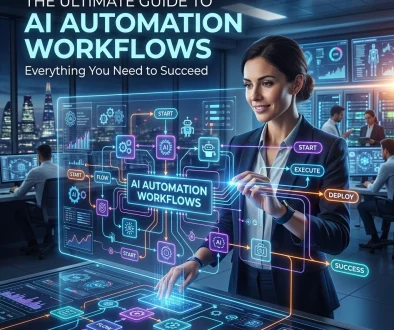
The Ultimate Guide to Automate Business Operations with AI: Everything You Need to Succeed
Current State of AI Business Process Automation
Artificial intelligence facilitates the execution of complex business tasks through machine learning, natural language processing (NLP), and predictive analytics. Modern systems move beyond rigid, rule-based logic to adaptive frameworks. Implementation of these technologies is associated with cost reductions of 15% to 30%. Organizations utilizing autonomous agents frequently report return on investment (ROI) metrics exceeding 200%.
To automate business operations with ai requires a transition from Robotic Process Automation (RPA) to Intelligent Process Automation (IPA). While RPA handles structured data and repetitive clicks, IPA interprets unstructured data, including emails, voice notes, and legal documents.

Technical Differentiation: RPA vs. AI-Driven Automation
Standard automation operates on "If-This-Then-That" logic. It fails when data formats change or exceptions occur. AI-powered systems employ probabilistic logic.
| Feature | Traditional Automation (RPA) | AI-Driven Automation |
|---|---|---|
| Data Handling | Structured data only | Unstructured and semi-structured |
| Logic | Rule-based (Fixed) | Probabilistic (Adaptive) |
| Learning | None | Continuous through feedback loops |
| Scalability | Manual updates required | Self-optimizing |
| Context | Lacks context awareness | Context-aware processing |
Systems that automate business operations with ai are capable of identifying patterns within historical datasets to predict future requirements, such as inventory replenishment or customer churn.
Core Operational Domains for Automation
1. Customer Service and Support
AI agents manage Tier 1 and Tier 2 inquiries. These systems utilize AI Automations to query internal knowledge bases and resolve issues without human intervention. Integration with CRM systems ensures data consistency across the organization.
2. Finance and Accounting
Automation workflows handle invoice processing, expense categorization, and anomaly detection. Machine learning models identify fraudulent transactions by comparing real-time data against historical baselines.
3. Supply Chain and Logistics
Predictive models analyze global shipping data, weather patterns, and local demand to optimize route planning. This reduces fuel consumption and delivery lead times.
4. Human Resources
AI tools screen resumes, schedule interviews, and manage employee onboarding documentation. This reduces the administrative burden on HR departments, allowing a focus on talent strategy.

Advanced Strategies: Connecting Disparate Systems
A primary barrier to operational efficiency is the presence of siloed data. To effectively automate business operations with ai, disparate software must be unified through a centralized intelligence layer.
API Orchestration
Application Programming Interfaces (APIs) serve as the communication bridge between legacy software and modern AI models. Marketrun specializes in AI Development that connects ERPs (Enterprise Resource Planning) with custom LLM (Large Language Model) agents.
Webhooks and Real-Time Event Triggers
Webhooks allow one system to send real-time data to another as soon as an event occurs. For example, a successful payment in Stripe can trigger an automated welcome sequence in a custom web application and update an inventory database simultaneously.
Middleware and Integration Platforms
Tools such as n8n, Zapier, or custom-built middleware act as the "nervous system" for ai automation workflows. These platforms ingest data from multiple sources, transform it via an AI model (such as GPT-4 or Claude 3.5), and output the result to the destination system.
Strategic AI Automation Workflows: Design and Execution
Execution of an automation strategy requires a structured framework.
Phase 1: Process Identification and Mapping
Processes suitable for automation are characterized by high volume and repetitive logic. Tasks involving 100+ daily emails or 50+ manual data entries are primary candidates. Visual mapping of these workflows identifies bottlenecks and decision points.
Phase 2: Data Consolidation
AI models require access to clean, centralized data. Information residing in disparate spreadsheets must be migrated to a unified database or warehouse. Marketrun provides Custom Software solutions to facilitate this migration and ensure data integrity.
Phase 3: Model Selection and Fine-Tuning
Depending on the complexity of the task, businesses may choose between general-purpose LLMs or specialized models. Sensitive industries often require Self-Hosting LLMs to maintain data privacy and compliance.
Phase 4: Implementation of Feedback Loops
Automation is not a static deployment. Continuous monitoring allows the system to learn from human corrections. This "Human-in-the-loop" (HITL) architecture ensures that edge cases are handled correctly and incorporated into the model's training data.

Infrastructure and Security Considerations
Automating business operations introduces technical requirements regarding infrastructure and data security.
- Open Source Deployment: Utilizing open-source models reduces vendor lock-in and provides greater control over the technology stack. Explore Open Source Deployment options for enterprise environments.
- Edge Computing: For operations requiring low latency, such as manufacturing floor monitoring, AI processing should occur close to the data source.
- Security Protocols: Encryption of data in transit and at rest is mandatory. Access controls must be strictly defined to ensure AI agents only interact with authorized datasets.
For organizations operating across multiple regions, understanding the cost-benefit analysis of development locations is essential. Review the Custom Software India vs USA Cost 2026 Guide for comparative data.
Measuring ROI in AI Automation
Success is measured through specific Key Performance Indicators (KPIs).
- Labor Hours Reclaimed: Total time saved per employee on automated tasks.
- Error Rate Reduction: Comparison of manual data entry errors versus automated accuracy.
- Processing Speed: The time taken to complete a transaction from start to finish.
- Scalability Metric: The ability to handle a 10x increase in volume without a corresponding increase in headcount.
Marketrun offers an AI Automation ROI Calculator to assist businesses in quantifying these improvements.

Advanced Implementation: Agentic Workflows
The current frontier of business automation involves AI Agents. Unlike standard chatbots, agents are capable of autonomous decision-making. They do not just provide information; they execute actions.
An agentic ai automation workflow might include:
- Scanning an incoming legal contract.
- Identifying clauses that deviate from company policy.
- Drafting an email to the legal department with suggested revisions.
- Updating the status of the contract in the company's project management tool.
This level of autonomy is detailed in the AI Agents and Automations Guide 2026.
Practical Steps to Begin
Initiating an AI automation project requires a prioritized approach:
- Audit Workflows: Identify the top three manual tasks consuming the most time.
- Consult Experts: Engage with specialists in AI and Custom Software Development.
- Pilot Program: Implement a small-scale automation in a single department (e.g., Customer Support) to validate the technology.
- Scale: Expand the successful pilot to other departments, connecting disparate systems as the infrastructure matures.
For businesses targeting specific markets, Marketrun provides localized services for US Clients and India Clients, ensuring compliance with regional regulations and operational standards.
Summary of Functional Components
Successful business automation with AI rests on three pillars:
- Connectivity: Ensuring all software systems communicate via APIs.
- Intelligence: Utilizing the correct AI models for the specific task complexity.
- Data: Maintaining high-quality, accessible data streams to feed the automation logic.
By adhering to these principles, organizations transition from reactive operations to proactive, autonomous systems. For further technical details on implementation, visit the Marketrun Blog.