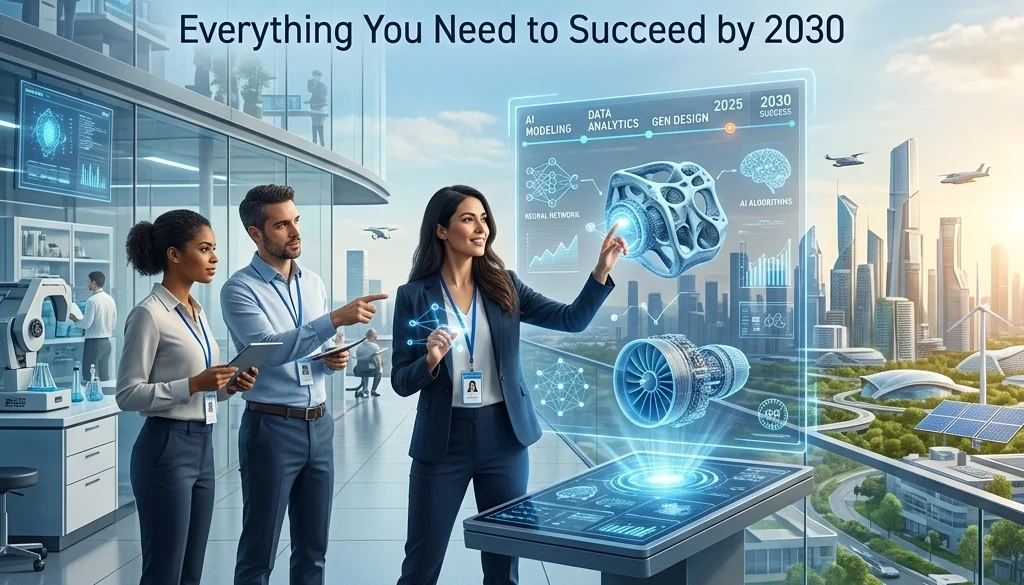
The Ultimate Guide to AI-Driven Engineering: Everything You Need to Succeed by 2030
Current Engineering Status: April 2026
The engineering landscape in 2026 reflects a complete transition from manual code generation to system orchestration. Software development no longer centers on syntax proficiency. Engineering success now depends on the ability to manage autonomous systems and integrate proprietary data into large-scale models. By 2030, the distinction between a software engineer and an AI systems architect will disappear.
The Automation Risk Matrix
Automation impact is not uniform across engineering roles. Task classification determines the survival of specific career paths.
High-Risk Tasks (70-90% Automation Potential):
- Boilerplate Generation: Writing standard CRUD operations and API endpoints.
- Unit Testing: AI agents now generate, execute, and refactor test suites with minimal human intervention.
- Documentation: Technical documentation is generated directly from system architecture logs.
- Basic Debugging: Automated identification of syntax errors and common logic flaws.
Low-Risk Tasks (10-25% Automation Potential):
- System Architecture: Designing the interaction between complex microservices and AI agents.
- Stakeholder Requirements: Translating business objectives into technical constraints.
- Ethical Governance: Ensuring AI decision-making aligns with safety and regulatory standards.
- Cross-Domain Integration: Connecting disparate legacy systems with modern AI-native infrastructure.

AI Agents for Business: The Core of 2030 Engineering
The deployment of ai agents for business has shifted from experimental use cases to core operational infrastructure. An AI agent is no longer a simple chatbot; it is a persistent software entity capable of planning, tool use, and recursive self-improvement.
Engineers must shift focus toward the development of multi-agent systems. These systems involve specialized agents: such as a "Security Agent," a "DevOps Agent," and a "Feature Agent": working in coordination. Marketrun prioritizes the creation of these autonomous workflows through AI automations.
Success in this era requires a shift in technical mastery. Knowledge of specific programming languages is secondary to expertise in:
- Agentic Workflow Design: Structuring how agents interact with external APIs.
- Prompt Orchestration: Managing high-dimensional inputs to ensure consistent agent output.
- State Management: Maintaining context across long-running autonomous processes.
Custom AI Solutions for SMBs: Democratizing Engineering
In the 2020s, advanced AI was the domain of large enterprises with massive compute budgets. In 2026, the trend has shifted toward custom ai solutions for smbs. Small and medium businesses now leverage specialized models trained on proprietary data to compete with larger entities.
The engineering challenge for SMBs is cost-efficiency and data sovereignty. Marketrun addresses this by facilitating custom software development that integrates locally hosted models. By 2030, successful engineers will be those who can deploy high-performance systems without relying exclusively on expensive, centralized cloud providers.
The Rise of Localized LLMs
Data privacy regulations and cost considerations drive the adoption of local inference. Engineering strategies now emphasize:
- Quantization: Reducing model size to run on consumer-grade hardware.
- Fine-tuning: Adapting open-source models for niche industry requirements.
- Hybrid Cloud Architectures: Balancing local processing for privacy and cloud processing for scale.
For insights into managing these transitions, engineers utilize the guide to self-hosting LLMs.

Technical Stack Requirements for 2030
To maintain relevance, the engineering toolkit must include specific data and orchestration technologies.
1. Data Ubiquity and Management
By 2030, data will be embedded into every system process. Engineers must master:
- Vector Databases: For efficient retrieval-augmented generation (RAG).
- Real-time Streaming: Using Apache Spark or similar frameworks for continuous data ingestion.
- Data Integrity Protocols: Ensuring the information fed into AI agents is accurate and unbiased.
2. Machine Learning Frameworks
Proficiency in high-level ML frameworks is mandatory. This includes:
- Keras and PyTorch: For model customization and fine-tuning.
- Open Source Deployment: Utilizing tools for open source deployment to avoid vendor lock-in.
3. Cloud-Native AI Infrastructure
The ability to manage AI development within AWS, Azure, or Google Cloud remains a fundamental requirement. However, the focus is on "Serverless AI" where compute is allocated dynamically based on agent demand.

Strategic Pathways for Professional Development
Success in AI-driven engineering requires a transition from "doing" to "directing."
Shift to System Architecture
The value of an engineer in 2030 is found in their ability to design robust architectures. This involves defining how AI components interact with legacy databases and user interfaces. Architecture skills have a low automation risk because they require creative synthesis and human-centric judgment.
Mastery of AI Maintenance and Monitoring
As systems become autonomous, the role of "Maintenance Engineer" evolves. This role involves:
- Model Drift Detection: Identifying when an AI agent’s performance degrades over time.
- Prompt Optimization: Refining the instructions that guide agent behavior.
- Security Auditing: Protecting AI systems from prompt injection and data poisoning attacks.
Focus on Ethical AI Oversight
Regulations such as the EU AI Act and similar global standards necessitate human oversight. Engineers must understand the mathematical foundations of bias and the technical methods for ensuring transparency.
Marketrun Vision: The Next Decade
Marketrun views the future of software as modular and agent-centric. The goal is to eliminate the friction between business intent and technical execution. This is achieved through:
- Custom Software for Global Clients: Balancing costs between regions, as outlined in our India vs USA cost guide.
- Mobile and Web Convergence: Using AI to generate cross-platform applications instantly from wireframes.
- Self-Healing Systems: Software that identifies its own bugs and deploys its own fixes.
Actionable Steps for 2026-2030
To ensure career longevity, engineers should adopt the following protocol:
- Automate Routine Coding: Use AI tools to handle 100% of boilerplate and unit testing. Focus remaining time on high-level design.
- Develop Data Literacy: Move beyond SQL to understand vector embeddings and unstructured data pipelines.
- Specialization: Identify a niche: such as AI security, bio-informatics engineering, or smart city infrastructure: where human expertise remains critical.
- Adopt Agentic Thinking: Stop writing linear scripts. Start designing systems where agents complete tasks based on goals.
The transition to 2030 is not about the replacement of engineers, but the replacement of manual engineering methods. Those who adopt custom AI solutions and lead the implementation of ai agents for business will define the next decade of technology.

Summary of Status Indicators
- Syntax Proficiency: Obsolete.
- System Architecture: Critical.
- Data Management: Essential.
- AI Ethics: Mandatory.
- Human-in-the-loop: Required for high-stakes decision making.
For further information on pricing and solution implementation, visit our pricing page or explore our full solutions directory.