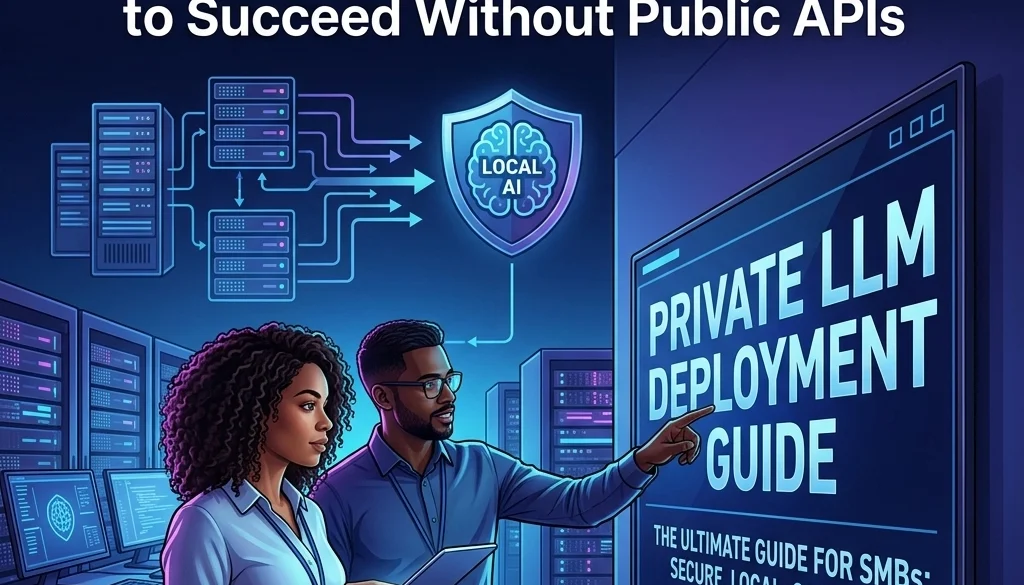
The Ultimate Guide to Private LLM Deployment: Everything SMBs Need to Succeed Without Public APIs
Private LLM Deployment: Definition and Scope
Private LLM deployment is the practice of hosting large language models on local servers or private cloud environments. This configuration replaces dependency on public APIs provided by external entities. The primary objective is the containment of data within a controlled perimeter. Small and medium businesses (SMBs) utilize this architecture to maintain data sovereignty and operational continuity.
Detailed technical information on implementation is available via Marketrun AI development services.
Comparative Analysis: Public APIs vs. Private Hosting
Public API Infrastructure
- Data Transmission: Information is sent to external servers.
- Privacy: Data usage policies vary by provider.
- Latency: Dependent on internet connectivity and provider load.
- Cost: Usage-based billing models.
- Control: Model versions and availability are managed by the provider.
Private Deployment Infrastructure
- Data Transmission: Information remains within the local network or Virtual Private Cloud (VPC).
- Privacy: Zero data leakage to third parties.
- Latency: Reduced through local network proximity.
- Cost: Fixed infrastructure costs with zero per-token fees.
- Control: Full ownership of model weights, fine-tuning, and update schedules.

Regulatory Compliance: GDPR and HIPAA
Compliance with international and industry-specific data regulations is a primary driver for private deployment.
GDPR Requirements
General Data Protection Regulation (GDPR) mandates the protection of personal data of EU residents. Public API usage often involves data transfers to regions without equivalent protections. Private LLM deployment ensures that Personal Identifiable Information (PII) stays within sanctioned jurisdictions. This architecture simplifies the Data Protection Impact Assessment (DPIA) process.
HIPAA Requirements
The Health Insurance Portability and Accountability Act (HIPAA) governs protected health information (PHI) in the United States. Private hosting on HIPAA-compliant infrastructure (such as AWS Nitro or localized hardware) prevents unauthorized access to patient data. It eliminates the need for complex Business Associate Agreements (BAAs) with multiple AI service providers.
Explore self-hosting LLMs for specific compliance configurations.
Technical Infrastructure: Hardware Requirements
Hardware selection is determined by model parameter count and required inference speed.
GPU Specifications
- 7B Parameter Models: Require 8GB to 16GB of VRAM. Suitable for NVIDIA RTX 3060/4060 series.
- 13B Parameter Models: Require 24GB of VRAM. Suitable for NVIDIA RTX 3090/4090 or A10 models.
- 70B Parameter Models: Require 48GB to 80GB of VRAM. Requires NVIDIA A100 or H100 configurations.
System Memory and Storage
- RAM: Minimum 2x the model size in GB for loading weights.
- Storage: NVMe SSDs are required for high-speed model loading and checkpointing.
- Compute: Multi-core CPUs (AMD EPYC or Intel Xeon) handle pre-processing and post-processing tasks.
Detailed hardware benchmarks are found in the 2026 self-hosting guide.

Technical Infrastructure: Software Stack
Successful deployment requires a synchronized software layer.
Inference Engines
- vLLM: A high-throughput library for LLM serving.
- Ollama: A tool for running and managing models in simplified environments.
- Triton Inference Server: NVIDIA-developed software for production model deployment.
Containerization and Orchestration
- Docker: Facilitates model portability and environment consistency.
- Kubernetes (K8s): Manages scaling and resource allocation across GPU clusters.
Frameworks
- PyTorch/TensorFlow: Core libraries for model execution.
- LangChain/LlamaIndex: Frameworks for integrating models with external data sources through Retrieval-Augmented Generation (RAG).
For open-source implementation details, refer to open source deployment solutions.
Deployment Architectures
1. On-Premises Hardware
Physical servers are located within the business facility. This provides the highest level of security. Hardware procurement and maintenance are the responsibility of the internal IT department.
2. Virtual Private Cloud (VPC)
Models run on isolated instances within cloud providers like AWS, Azure, or Google Cloud. Data remains within the company's virtual network. This offers scalability without physical hardware management.
3. Managed Private Instances
Third-party providers host dedicated instances for the business. This model reduces technical overhead while maintaining data isolation.
Implementation Roadmap for SMBs
Phase 1: Assessment and Selection
- Identify specific business use cases (e.g., customer support, document analysis).
- Select an appropriate model (e.g., Llama 3, Mistral, Falcon).
- Define performance metrics (Tokens per second, latency).
Phase 2: Environment Provisioning
- Acquire hardware or configure cloud VPC.
- Install drivers (NVIDIA CUDA) and container runtimes.
- Set up monitoring tools (Prometheus, Grafana).
Phase 3: Model Deployment and Tuning
- Quantize models to optimize memory usage (4-bit or 8-bit precision).
- Implement Retrieval-Augmented Generation (RAG) to connect models to proprietary data.
- Establish secure API endpoints for internal application integration.

Data Security Protocols
Private deployment requires the implementation of standard security measures:
- Encryption at Rest: All model weights and cached data are encrypted.
- Encryption in Transit: TLS 1.3 for all internal API communications.
- Identity and Access Management (IAM): Role-based access control (RBAC) to restrict model interaction.
- Network Isolation: Deployment within air-gapped or firewall-restricted segments.
Cost-Benefit Analysis
Capital Expenditure (CapEx)
Initial investment includes GPU hardware, server chassis, and networking equipment. High upfront costs are offset by long-term savings.
Operational Expenditure (OpEx)
Includes electricity, cooling, and personnel costs for maintenance. In VPC setups, OpEx consists of hourly instance fees.
ROI Factors
- Elimination of Token Fees: High-volume usage results in lower total cost of ownership (TCO) compared to public APIs.
- Intellectual Property Protection: Prevents the loss of proprietary trade secrets.
- System Uptime: Independence from third-party service outages.
Detailed ROI calculations are available at Marketrun custom software solutions.
Operational Maintenance
Ongoing tasks for private LLM systems:
- Model Updates: Replacing base models as newer versions are released.
- Vector Database Optimization: Periodic cleaning and re-indexing of data used in RAG.
- Hardware Monitoring: Tracking GPU temperature and memory utilization.
- Security Patching: Updating container images and host OS.

Execution Summary
Private LLM deployment is a viable strategy for SMBs requiring high levels of security and compliance. By eliminating public API dependencies, businesses gain control over their data and infrastructure. Success is dependent on accurate hardware provisioning, robust software orchestration, and adherence to security protocols.
For organizations seeking professional implementation, Marketrun provides end-to-end deployment services.
System Status Indicators
- Privacy Level: Maximum
- Compliance Status: Compliant (GDPR/HIPAA)
- Inference Location: Local/VPC
- Data Retention: Internal Only
- Dependency Level: Low (No Public API)