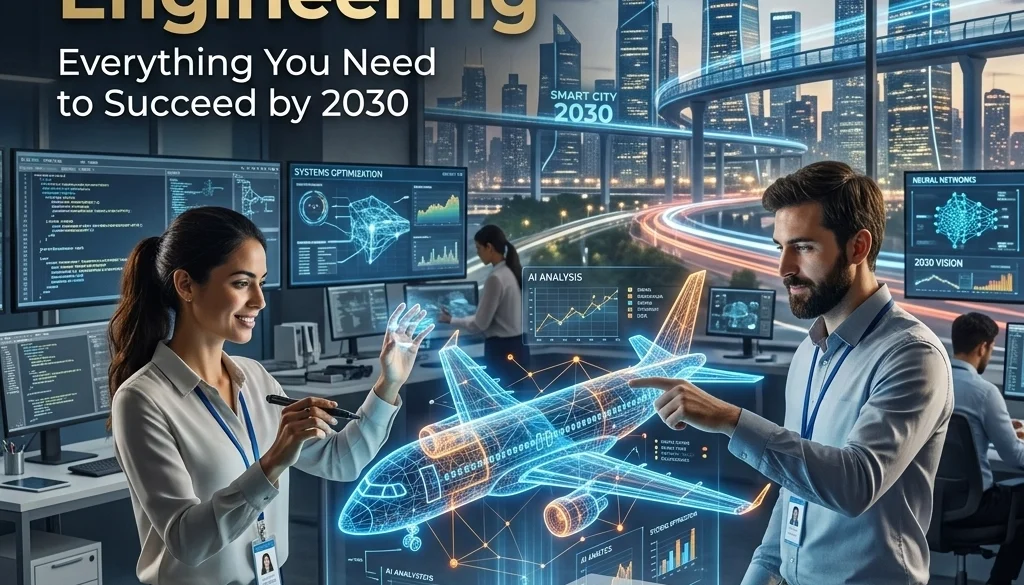
The Ultimate Guide to AI-Driven Engineering: Everything You Need to Succeed by 2030
Current Trajectory of AI-Driven Engineering
The field of software engineering is undergoing a transition toward automated synthesis and intelligent system management. By the year 2030, the integration of artificial intelligence into the development lifecycle will be a standard operational requirement. Market data indicates a 25.6% annual growth rate in the U.S. AI market through the end of the decade.
This guide serves as a technical status report on the competencies, infrastructures, and strategic deployments required for success in this period.
Automation and Efficiency Metrics
Current projections for 2030 indicate significant shifts in task allocation within engineering departments.
Primary Automation Targets
- Boilerplate Code Generation: 80% automation rate projected.
- Manual QA Testing: 75% automation rate projected.
- Bug Detection and Resolution: 60% automation rate projected.
- Documentation and Metadata: 90% automation rate projected.
The utilization of AI automations reduces the time required for low-level syntax tasks. This shift allocates resources toward high-level system design and architecture.

Evolution of Engineering Roles
The designation of "Software Engineer" is evolving into "AI Systems Architect." The focus is shifting from manual code writing to the management of AI development cycles.
Required Skillsets for 2030
- System Architecture: Design of scalable infrastructures that host autonomous agents.
- AI Ethics and Compliance: Monitoring systems for bias and adherence to international regulations.
- Prompt Engineering and Model Tuning: Optimization of LLM outputs for specific business logic.
- Cybersecurity for AI: Protection of proprietary models and data sets.
- Hybrid Environment Management: Overseeing systems that combine legacy software with modern AI layers.
Resources for these transitions are documented in the guide to AI agents and automations 2026.
Deployment of AI Agents for Business
AI agents for business are defined as autonomous or semi-autonomous software entities capable of executing multi-step workflows without human intervention. These agents are replacing traditional static automation scripts.
Functional Applications
- Automated Procurement: Agents evaluate vendor data, negotiate based on parameters, and execute purchase orders.
- Customer Support Autonomy: Intelligent agents resolve complex tier-2 support queries through real-time documentation retrieval.
- Software Maintenance: Continuous monitoring agents identify vulnerabilities and deploy patches automatically.
The implementation of these agents is detailed in the solutions for AI automations section of Marketrun.

Custom AI Solutions for SMBs
Small and Medium-sized Businesses (SMBs) require tailored implementations to maintain competitiveness against enterprise-scale entities. Custom AI solutions for SMBs provide specific competitive advantages by utilizing proprietary data rather than general-market models.
Benefits of Targeted AI Development
- Operational Efficiency: Reduced overhead through automated data processing.
- Predictive Analysis: Utilization of historical SMB data to forecast market trends.
- Cost Management: Reduced reliance on large-scale SaaS subscriptions through custom internal tools.
Information on custom software solutions highlights the transition from off-the-shelf products to bespoke intelligent systems.
Strategic Infrastructure: Self-Hosting and Security
Data sovereignty is a primary concern for engineering teams. The shift toward self-hosting LLMs ensures that proprietary information remains within local or private cloud environments.
Advantages of Local Model Deployment
- Data Privacy: Critical business logic is not transmitted to third-party providers.
- Latency Reduction: On-site processing facilitates real-time agent responses.
- Cost Control: Elimination of token-based pricing models in favor of fixed infrastructure costs.
Comprehensive details are available in the 2026 guide to self-hosting LLMs.

Regional Cost and Resource Analysis
Engineering success by 2030 necessitates an understanding of global resource distribution. The cost differential between various development hubs remains a factor in strategic planning.
Comparative Development Costs (2026 Projections)
| Region | Average Cost per Unit (AI Development) | Talent Availability |
|---|---|---|
| USA | High | Moderate |
| India | Moderate/Low | High |
| Europe | High | Moderate |
For US-based entities, utilizing offshore web and mobile app guides provides a framework for managing global teams. Further cost breakdowns are found in the India vs USA cost comparison.
AI in Web and Mobile Environments
The creation of interfaces is now driven by generative models. AI website creation and mobile web apps are increasingly integrated with real-time SEO adjustments.
Technical Indicators for Web Development
- Dynamic UI: Interfaces that adapt based on user intent signals.
- Automated SEO: Continuous metadata optimization based on search algorithm updates.
- Cross-Platform Parity: Instant conversion of web assets into mobile-native applications.
Specific strategies for optimization are detailed in the AI website SEO 2026 report.

Roadmap to 2030: Actionable Phases
Success is achieved through phased integration of AI capabilities.
Phase 1: Foundation (2024-2025)
- Establishment of data pipelines.
- Migration to cloud-native infrastructures.
- Initial pilot programs for AI agents for business.
Phase 2: Integration (2026-2027)
- Scaling of custom AI solutions for SMBs.
- Implementation of self-hosting LLMs for sensitive operations.
- Widespread use of AI-driven coding assistants.
Phase 3: Autonomy (2028-2030)
- Transition to agent-first workflows.
- Autonomous system maintenance and self-healing code.
- Full integration of AI into executive decision-making processes.
Resource Allocation and ROI
The determination of investment levels is facilitated by the AI automation ROI calculator. Financial planning must account for:
- Initial Training Costs: Upskilling existing engineering staff.
- Infrastructural Upgrades: GPUs and specialized AI hardware.
- Maintenance: Continuous model updates and security audits.
Marketrun provides tiered pricing models to accommodate varied scales of implementation.
Technical Conclusion of Status Report
By 2030, engineering will be defined by the ability to orchestrate complex AI systems rather than the manual production of code. Success requires the immediate adoption of autonomous workflows, specialized AI architectures, and secure infrastructure.
For further technical documentation and solution overviews, visit the Marketrun solutions page.