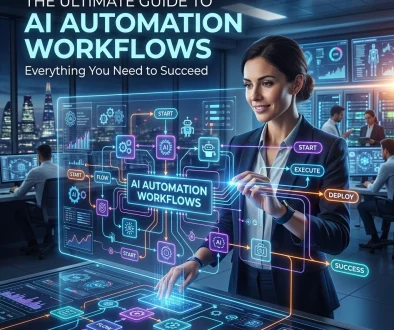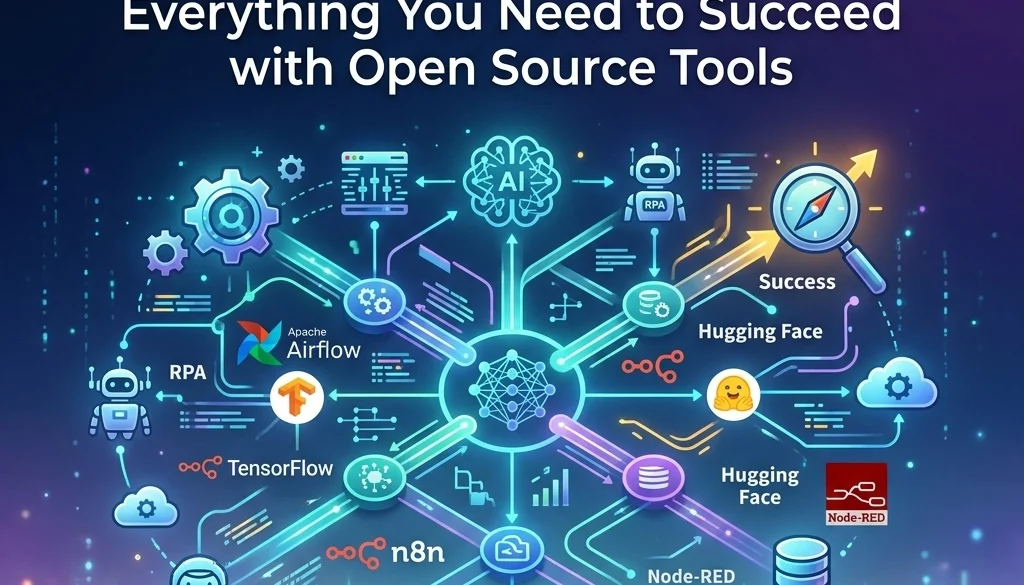
The Ultimate Guide to AI Automation Workflows: Everything You Need to Succeed with Open Source Tools
Overview of AI Automation Workflows
AI automation workflows consist of sequences where artificial intelligence performs specific tasks within a business process. These workflows eliminate manual data entry, decision-making, and routing. To automate business operations with AI, a structured approach involving data ingestion, processing, and output execution is required.
The adoption of open-source tools provides organizations with control over data privacy, cost management, and customization. This guide details the technical requirements and implementation strategies for creating robust ai automation workflows.
Anatomy of an AI Workflow
A functional AI workflow contains five primary layers:
- Trigger Mechanism: The initial event that starts the process. Examples include incoming emails, database updates, or scheduled intervals.
- Data Ingestion and Transformation: The extraction of raw data from the trigger source and its conversion into a machine-readable format.
- AI Logic Layer: The application of Large Language Models (LLMs), machine learning classifiers, or computer vision to analyze data.
- Action Execution: The resulting operation performed by the system, such as updating a CRM, sending a notification, or generating a document.
- Logging and Audit Trail: The documentation of each step for compliance and performance monitoring.

Open Source Infrastructure for AI Workflows
Selecting the correct software stack is necessary for scalability. Open-source solutions offer an alternative to proprietary platforms.
Orchestration Engines
Orchestration engines manage the flow of data between different services.
- n8n: A workflow automation tool that allows for complex branching logic and integrates with self-hosted AI services.
- Temporal: A durable execution system for managing long-running, reliable workflows.
LLM Frameworks and Hosting
To handle the "intelligence" aspect of the workflow:
- Ollama: Facilitates the local execution of LLMs like Llama 3 or Mistral. Information on self-hosting LLMs is available for organizations requiring data sovereignty.
- Flowise/LangFlow: Graphical interfaces for building LangChain-based applications. These allow for the creation of Retrieval-Augmented Generation (RAG) pipelines.
Database and Vector Storage
AI workflows often require memory or context.
- PostgreSQL with pgvector: A relational database that supports vector embeddings.
- ChromaDB/Qdrant: Specialized vector databases for storing and retrieving high-dimensional data used in AI context windows.
Connecting Disparate Systems
To automate business operations with ai, integration between disconnected software is mandatory. Disparate systems include legacy databases, modern SaaS APIs, and local file systems.
API Integration
Most modern business applications provide REST or GraphQL APIs. AI workflows use these interfaces to pull data or push results. For custom requirements, custom software development ensures that legacy systems without native APIs can be connected to the automation layer.
Webhooks
Webhooks allow for real-time communication. When an event occurs in a third-party system (e.g., a payment is processed in Stripe), a POST request is sent to the AI workflow orchestrator, initiating immediate processing.
Data Normalization
Data from different sources often lacks a uniform structure. The automation workflow must include a normalization step where AI or scripts format the data before it reaches the model. This ensures consistency and reduces errors in model output.

Implementation Process for AI Automation Workflows
Systematic deployment reduces the risk of operational failure.
Phase 1: Use Case Identification
Identify tasks characterized by high volume, repetitive nature, and clear logic. Common examples:
- Customer support ticket classification.
- Invoice data extraction and ERP entry.
- Automated lead scoring and routing.
Phase 2: Data Mapping and Preparation
Identify the location of necessary data. Clean the data to remove duplicates and errors. Determine if the data contains sensitive information that requires open source deployment to remain on-premises.
Phase 3: Prototyping
Develop a Minimum Viable Product (MVP). Use tools like n8n to connect a trigger to an LLM and observe the output. This phase validates the feasibility of the AI logic.
Phase 4: Error Handling and Human-in-the-Loop
Automated systems require mechanisms for failure.
- Retries: Automatic re-execution of failed steps.
- Human-in-the-loop (HITL): If AI confidence is below a defined threshold, the task is routed to a human operator for review.
Phase 5: Production Scaling
Deploy the workflow in a containerized environment (e.g., Docker or Kubernetes). Monitor resource consumption, specifically GPU and memory usage when running local models.

Advanced Automation Tips
1. Implementing RAG (Retrieval-Augmented Generation)
Standard LLMs lack knowledge of internal company data. RAG allows the workflow to search a vector database for relevant documents before generating a response. This increases accuracy and reduces hallucinations in ai automation workflows.
2. Prompt Engineering and Versioning
Prompts should be treated as code. Maintain a version-controlled repository of prompts used in workflows. Use "Chain of Thought" prompting to improve the reasoning capabilities of the AI for complex business operations.
3. Rate Limiting and Cost Controls
When using external APIs or local hardware, implement rate limiting to prevent system crashes. Monitor token usage to manage costs effectively. Organizations can calculate potential savings using an AI automation ROI calculator.
4. Multi-Agent Systems
Complex operations require multiple AI agents with specialized roles. One agent may handle data extraction, while another handles sentiment analysis. These agents communicate within the orchestration engine to complete a multi-step objective.

Monitoring and Maintenance
Post-deployment maintenance is required to ensure continued performance.
- Model Drift Monitoring: Evaluate if model performance degrades over time as business data changes.
- Latency Tracking: Measure the time taken from trigger to completion. High latency may require hardware upgrades or model optimization (e.g., quantization).
- Log Analysis: Regularly review logs to identify recurring failure points in the integration layer.
Marketrun provides specialized AI automations and AI development services to assist organizations in constructing these systems. For detailed strategies on offshore development and cost optimization, refer to the guide on custom software in India vs USA.
Security and Compliance
Automating business operations with ai necessitates strict security protocols.
- Encryption: Data must be encrypted at rest and in transit.
- Access Control: Implement Role-Based Access Control (RBAC) within the orchestration platform.
- Data Sovereignty: Use local hosting to comply with regulations such as GDPR or HIPAA. Self-hosting LLMs is a primary method for achieving this.
For organizations operating internationally, understanding the differences in regional requirements is critical. Marketrun offers specific support for US clients and India clients.
Conclusion of Technical Framework
The transition to AI-driven operations involves integrating open-source orchestration, local or cloud-based LLMs, and robust data pipelines. Success is dependent on the precise connection of disparate systems and the implementation of human-oversight mechanisms.