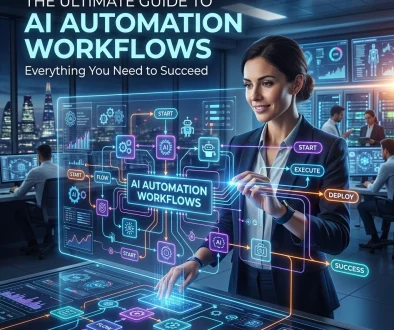
The Ultimate Guide to AI Automation Workflows: Everything You Need to Succeed in 2026
1. Core Definition of AI Automation Workflows
AI automation workflows consist of sequences where Artificial Intelligence (AI) models perform tasks, make decisions, and move data between software systems. These workflows differ from traditional automation through the inclusion of probabilistic reasoning, natural language understanding, and pattern recognition. In 2026, the transition from deterministic scripts to autonomous agents defines the operational standard.
The primary objective is to automate business operations with ai to reduce manual intervention. A functional workflow requires a trigger, a logic processor (AI), and an action.
2. Infrastructure for System Integration
To automate business operations with ai, disparate systems must be connected. Integration protocols facilitate the exchange of data between siloed environments.
2.1 API Management
Application Programming Interfaces (APIs) serve as the primary conduits for data. REST, GraphQL, and Webhooks enable real-time communication. Automation platforms orchestrate these connections.
2.2 Data Middleware
Middleware layers normalize data formats. When system A outputs JSON and system B requires XML, the middleware performs the transformation. In 2026, AI models handle unstructured data normalization without manual mapping.
2.3 Legacy System Connectivity
Robotic Process Automation (RPA) is utilized for systems lacking APIs. RPA agents interact with User Interfaces (UI) to extract or input data, which is then fed into ai automation workflows.

3. Components of Advanced AI Workflows
3.1 Trigger Mechanisms
Workflows initiate based on specific events:
- Time-based: Scheduled executions.
- Event-based: New email arrival, CRM status change, or database update.
- Threshold-based: Sentiment scores dropping below a set level or inventory levels reaching a minimum.
3.2 Cognitive Processing (The LLM Layer)
Large Language Models (LLMs) act as the reasoning engine. Functions include:
- Summarization: Condensing long documents.
- Classification: Categorizing support tickets or leads.
- Extraction: Identifying entities like dates, names, or prices from text.
- Generation: Creating responses or documentation based on input parameters.
For organizations requiring data privacy, self-hosting LLMs is a standard procedure in 2026.
3.3 Decision Logic and Branching
AI workflows utilize conditional logic. If an AI classifies a lead as "High Priority," the workflow triggers an immediate notification. If classified as "Low Priority," the data is moved to a long-term nurture sequence.

4. Advanced Automation Tips: Connecting Disparate Systems
4.1 Vector Databases for Context
Connecting systems requires shared context. Vector databases (e.g., Pinecone, Weaviate) store embeddings of business data. This allows the AI to reference past interactions from the CRM while drafting an email in the marketing suite.
4.2 Semantic Routing
Semantic routers direct inputs to specific models or sub-workflows based on meaning rather than keywords. This ensures that a technical query is routed to a specialized AI development model, while a billing query is sent to the finance automation module.
4.3 Human-in-the-Loop (HITL)
High-stakes operations require human verification. Modern workflows include "Pause and Review" states. The AI prepares a transaction or document and waits for a human administrator to provide a digital signature before final execution.
5. Step-by-Step Implementation Framework
The following steps are required to implement ai automation workflows:
- Process Audit: Identify repetitive tasks involving unstructured data (text, images, audio).
- Tool Selection: Choose between low-code platforms (Make, Zapier, n8n) or custom software development.
- Authentication Setup: Configure OAuth, API keys, and secure credential storage.
- Prompt Engineering: Develop and version control system prompts for the AI components.
- Error Handling: Define retry logic and fallback models for instances of API downtime or model hallucinations.
- Testing: Execute workflows in a sandbox environment using synthetic data.
- Deployment: Transition to production with active monitoring.

6. Operational Use Cases in 2026
6.1 Customer Support Orchestration
- Inbound: Customer sends an image of a broken product.
- AI Action: Vision model identifies the product and defect.
- Integration: AI checks inventory in the ERP system.
- Outbound: AI drafts a replacement confirmation and updates the CRM.
6.2 Intelligent Financial Operations
- Inbound: Invoice received via email.
- AI Action: OCR and extraction of line items and tax data.
- Integration: Cross-reference with purchase orders in the accounting software.
- Action: Schedule payment via banking API if data matches.
6.3 Sales and Marketing Personalization
Workflows connect LinkedIn scrapers, CRM data, and email senders. The AI generates personalized outreach based on the prospect's recent public activity and the company's internal case studies. More details on these strategies are available in the AI Website SEO guide.
7. Selecting the Right Automation Stack
The choice of technology impacts scalability and cost.
| Feature | Low-Code Platforms | Custom AI Development |
|---|---|---|
| Setup Speed | High | Medium |
| Customization | Limited | Unlimited |
| Cost per Run | High (Subscription) | Low (Infrastructure) |
| Security | Third-party dependent | Full control |
Marketrun provides AI development solutions for enterprises seeking bespoke automation architectures.

8. Security, Governance, and Compliance
To automate business operations with ai safely, specific guardrails are necessary:
- Data Masking: Sensitive information (PII) is redacted before being sent to external LLM providers.
- Audit Logs: Every AI decision and system interaction is logged for compliance audits.
- Rate Limiting: Controls are placed on API calls to prevent system overloads or excessive costs.
- Encryption: Data is encrypted at rest and in transit between all connected systems.
Organizations often evaluate the cost-benefit of these implementations using an AI automation ROI calculator.
9. Future-Proofing AI Workflows
Workflows in 2026 are increasingly "Agentic." This means the system does not follow a linear path but is given a goal and allowed to select the necessary tools (APIs) to achieve it.
9.1 Multi-Agent Systems
Complex operations use multiple specialized agents. One agent conducts research, another performs data analysis, and a third handles reporting. These agents communicate via a central "Orchestrator" workflow.
9.2 Autonomous Optimization
AI systems now monitor their own performance. If a specific prompt results in high error rates, the system flags the issue for refinement or attempts self-correction through iterative testing.
10. Conclusion of System Requirements
Successful AI automation requires a stable integration layer, high-quality data inputs, and robust error handling. Connecting disparate systems is no longer a manual coding task but a structural configuration of AI-enabled nodes.
For comprehensive assistance in building these systems, Marketrun offers AI automation services and specialized open-source deployment to ensure operational efficiency and data sovereignty.

Technical Resource Summary
- Main Website: https://marketrun.io
- Solutions Portfolio: https://marketrun.io/solutions
- Pricing Models: https://marketrun.io/pricing
- Development Blog: https://marketrun.io/blog