Mastering AI Automation Workflows: The Proven Framework to Scale Your Business Operations
AI Automation Workflow Definition
AI automation workflows integrate artificial intelligence models into business processes to manage tasks requiring interpretation of unstructured data. These systems utilize Large Language Models (LLMs) and machine learning algorithms to execute decision-making operations. Traditional automation relies on static, rule-based logic. AI automation allows for the processing of variable inputs and the generation of context-aware outputs. To automate business operations with ai requires a shift from linear scripts to dynamic execution paths.
Core Architecture for AI Workflows
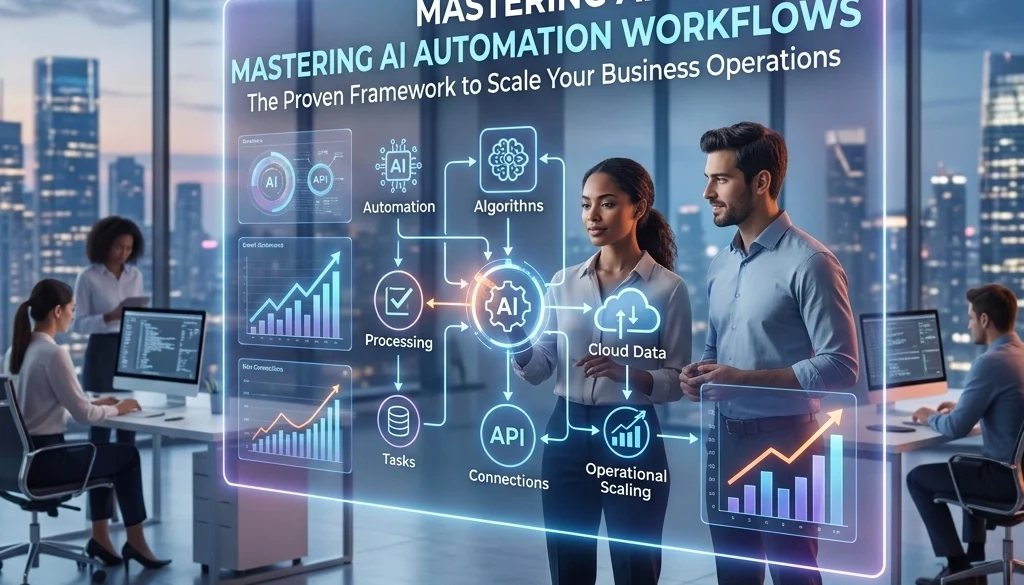
The implementation of scalable ai automation workflows follows a standard six-stage framework. This structure ensures reliability and auditability.
1. Trigger Initialization
A workflow commences with a trigger event. This event originates from external or internal sources. Common triggers include the arrival of an email, a database update, a webhook notification, or a scheduled time interval. The trigger provides the initial data payload for the system.
2. Data Preprocessing
Raw data requires cleaning and formatting before model ingestion. Preprocessing involves several technical operations:
- Removal of redundant characters or metadata.
- Data normalization into standardized JSON formats.
- Extraction of relevant text segments from large documents.
- Conversion of audio or image files into text-based representations.
3. Large Language Model (LLM) Integration
The processed data enters the LLM stage. The system sends a prompt to the model. This prompt includes:
- System Instructions: Definitions of the role and constraints of the model.
- Contextual Data: The specific information extracted during preprocessing.
- Output Schema: A defined structure, such as JSON, for the model to follow.
- Few-Shot Examples: Demonstrations of desired input-output pairs to improve accuracy.
4. Tool Execution and API Calls
The LLM generates an output that indicates specific actions. These actions involve calling external tools or APIs. The system executes functions within a custom software environment. Examples include:
- Updating a record in a CRM.
- Querying a vector database for relevant documentation.
- Sending a notification via messaging platforms.
- Generating a financial report in a spreadsheet application.
5. Post-Processing and Validation
Outputs from the tool execution and the LLM require validation. This stage verifies that the data meets technical specifications. Validation includes:
- Schema checks to ensure JSON integrity.
- Logic gates to confirm that the action aligns with business rules.
- Fact-checking against authoritative data sources.
6. Storage and Logging
The system records every step of the workflow. Logging provides a trail for auditing and performance monitoring. Data storage facilitates the calculation of ai automation ROI.

Connecting Disparate Systems
Advanced automation requires the integration of separate software platforms. Business operations often reside in silos. Effective AI workflows bridge these gaps through technical connectivity methods.
API Orchestration
Application Programming Interfaces (APIs) serve as the primary communication link between disparate systems. AI workflows use orchestration layers to manage the flow of data between multiple APIs. This involves handling authentication protocols, such as OAuth2, and managing rate limits.
Webhook Listeners
Webhooks enable real-time data transfer. When an event occurs in one system, a webhook sends an HTTP POST request to the automation server. This eliminates the need for constant polling and reduces latency in business operations.
Data Transformation Layers
Disparate systems use different data structures. An automation framework must include a transformation layer. This layer converts data from Source A into the format required by Source B. AI models assist in this process by mapping inconsistent fields to a unified data model.

Workflow Design vs. AI Agent Deployment
A critical distinction exists between explicit workflows and autonomous agents. The choice of architecture impacts the stability of business operations.
Explicit Workflows
Explicit workflows follow a predetermined path. The logic is defined by the developer. AI is used within specific steps to process data, but the overall sequence is static. Use explicit workflows for:
- Processes with high regulatory requirements.
- Tasks where predictable outcomes are mandatory.
- Operations with fixed budget constraints.
AI Agents
AI agents use LLMs to determine the sequence of steps autonomously. The agent receives a goal and selects tools to achieve it. This is suitable for:
- Highly variable tasks with no fixed sequence.
- Handling complex customer inquiries.
- Research and data synthesis across multiple web sources.

Advanced Implementation Tips
Scaling AI automation involves addressing technical challenges related to performance and security.
Latency Optimization
LLM inference introduces latency. Optimization strategies include:
- Model Quantization: Reducing model size to increase processing speed.
- Parallel Processing: Executing non-dependent workflow steps simultaneously.
- Prompt Caching: Storing frequently used context to reduce token consumption and time.
Security and Data Privacy
Automating business operations with AI requires strict data handling protocols. Data must be encrypted at rest and in transit. For organizations with high security needs, self-hosting LLMs provides control over data residency. This prevents sensitive information from leaving the internal network.
Error Handling and Redundancy
Workflows must account for potential failures. Implementation should include:
- Retry Logic: Automatic re-execution of failed API calls.
- Fallback Models: Switching to a different LLM if the primary model is unavailable.
- Human-in-the-loop (HITL): Redirecting a task to a human operator when confidence scores fall below a defined threshold.

Monitoring and Maintenance
AI systems are subject to model drift and data changes. Continuous monitoring ensures the framework remains effective.
Performance Metrics
The system should track specific Key Performance Indicators (KPIs):
- Success Rate: The percentage of workflows completed without error.
- Cost Per Execution: The total token and infrastructure cost per run.
- Latency: The time taken from trigger to completion.
- Accuracy: The alignment of AI outputs with ground truth data.
Version Control
Changes to prompts, model versions, or workflow logic must be version-controlled. This allows for rollback in the event of performance degradation. Testing in a staging environment is required before deploying updates to production business operations.

Scaling Operations Through Modular Design
A modular approach allows for the expansion of automation capabilities without re-engineering the entire system.
Reusable Components
Components such as authentication modules, data cleaners, and specific tool connectors should be built as reusable services. This speeds up the development of new AI agents and automations.
Infrastructure Scalability
Cloud-native technologies, such as Kubernetes and serverless functions, allow the automation framework to scale based on demand. This ensures that a sudden increase in trigger events does not lead to system failure or excessive latency.
Deployment Geography
The location of the development team and the hosting infrastructure affects cost and performance. Organizations often evaluate the benefits of offshore development for mobile and web apps to balance technical expertise with operational expenditure.

Conclusion of Technical Requirements
The transition to AI-driven operations requires a robust framework. By following the trigger-preprocess-llm-tool-postprocess-log sequence, businesses establish a foundation for reliable scaling. Integration of disparate systems through APIs and webhooks facilitates a unified operational environment. The selection between deterministic workflows and autonomous agents depends on the necessity for control versus flexibility. Security, monitoring, and modular design are the pillars of a long-term automation strategy. For further technical details on implementation, review the Marketrun solutions.