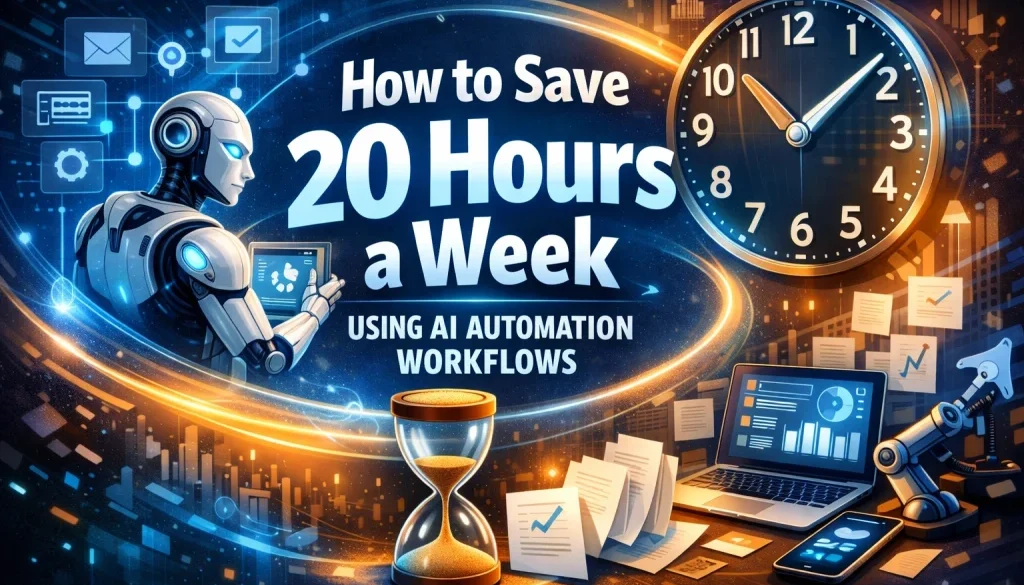
How to Save 20 Hours a Week Using AI Automation Workflows
Operational Overview: AI Automation and Time Reclamation
Current enterprise data indicates that Small and Medium Businesses (SMBs) lose approximately 20 to 30 hours per week per employee on repetitive administrative tasks. The implementation of AI automation workflows facilitates the reclamation of this time. These workflows utilize Large Language Models (LLMs) and orchestration tools to execute high-frequency operations without human intervention.
The primary objective of AI agents for business is the autonomous handling of data processing, communication, and scheduling. By utilizing open-source platforms like n8n and integrated LLM APIs, businesses establish a digital workforce capable of 24/7 operation.
Analysis of Time Deficit
Manual task execution follows a linear progression. Inefficiency is identified in the following sectors:
- Email Management: 4.5 hours/week average.
- Customer Inquiry Sorting: 6 hours/week average.
- Data Entry and Syncing: 5 hours/week average.
- Meeting Synthesis: 3 hours/week average.
- Content Creation: 5 hours/week average.
Total estimated manual load: 23.5 hours.
Target state after automation: 3.5 hours.
Net gain: 20 hours.

Core Infrastructure: AI Agents for Business
AI agents for business function as autonomous units designed to complete specific objectives within a workflow. Unlike traditional software, these agents possess reasoning capabilities provided by models such as GPT-4o or Claude 3.5 Sonnet.
Architectural Requirements
- Orchestration Layer: n8n or Zapier.
- Intelligence Layer: LLM API (OpenAI, Anthropic, or self-hosted Llama 3).
- Data Layer: CRM (HubSpot, Salesforce), Google Sheets, or SQL databases.
- Trigger Layer: Webhooks, Email IMAP, or Cron schedules.
For organizations requiring data sovereignty, self-hosting LLMs ensures that proprietary information remains within local infrastructure.
Protocol 1: Automated Email Triage and Response Drafting
Manual email processing is identified as a primary time sink. An AI-driven email workflow executes the following logic:
Execution Logic
- Trigger: New email received in Inbox.
- Action 1: Forward email content to LLM.
- Action 2: Categorize email based on intent (Sales, Support, Billing, Spam).
- Action 3: Query CRM for sender history and current deal status.
- Action 4: Draft a contextually accurate response.
- Action 5: Place draft in the "Drafts" folder for human approval or send automatically if confidence score exceeds 0.95.
This system reduces time spent per email from 5 minutes to 30 seconds (review time). Integrated AI automations facilitate this process across diverse departments.
Protocol 2: Intelligent Lead Qualification and Routing
Sales operations often stall during the initial qualification phase. AI agents automate the assessment of inbound leads.
Workflow Specification
- Form Submission: Triggered by a website inquiry.
- Data Enrichment: The agent scrapes the lead's website and LinkedIn profile.
- Scoring: The agent compares lead data against Ideal Customer Profile (ICP) parameters.
- Action: High-priority leads are routed to an Account Executive via Slack with a summary report. Low-priority leads are entered into a nurturing sequence.
Implementation of custom software solutions allows for the creation of proprietary scoring algorithms unique to the business model.

Protocol 3: Autonomous Customer Support and Ticketing
Customer support workflows benefit from immediate response times. AI agents for business handle the First Level (L1) support tier.
System Parameters
- Input: Customer ticket or chat message.
- Retrieval: The agent accesses a Vector Database containing all product documentation and previous resolution logs.
- Generation: A precise answer is formulated using Retrieval-Augmented Generation (RAG).
- Escalation: If the query requires human intervention, the agent summarizes the context and assigns it to a human representative.
For SMBs, this reduces ticket resolution time by approximately 70%. Detailed insights on the financial impact are available via the AI automation ROI calculator.
Protocol 4: Meeting Synthesis and Action Item Extraction
Meetings generate large volumes of unstructured audio data. Automating the extraction of value from these recordings saves 2-4 hours weekly.
Automation Sequence
- Step 1: Record meeting via digital conferencing tool.
- Step 2: Transcribe audio to text.
- Step 3: AI Agent identifies key decisions, assigned tasks, and deadlines.
- Step 4: Automatic distribution of meeting minutes to participants via email or Slack.
- Step 5: Integration of tasks into project management tools (Jira, Asana, Trello).
This ensures zero loss of information and removes the administrative burden of manual note-taking.
Deployment Strategy: Utilizing n8n for Custom Workflows
The selection of an automation tool is critical for scalability. n8n is recommended for its "fair-code" model, allowing for open source deployment.
Benefits of n8n in AI Workflows
- Node-Based Visualization: Simplifies complex logic mapping.
- Data Privacy: Can be hosted on-premise to meet compliance standards.
- Cost Efficiency: No per-task execution fees, unlike Zapier.
- Advanced Logic: Supports JavaScript for complex data transformations.
Organizations seeking to implement these systems often utilize AI development services to ensure robust architecture and security.

Quantitative Impact Analysis
The following table represents the projected weekly time savings for a standard 10-person SMB department.
| Task Category | Manual Time (Hours) | Automated Time (Hours) | Weekly Savings (Hours) |
|---|---|---|---|
| Email Sorting | 45 | 5 | 40 |
| Lead Qualification | 30 | 3 | 27 |
| Support L1 | 60 | 10 | 50 |
| Content Prep | 25 | 4 | 21 |
| Total | 160 | 22 | 138 |
On an individual basis, this equates to approximately 13.8 hours saved. When including ad-hoc data entry and reporting, the figure reaches the 20-hour threshold.
Strategic Integration of AI Agents
To achieve a 20-hour reduction, the integration of AI agents must be holistic. Disconnected automations result in "automation silos" which require manual bridging.
- Unified Data Source: Ensure all agents read from and write to a centralized source of truth.
- Error Handling: Implement "Dead Letter Queues" where agents alert humans when confidence scores are low.
- Iterative Refinement: Regularly update LLM prompts based on performance feedback.
The transition to an AI-first operational model is a prerequisite for competitiveness in the 2026 market. Information regarding regional implementation costs and strategies can be found in our guide on custom software India vs USA cost.
Final System Status
- Status: Optimization feasible.
- Requirement: Integration of AI agents for business.
- Tooling: n8n, LLM APIs, and custom logic.
- Outcome: 20 hours per week reclaimed for high-value strategic objectives.

Detailed technical specifications and solution architectures are available through Marketrun's professional services. Exploratory consultations regarding AI automations assist in identifying specific high-ROI targets within organizational structures.