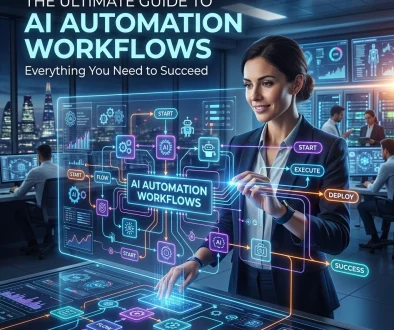
How to Build AI Automation Workflows That Save Your Team 20 Hours a Week
Identification of Operational Inefficiency
Manual processing of repetitive tasks represents a significant drain on small and medium-sized business (SMB) resources. Operational drag occurs when human personnel perform high-frequency, low-complexity actions. The implementation of ai automation workflows addresses these inefficiencies by shifting the burden of data movement and preliminary decision-making to autonomous systems.
The current standard for operational efficiency in 2026 requires the transition from static automation: simple triggers and actions: to intelligent orchestration. This involves the deployment of ai agents for business that utilize Large Language Models (LLMs) to interpret context, categorize data, and execute multi-step logic.
Quantifying Automation ROI
Prioritization of automation targets is conducted through quantitative analysis of time allocation. The following formula determines the viability of a workflow for automation:
Weekly Time Saved = (Minutes per Task × Frequency per Week) / 60
Tasks suitable for automation typically consume 5 to 30 minutes and occur multiple times per week. Common examples include email triaging, lead qualification, and data entry. When aggregated, the automation of four to five such processes frequently results in a reduction of 20 labor hours per week.
Based on an average labor cost of $50 per hour, a 20-hour reduction generates a direct cost avoidance of $1,000 weekly. Over a fiscal year, this total reaches $48,000 in recovered productivity. Organizations can evaluate specific savings using tools such as the AI Automation ROI Calculator.

Architecture of Modern AI Automation Workflows
Efficient workflows require an orchestration layer to connect disparate software systems. n8n serves as a primary tool for this purpose, providing a visual interface for complex logic and integration.
The Orchestration Layer: n8n
n8n facilitates the connection between triggers (e.g., a new email, a form submission) and actions (e.g., updating a CRM, sending a Slack notification). Unlike linear automation tools, n8n allows for conditional branching and loops, which are essential for handling business exceptions.
The Intelligence Layer: AI Agents
Ai agents for business function as the cognitive component within the workflow. By integrating LLM APIs (such as Claude or GPT-4) into n8n nodes, the system can perform the following:
- Semantic Analysis: Understanding the intent of a customer inquiry.
- Data Extraction: Identifying names, dates, and amounts from unstructured text.
- Synthesis: Summarizing long documents or meeting transcripts into actionable items.
For organizations with high security requirements, self-hosting LLMs ensures that data remains within the corporate perimeter while maintaining agent functionality.
Workflow 1: Autonomous Email Triage and Response
The management of high-volume inboxes is a primary source of time loss. A standard ai automation workflow for email involves:
- Trigger: Receipt of a new message in a monitored IMAP or Gmail account.
- Classification: An AI agent analyzes the message content to determine the category (e.g., Sales, Support, Billing, Spam) and priority.
- Action:
- Spam: Automatic archiving.
- Support: Search of internal documentation for relevant answers and drafting a response.
- Sales: Extraction of lead data and insertion into the CRM.
- Notification: The drafted response and classification are sent to a human operator for final approval or routed directly to the relevant department via Slack.
This system reduces the necessity for manual inbox monitoring and ensures that urgent inquiries are prioritized.

Workflow 2: Automated Lead Qualification and Scoring
Manual review of every inbound lead is inefficient. AI agents for business can automate the qualification process to ensure sales teams focus on high-probability opportunities.
The workflow structure includes:
- Data Collection: Capture of form data from AI-integrated websites.
- Enrichment: Use of external APIs to gather company size, industry, and funding data.
- Evaluation: An AI agent compares the lead profile against the Ideal Customer Profile (ICP).
- Scoring: Allocation of a numerical value based on budget, authority, need, and timeline (BANT).
- Routing: High-scoring leads trigger immediate alerts. Low-scoring leads are added to automated nurture sequences.
Implementation of this workflow frequently saves 2 to 4 hours weekly for sales managers. For specialized requirements, custom software development can provide deeper integration with legacy CRM systems.

Workflow 3: Document Processing and Data Extraction
SMBs often handle high volumes of invoices, receipts, and contracts. Manual data entry from these documents is prone to error and time-intensive.
The automation process follows these steps:
- Ingestion: Receipt of PDFs or images via email or cloud storage (Google Drive, Dropbox).
- OCR and Extraction: AI agents utilize Vision-capable models to read the document and extract specific fields (Invoice Number, Date, Total, Line Items).
- Validation: The system checks the extracted data against existing purchase orders or database records.
- Integration: Validated data is automatically pushed to accounting software or a centralized database.
This specific application of AI automations eliminates the need for manual data entry, saving approximately 3 to 5 hours per week.
Workflow 4: Content Repurposing Pipeline
Content marketing requires the creation of multiple assets for different platforms. A single long-form piece of content can be transformed into multiple micro-assets through an automated pipeline.
The technical flow involves:
- Source Input: Upload of a blog post, podcast transcript, or video script.
- Transformation: An AI agent generates 10–15 unique pieces of content, including LinkedIn posts, Twitter threads, email newsletters, and executive summaries.
- Formatting: Application of specific platform formatting rules.
- Scheduling: Distribution of drafts to a social media management tool for review and scheduling.
This workflow reduces the time required for content distribution by 4 to 6 hours per week, allowing for a higher volume of output without increased headcount.

Deployment and Security Considerations
Successful deployment of ai automation workflows requires consideration of data privacy and system reliability. Organizations must choose between cloud-based services and open-source deployment models.
Data Privacy
Processing sensitive client information requires encryption and secure API handling. SMBs operating in regulated industries (Healthcare, Finance) should prioritize solutions that allow for local data processing or enterprise-grade cloud security.
System Monitoring
Automated workflows require periodic monitoring to ensure accuracy. "Human-in-the-loop" configurations, where an AI agent drafts an action but a human provides final authorization, are recommended for critical business processes.
Technical Support and Scalability
The transition to an AI-automated environment is an iterative process. Initial deployments should focus on the highest-impact tasks identified in the ROI analysis. As internal systems become more integrated, the complexity and scope of the ai agents for business can expand.
Marketrun provides specialized services for companies seeking to implement these systems, ranging from mobile and web applications to full-scale AI development. For international operations, specific guides are available for US-based clients and India-based clients.
Summary of Time Savings
The cumulative impact of the discussed workflows is outlined in the table below:
| Workflow Type | Estimated Weekly Savings (Hours) |
|---|---|
| Email Triage | 3 – 5 |
| Lead Qualification | 2 – 4 |
| Document Processing | 3 – 5 |
| Content Repurposing | 4 – 6 |
| Meeting Summaries | 2 – 4 |
| Total Potential Savings | 14 – 24 Hours |
The reclamation of 20 hours per week allows for the reallocation of human talent toward strategic growth and complex problem-solving. Organizations seeking to begin this transition can explore further resources on the Marketrun blog.