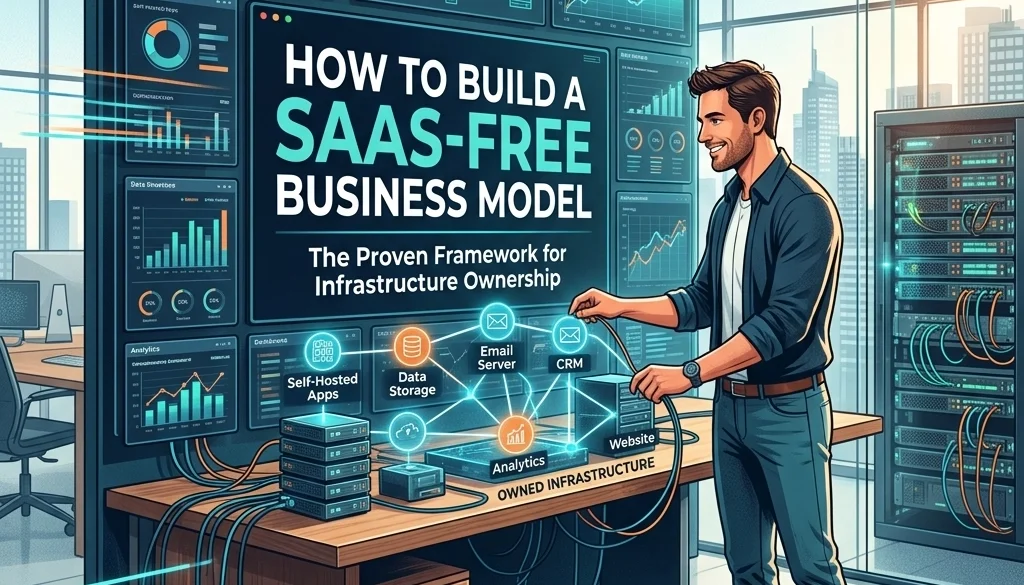
How to Build a SaaS-Free Business Model: The Proven Framework for Infrastructure Ownership
Infrastructure Ownership Overview
Current business operations rely on Software as a Service (SaaS) subscriptions. This model results in recurring monthly expenditures, data silos, and vendor dependency. The transition to a SaaS-free model involves migrating functional requirements to self-hosted infrastructure. This framework outlines the identification, deployment, and management of open source saas alternatives.
Economic Impact of SaaS Proliferation
Standard enterprise operations utilize between 20 and 100 distinct SaaS applications. Cumulative costs increase linearly with user count. Data indicates that subscription fees represent a significant portion of operational expenditure. Infrastructure ownership shifts costs from recurring operational expenditure (OPEX) to controlled capital or fixed infrastructure expenditure.
Cost Comparison Metrics
| Category | SaaS Model (Monthly) | Self-Hosted Model (Monthly) |
|---|---|---|
| CRM | $150 – $500 | $10 – $40 (VPS) |
| Communication | $10 – $20 per user | $20 – $50 (Total) |
| Project Management | $10 – $30 per user | Included in server cost |
| Data Storage | $0.10 – $0.20 per GB | $0.01 – $0.05 per GB |
Information regarding budget allocation for custom infrastructure is available at https://marketrun.io/pricing.
Infrastructure Selection: VPS Setup and Management
The foundation of a SaaS-free model is the Virtual Private Server (VPS). Unlike shared hosting, a VPS provides dedicated resources and root access.
Hardware Specification Requirements
- CPU: Minimum 2 cores for basic applications; 8+ cores for AI-integrated tasks.
- RAM: 4GB for base OS and minor tools; 16GB+ for containerized environments.
- Storage: NVMe SSD is required for database performance.
- Network: 1Gbps uplink for external-facing services.
VPS Setup and Management Protocols
Deployment follows a standardized sequence. The operating system, typically a Linux distribution (Ubuntu LTS or Debian), is installed. Security hardening is the primary objective. This includes:
- Disabling root login.
- Configuring SSH keys.
- Implementing Firewall (UFW/IPTABLES).
- Setting up automated security updates.

Open Source SaaS Alternatives: Functional Replacement
Functional requirements are met through the deployment of specific open source software. These tools replace the utility of major SaaS providers.
Customer Relationship Management (CRM)
Proprietary CRMs are replaced by platforms such as SuiteCRM or ERPNext. These systems handle lead management, sales pipelines, and customer data without per-user licensing fees. Details on integration are found at https://marketrun.io/solutions/custom-software.
Internal Communication
Slack or Microsoft Teams alternatives include Mattermost or Rocket.Chat. These applications provide encrypted messaging and file sharing within the owned infrastructure.
Productivity and Collaboration
Google Workspace or Microsoft 365 functionalities are replicated via Nextcloud. Nextcloud provides file storage, calendar synchronization, and document editing.
Technical Framework: Containerization and Orchestration
Efficient management of multiple self-hosted services requires containerization. Docker and Docker Compose allow for isolated environments.
Deployment Process
- Service Definition: Each application is defined in a YAML file.
- Reverse Proxy: Nginx Proxy Manager or Traefik manages SSL certificates (Let's Encrypt) and routes traffic to containers.
- Data Persistence: External volumes are mapped to ensure data remains during container updates.
- Monitoring: Netdata or Prometheus/Grafana provide real-time resource utilization statistics.
Implementation of complex architectures is documented at https://marketrun.io/solutions/open-source-deployment.
Security and Redundancy Protocols
Infrastructure ownership necessitates internal management of security.
Backup Strategy
The 3-2-1 backup rule is applied:
- 3 copies of data.
- 2 different media types.
- 1 off-site location.
Tools like Restic or BorgBackup automate encrypted backups to S3-compatible storage.
Security Monitoring
Intrusion detection systems (IDS) and log analysis tools (Fail2Ban) monitor for unauthorized access attempts. Regular updates to container images are mandatory to patch vulnerabilities.

Scaling the Model: Advanced Infrastructure
As operational requirements expand, the infrastructure must scale.
Load Balancing
Traffic is distributed across multiple VPS instances to maintain availability. High availability (HA) configurations ensure service continuity in the event of hardware failure.
Custom Software Development
Standard open source tools may require modification to meet specific business logic. Development of bespoke modules ensures the infrastructure aligns with operational workflows. Information on custom application development is available at https://marketrun.io/solutions/mobile-web-apps.
Integration of AI and Local LLMs
The SaaS-free model extends to Artificial Intelligence. Subscription-based AI models (OpenAI, Anthropic) present data privacy risks and recurring costs.
Self-Hosting LLMs
Local Large Language Models (LLMs) are deployed on owned hardware. This ensures data remains within the private network.
- Hardware: GPU acceleration (NVIDIA A100/H100 or consumer RTX 4090) is required for inference.
- Software: Ollama, LocalAI, or vLLM serve as the backend for internal AI tools.
Frameworks for deploying private AI models are detailed at https://marketrun.io/self-hosting-llms and further explored in the guide https://marketrun.io/blog/self-hosting-llms-2026-guide.

Comparison of Regional Implementation
Infrastructure costs vary based on geographic location and provider availability.
US-Based Infrastructure
US providers offer low latency for North American users. High-tier data centers are standard. Costs are consistent with global averages. Guidance for US entities is located at https://marketrun.io/for-us-clients.
India-Based Infrastructure
India provides cost-effective labor for infrastructure management and maintenance. Regional data centers reduce latency for Asian markets. Guidance for Indian entities is located at https://marketrun.io/for-india-clients. A cost analysis between these regions is provided at https://marketrun.io/blog/custom-software-india-vs-usa-cost-2026.
Management Framework for Automation
Manual intervention in infrastructure management is minimized through automation.
AI Agents and Workflow Automation
Automation scripts and AI agents perform repetitive tasks such as log rotation, user provisioning, and system health checks.
- Tooling: n8n or Node-RED (Self-hosted) are used instead of Zapier.
- Optimization: AI agents optimize resource allocation based on predicted load.
Resources for AI-driven automation are available at https://marketrun.io/solutions/ai-automations and https://marketrun.io/blog/ai-agents-automations-guide-2026.

Implementation Timeline
- Week 1-2: Inventory of existing SaaS subscriptions and data mapping.
- Week 3-4: VPS setup and management protocol establishment.
- Week 5-8: Migration of core services (Communication, File Storage).
- Week 9-12: Migration of complex services (CRM, ERP, AI Models).
- Ongoing: Security monitoring and system optimization.
Conclusion of Ownership Framework
Transitioning to a SaaS-free business model requires initial technical investment but results in long-term fiscal reduction and data sovereignty. Infrastructure ownership provides the foundation for scalable, secure, and independent business operations.
Further information on the ROI of this transition can be evaluated using the https://marketrun.io/blog/ai-automation-roi-calculator. For specialized deployment services, visit https://marketrun.io/solutions.