How to Automate Business Operations with AI and Sync Your Entire Tech Stack
Operational Automation Overview
Business operations require the execution of repetitive tasks across multiple digital environments. Modern infrastructure utilizes artificial intelligence to facilitate the transition from manual input to autonomous execution. To automate business operations with ai, a technical framework is established to connect disparate software systems. This process ensures data consistency and operational speed.
The integration of AI into end-to-end business processes allows for the orchestration of multiple systems and automation tools. This methodology combines various AI capabilities to manage both routine and complex workflows. Organizations utilize these systems to maintain competitive functionality in a digital economy. Documentation of these processes is essential for system maintenance and scalability.
Foundational AI Technologies for Workflow Integration
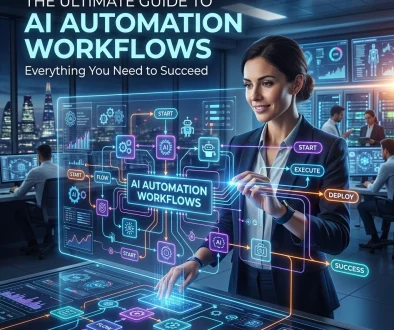
The deployment of ai automation workflows depends on several core technologies. Each technology serves a specific function within the broader tech stack.
Machine Learning Algorithms
Machine learning algorithms process historical data sets. The objective is the identification of patterns and the prediction of outcomes. These algorithms support automated decision-making processes. Data analysis occurs without explicit programming for every scenario. Predictive models are utilized to forecast demand and optimize resource allocation.
Natural Language Processing (NLP)
NLP enables the interaction between human language and computer systems. It is utilized in the deployment of chatbots and the automation of email communications. NLP systems extract information from unstructured text and facilitate automated responses. This technology is a primary component of automated customer service modules.
Robotic Process Automation (RPA)
RPA systems execute rule-based tasks. These tasks include data entry, form processing, and file management. RPA operates as a digital workforce, performing actions previously requiring manual human intervention. When combined with AI, RPA handles semi-structured data and adapts to changes in user interfaces.
IoT and Big Data Analytics
Internet of Things (IoT) devices monitor physical assets and generate real-time data. Big data analytics platforms process these high-volume data streams. The resulting insights inform automated control systems. This integration is critical for manufacturing and logistics operations.

Tech Stack Synchronization Protocols
Syncing a tech stack involves the creation of a unified data environment. Disparate systems must communicate through standardized protocols to ensure functional automation.
API Integration and Middleware
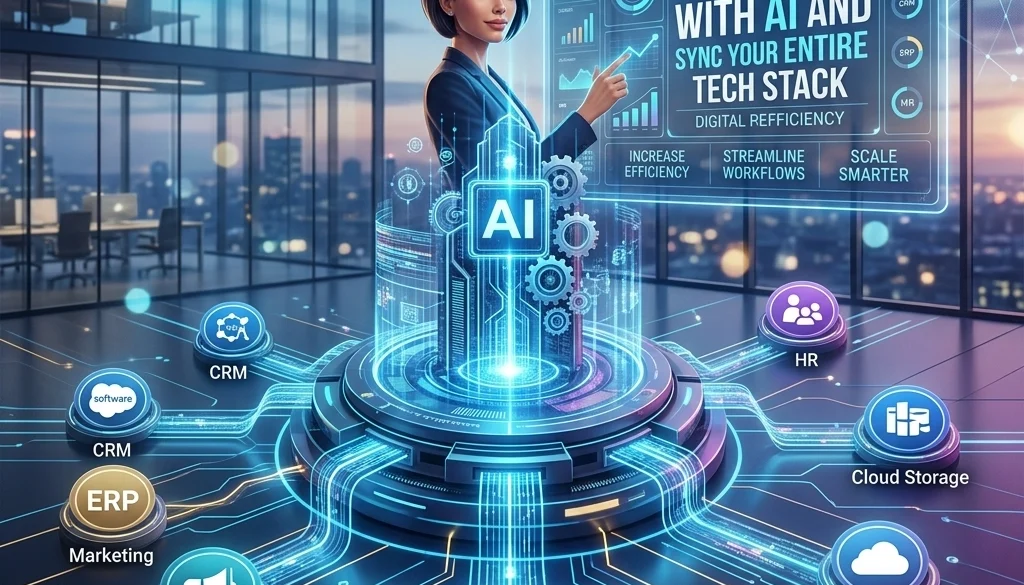
Application Programming Interfaces (APIs) serve as the primary conduits for data exchange between software applications. Middleware solutions act as intermediaries, translating data formats and managing communication between incompatible systems. This layer is necessary for the synchronization of CRM, ERP, and marketing automation tools.
Unified Platforms
Unified platforms aggregate data from various sources into a single interface. These platforms support real-time data synchronization. Automated mapping of data fields occurs between systems. This prevents data silos and ensures that AI models have access to current information. For organizations seeking specialized development, Marketrun Custom Software provides the necessary architecture for these integrations.
Data Aggregation for Machine Learning
Automation generates large volumes of operational data. This data is aggregated and stored in centralized repositories. These repositories provide the training data required to refine machine learning models. High-quality data feeds are essential for the accuracy of automated predictions and actions. Organizations often utilize Self-Hosting LLMs to maintain data privacy while processing these aggregates.
Departmental Automation Matrices
Automation is applied across specific business functions to achieve targeted efficiency gains.
Customer Service and Support
AI-driven chatbots handle 24/7 inquiry resolution. Virtual assistants process common requests, reducing the load on human personnel. Tickets are automatically categorized and routed based on content analysis. This reduces response latency and improves resolution rates. Information on these implementations can be found at Marketrun AI Automations.
Finance and Accounting
Automated systems process invoices and track expenses. Payroll cycles are executed based on pre-defined schedules and integrated time-tracking data. Financial reporting is generated through the automated aggregation of ledger data. AI identifies anomalies in transactions to prevent fraud and ensure compliance.
Supply Chain and Logistics
AI predicts demand trends based on market variables. Inventory levels are monitored and replenished automatically when thresholds are met. Routing algorithms optimize delivery paths to reduce fuel consumption and transit time. Real-time tracking provides visibility into the movement of goods across the supply chain.
Human Resources and Workforce Operations
Onboarding processes are streamlined through automated document verification and account provisioning. Benefits administration and compliance tracking are managed by system-driven triggers. AI tools analyze recruitment data to identify candidates matching specific job descriptions. Detailed guides on these agents are available at AI Agents Automations Guide 2026.

Advanced AI Automation Workflows
Advanced workflows involve multi-step processes where AI makes autonomous decisions based on environmental inputs.
- Trigger Event: A system detects an input, such as a customer email or a drop in inventory.
- Data Extraction: NLP or computer vision identifies key variables within the input.
- Contextual Analysis: AI evaluates the data against historical records and business rules.
- Action Execution: The system performs a task, such as generating an invoice or updating a database.
- Verification and Logging: The outcome is verified for accuracy and recorded in the system log.
These workflows eliminate bottlenecks associated with human review cycles. They enable the scaling of operations without a linear increase in headcount. For businesses operating internationally, the choice between development regions is a factor in cost-efficiency, as discussed in Custom Software India vs USA Cost 2026.
Implementation Methodology
The transition to an automated operational state follows a structured protocol.
Identification of Automation Candidates
Repetitive and time-consuming tasks are evaluated. High-volume processes with low complexity are prioritized. Data-driven tasks where accuracy is critical are identified as primary candidates for AI integration.
System Mapping and Integration
The existing tech stack is mapped to identify data flow requirements. Integration platforms are selected to connect these systems. Security protocols are established to protect data during transit. Organizations may explore Marketrun Solutions for tailored integration strategies.
Development and Deployment
AI models are developed or integrated into the workflow. Testing occurs in isolated environments to ensure logic accuracy. Deployment is executed in phases to minimize operational disruption. Continuous monitoring is implemented to track system performance.
Optimization and Scaling
Feedback loops are established to refine AI models. As processes stabilize, automation is expanded to more complex workflows. Scalability is achieved through cloud computing and modular software design.

Expected Benefits and ROI
The application of AI to business operations results in measurable performance improvements.
- Productivity Increase: Worker productivity is observed to increase by approximately 40% following successful automation deployment.
- Cost Reduction: Operational costs are reduced through the elimination of manual errors and the optimization of resource usage.
- Growth Acceleration: Organizations utilizing AI automation report 25% greater growth compared to those using standard automation.
- Decision Accuracy: Data-driven insights provide a factual basis for strategic planning.
The return on investment (ROI) is calculated based on time saved, error reduction, and increased output capacity. For a detailed analysis, the AI Automation ROI Calculator provides quantitative projections.
Technical Maintenance and Evolution
Automated systems require ongoing maintenance to ensure functional integrity. API updates from third-party vendors must be monitored. AI models require periodic retraining with new data to prevent performance degradation. Security patches are applied to prevent unauthorized access to the automated infrastructure.
Organizations maintain a technical roadmap to incorporate emerging AI technologies. This ensures that the tech stack remains compatible with new standards in automation and data processing. For those utilizing open-source tools, Open Source Deployment offers a pathway for sustainable system evolution.

Geographic and Platform Considerations
Operational requirements vary by region and platform. Infrastructure for US Clients may focus on specific regulatory compliance, while India Clients may prioritize scalable growth frameworks. Furthermore, automation solutions must be compatible with existing operating systems, such as Windows Software, to ensure seamless synchronization across the entire corporate tech stack.
The process of syncing a tech stack with AI is a continuous operation. It necessitates a disciplined approach to data management and system architecture. Successful implementation results in a resilient, efficient, and scalable business infrastructure.