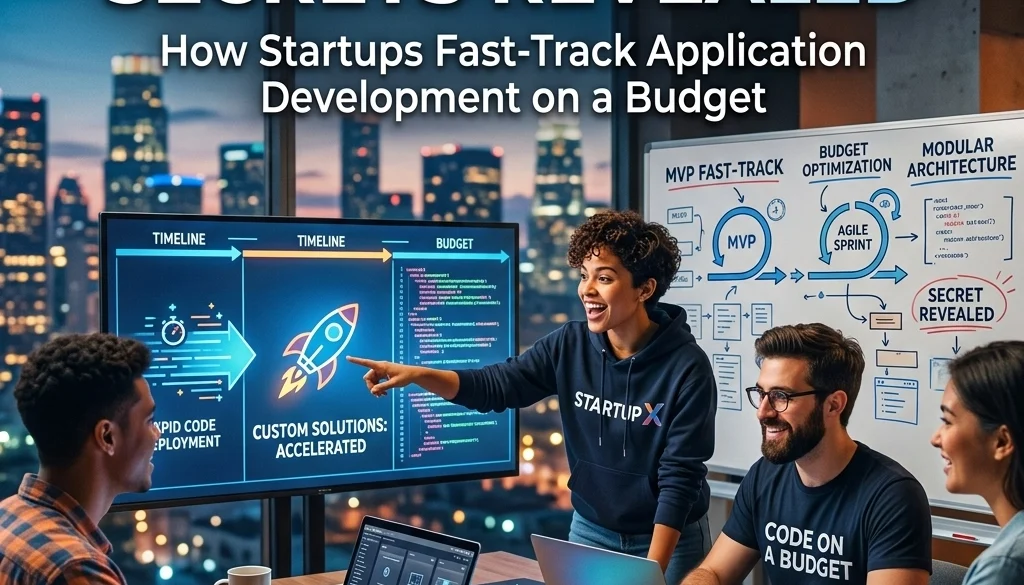
Custom Software Secrets Revealed: How Startups Fast-Track Application Development on a Budget
Technical Foundation and Strategic Discovery
Startup operations require specialized digital infrastructure to achieve competitive differentiation. The transition from conceptual ideation to production-ready software is governed by specific fiscal and technical constraints. Implementation of custom software necessitates a structured discovery phase.
Statistical data indicates that 5% to 10% of total project expenditure should be allocated to preliminary planning. This phase encompasses requirements gathering, technical feasibility analysis, and the generation of a Software Requirements Specification (SRS) document. The SRS serves as the foundational technical contract between stakeholders and development entities. Incomplete requirement definitions correlate with scope creep and technical debt accumulation.
Components of the Discovery Phase:
- Functional Requirements: Identification of necessary system operations and user interactions.
- Non-Functional Requirements: Specification of performance benchmarks, security protocols, and scalability parameters.
- Market Alignment: Verification of technical features against existing market demands.
Precision in the initial documentation phase minimizes rework requirements. Systematic planning ensures that application development remains aligned with initial budgetary projections.

Minimum Viable Product (MVP) Architecture
Resource optimization in startup environments is achieved through the prioritization of core functionality. The Minimum Viable Product (MVP) model focuses on the deployment of essential features required for operational viability.
Non-essential features are deferred to subsequent development cycles. This hierarchical approach to feature deployment reduces the initial capital requirement and accelerates time-to-market. Data suggests that development activities constitute approximately 65% of the initial budget; therefore, limiting scope to critical capabilities is a primary cost-control mechanism.
MVP Prioritization Logic:
- Core Value Proposition: Identification of features that solve the primary user problem.
- User Interface (UI) Essentials: Implementation of functional design elements over aesthetic complexity.
- Primary Data Workflows: Execution of critical data processing paths.
Strategic focus on website development for the MVP allows for rapid user feedback collection. This data informs future iterations, preventing expenditure on features that do not meet user requirements.
Agile Development Methodologies
Iterative development processes facilitate flexibility in response to evolving market conditions. Agile methodologies utilize time-boxed intervals known as sprints. Each sprint results in a functional increment of the software product.
System Benefits of Agile:
- Risk Mitigation: Frequent testing and review cycles identify technical errors early in the lifecycle.
- Cost Transparency: Resource utilization is tracked on a per-sprint basis.
- Adaptive Planning: Project direction is adjusted based on real-time performance data rather than static long-term predictions.
Agile frameworks allow for continuous integration and continuous deployment (CI/CD) of software updates. This systematic approach ensures that application development maintains high velocity without compromising code integrity.

Infrastructure and Hosting Strategies
Infrastructure selection impacts both initial capital expenditure and long-term operational costs. Modern software deployment utilizes cloud-based environments to eliminate the requirement for physical hardware management.
Cloud Service Models:
- Infrastructure as a Service (IaaS): Provisioning of virtualized computing resources via platforms such as AWS, Azure, or Google Cloud.
- Platform as a Service (PaaS): Utilization of managed environments for application execution.
- Usage-Based Pricing: Operational costs are scaled in direct proportion to resource consumption.
For specific workloads, self-hosting LLMs or utilizing open-source deployment strategies can reduce recurring licensing fees. These decisions are dictated by the specific security and performance requirements of the startup entity.
Sourcing and Human Capital Allocation
The selection of development partners influences the fiscal trajectory of the project. Startups evaluate internal hiring against external procurement of technical services.
Geographic Cost Variance:
- Onshore Development: High labor costs associated with local expertise.
- Offshore Development: Reduced labor costs through global talent acquisition.
- Hybrid Models: Integration of local management with offshore execution units.
Comparative analysis of custom software development costs in India versus the USA reveals significant arbitrage opportunities for startups. Strategic outsourcing to established partners like Marketrun provides access to specialized technical stacks without the overhead of permanent full-time internal teams.

Integration of Artificial Intelligence and Automation
Contemporary website development and software engineering incorporate AI to enhance functionality. Automating routine processes within the application reduces the manual labor required by the end-user.
Automation Implementation Areas:
- Data Entry and Processing: Elimination of manual data input through automated parsers.
- Customer Support: Integration of AI agents for tier-1 query resolution.
- Predictive Analytics: Utilization of machine learning models for trend forecasting.
The implementation of AI and automations increases the initial development complexity but yields long-term operational efficiency. Marketrun specializes in the deployment of these advanced technical components.
Quality Assurance and Testing Protocols
Software stability is maintained through rigorous quality assurance (QA) protocols. Failure to implement comprehensive testing leads to increased maintenance costs post-launch.
Standard Testing Procedures:
- Unit Testing: Validation of individual code modules.
- Integration Testing: Verification of interaction between disparate system components.
- User Acceptance Testing (UAT): Confirmation that the software meets specified business requirements.
- Security Auditing: Identification of vulnerabilities within the codebase.
Automated testing frameworks are utilized to perform repetitive validation tasks, ensuring that new code deployments do not introduce regressions into the system.

Quantifying Return on Investment (ROI)
Investment in custom software is justified through measurable financial returns. Startups must establish Key Performance Indicators (KPIs) to track the efficacy of the software solution.
ROI Metrics:
- Efficiency Gains: Reduction in labor hours required for specific tasks.
- Revenue Generation: Direct income attributed to the software platform.
- Cost Avoidance: Elimination of third-party software licensing fees through custom alternatives.
Example: A custom automation solution that reduces manual processing by 20 hours per week at an average labor rate of $30/hour results in an annual savings of $31,200. These metrics are utilized to calculate the payback period for the initial pricing of the development project.
Maintenance and Scalability
Post-production activities include software maintenance and infrastructure scaling. Systems must be architected to handle increased user loads without performance degradation.
Scalability Considerations:
- Vertical Scaling: Increasing the capacity of existing server resources.
- Horizontal Scaling: Adding more server instances to distribute the load.
- Database Optimization: Refining query performance to support larger datasets.
Marketrun provides ongoing support structures to ensure that application development projects remain operational and performant as the startup scales. This includes regular security patches and feature updates based on market feedback.
Strategic Execution Framework
Successful software deployment for startups is the result of disciplined execution. The process follows a non-linear but highly structured pathway:
- Phase 01: Audit. Assessment of current technical state and requirements.
- Phase 02: Architecture. Design of the system schema and database structure.
- Phase 03: Iteration. Development of the MVP through agile sprints.
- Phase 04: Validation. Execution of QA protocols and user testing.
- Phase 05: Deployment. Launch into production environments.
For further information on specific implementation strategies, the Marketrun blog provides technical guides on AI website SEO and offshore development.

Summary of Operational Efficiency
Startups achieve budget-conscious development through:
- Strict requirement documentation.
- MVP-first strategies.
- Agile methodologies.
- Strategic infrastructure selection.
- Data-driven ROI analysis.
Marketrun facilitates these processes by providing AI and custom software development services tailored to the specific needs of emerging enterprises. Access to high-level technical expertise allows startups to compete with established entities through superior digital tooling.