Are Traditional Dev Cycles Dead? How AI Agents Are Redefining Business Operations
Status Report: Traditional Development Lifecycle (SDLC)
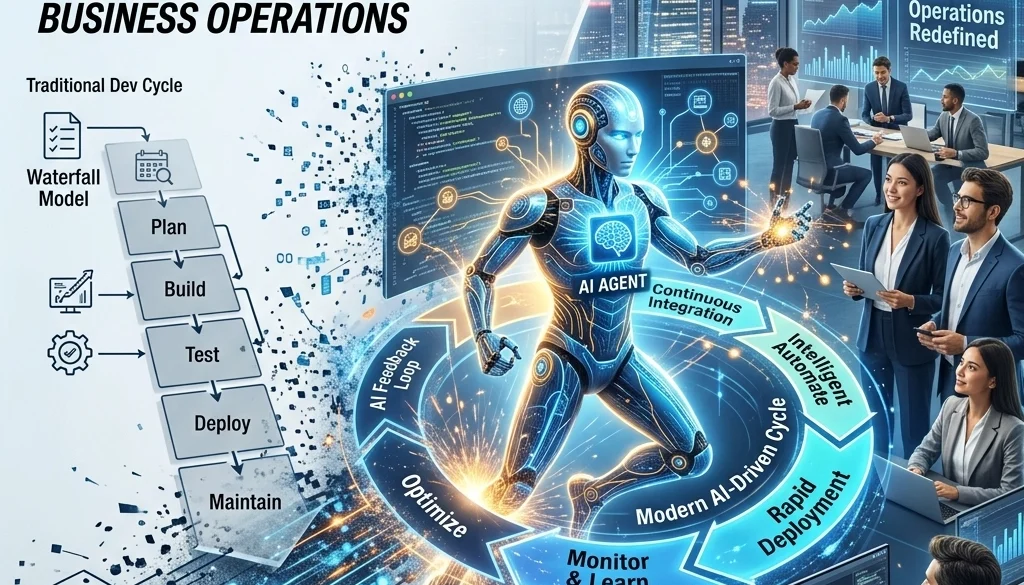
The traditional Software Development Life Cycle (SDLC) is undergoing a structural transition. The sequential progression from requirements gathering to maintenance is replaced by non-linear, automated processes.
Historical Framework
The standard model consisted of six discrete phases:
- Requirements Analysis
- System Design
- Implementation (Coding)
- Testing
- Deployment
- Maintenance
Current Deviation
AI agents now execute multiple phases simultaneously. The separation between design, code, and testing is removed. Real-time iteration replaces quarterly or monthly release cycles.
AI Agents for Business: Operational Transformation
AI agents operate as autonomous software entities. They execute tasks, make logic-based decisions, and interface with existing software stacks without human intervention.
Integration Metrics
Businesses utilizing ai agents for business report shifts in resource allocation:
- Human Input: Focused on intent definition and final verification.
- Agent Output: Code generation, documentation, and unit testing.
- Latency: Reduction in time-to-market by approximately 60-80% compared to 2024 standards.

Functional Autonomy
Agents are no longer restricted to simple automation. Current capabilities include:
- Self-Correction: Identifying and fixing bugs during the build phase.
- API Integration: Dynamic connection to third-party services via marketrun.io/solutions/ai-automations.
- Environment Management: Automated provisioning of cloud resources.
The New Workflow: Intent-Build-Observe-Repeat
The linear waterfall and agile methodologies are transitioning into a tighter loop: Intent-Build-Observe-Repeat.
Phase 1: Intent Definition
The user provides a high-level objective. Requirements are not documented in static PDF files but are maintained as dynamic prompts.
Phase 2: Build and Concurrent Testing
The agent generates the codebase. Testing is integrated into the generation process. If a test fails, the agent self-refines until the criteria are met. This occurs in seconds rather than days.
Phase 3: Observe and Deploy
Deployment is automated. Monitoring tools feed performance data back to the agent.
Phase 4: Repeat
The agent updates the software based on observation data or new intent.
Custom AI Solutions for SMBs: Accessibility and Cost
Small and Medium Businesses (SMBs) previously lacked the capital for large-scale custom software. The introduction of custom ai solutions for smbs has neutralized the entry barrier.
Cost Reduction Factors
- Reduced Headcount: Maintenance requires fewer engineers.
- Open Source Implementation: Utilizing models available at marketrun.io/solutions/open-source-deployment reduces licensing fees.
- Speed: Faster cycles result in lower total project costs.

Scalability for SMBs
Custom solutions now scale horizontally. An agent-based system built for a small customer base can expand its own infrastructure as load increases. Marketrun provides these frameworks via marketrun.io/solutions/custom-software.
Technical Implications of Agentic Engineering
Software engineering in 2026 is a discipline of orchestration. The focus is shifted from syntax to system architecture.
Code Obsolescence
Code produced by AI agents is frequently treated as ephemeral. If a feature requires modification, the agent may rewrite the entire module rather than patching existing lines. This eliminates technical debt accumulation.
Deployment Structures
- Continuous Deployment: Every intent change results in a production update.
- Self-Hosting LLMs: High-security environments utilize marketrun.io/self-hosting-llms to maintain data privacy.
- Automated QA: Agents simulate thousands of user interactions before a release goes live.

Marketrun Strategic Vision: The Next Decade
Marketrun views the next ten years as a transition toward "Invisible Software."
Automation of Operations
Business operations will be managed by a layer of AI agents. These agents will handle:
- Supply Chain Logic: Real-time adjustments based on external data.
- Customer Interaction: Resolution of complex support tickets.
- Internal Tooling: Generation of custom internal dashboards on demand.
Marketrun Solutions
The platform offers specialized paths for diverse geographical requirements:
- US Operations: Focused on high-speed innovation at marketrun.io/for-us-clients.
- India Operations: Focused on scale and cost-efficiency at marketrun.io/for-india-clients.
Comparative Analysis: 2024 vs. 2026
| Feature | 2024 Framework | 2026 Agentic Model |
|---|---|---|
| Development Time | 3-6 Months | 1-2 Weeks |
| QA Process | Manual/Scripted | Autonomous/Agentic |
| Maintenance | High Human Effort | Automated Self-Healing |
| Scalability | Manual Provisioning | Dynamic Auto-Scaling |
| Cost | High (Capex) | Low (Opex/Subscription) |

Implementation Protocols for Business Owners
Transitioning from traditional cycles to agent-driven operations requires a phased approach.
Step 1: Audit
Identify repetitive logic within the current software stack. Documentation on this process is available at marketrun.io/blog/ai-agents-automations-guide-2026.
Step 2: Integration of AI Agents
Deploy agents to handle specific modules. Mobile and web interfaces can be optimized via marketrun.io/solutions/mobile-web-apps.
Step 3: Shift to Autonomous Maintenance
Allow agents to monitor system health and deploy patches without human oversight.
System Status: Conclusion of Traditional Methods
The traditional development cycle is categorized as legacy. While certain highly regulated industries maintain manual checkpoints, the competitive standard is now agent-driven.
Final Metrics
- Efficiency Increase: 400% average improvement in feature delivery speed.
- Resource Reallocation: 70% of engineering time moved from "building" to "architecting."
Marketrun continues to develop the infrastructure required for this transition. For pricing and deployment options, visit marketrun.io/pricing.

Data Summary: AI Agent Impact
- Global Adoption: 70% of new applications utilize agentic workflows as of April 2026.
- SMB Growth: 45% increase in custom software deployment within the SMB sector due to AI efficiency.
- Error Rates: 90% reduction in production-level bugs through autonomous QA agents.
Further technical insights and industry updates are documented at marketrun.io/blog.