Are Traditional Apps Dead? How AI-Driven Engineering is Transforming Software
Software Paradigms: Historical and Current Status
The transition from traditional software architectures to AI-driven engineering represents a fundamental shift in digital infrastructure. Traditional applications are characterized by fixed logic, static user interfaces, and manual input requirements. These systems operate on "if-then" parameters defined by human developers during the build phase.
The current landscape indicates that traditional native and desktop applications are not obsolete but are undergoing a functional reconfiguration. Performance requirements, offline accessibility, and hardware integration maintain the relevance of native environments. However, the methodology behind their creation and the logic governing their operation is being replaced by AI-driven engineering.
Limitations of Legacy Software Models
Legacy software models encounter specific constraints in a data-saturated environment:
- Rigidity: Codebases require manual updates to adapt to new user behaviors or business requirements.
- Scalability Costs: Expansion of functionality requires proportional increases in developer hours and technical debt management.
- User Friction: Traditional UI/UX relies on users navigating complex menus to execute tasks.
The Rise of AI-Driven Engineering
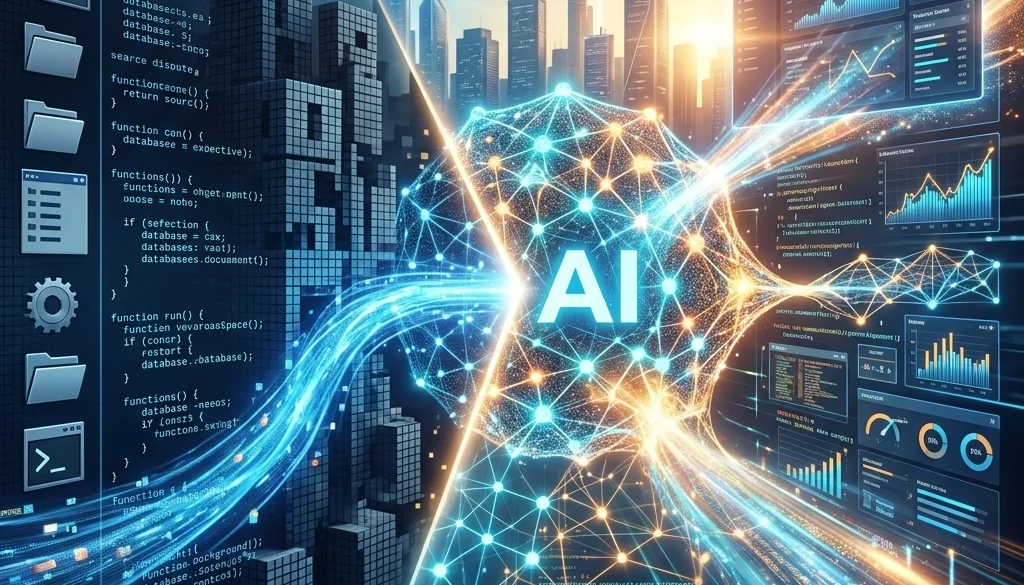
AI-driven engineering (AIDE) utilizes Large Language Models (LLMs) and autonomous agents to generate, optimize, and maintain software. This shift moves development from "writing instructions" to "defining outcomes."
Core Components of AIDE
- Neural Code Synthesis: Automated generation of optimized code snippets based on high-level architectural requirements.
- Self-Healing Architectures: Systems that monitor execution logs and autonomously deploy patches for identified bugs.
- Dynamic UI Generation: Interfaces that adapt in real-time to the specific intent of the user.

AI Agents for Business: Operational Transformation
The deployment of ai agents for business is replacing traditional software modules. Unlike a standard application that performs a single task (e.g., a CRM recording a lead), an AI agent manages the entire workflow autonomously.
Functional Capabilities of Business AI Agents
- Autonomous Decision Making: Agents evaluate data inputs against business objectives to select the optimal course of action without human intervention.
- Cross-Platform Integration: Agents interact with existing APIs and legacy databases to consolidate fragmented business processes.
- Continuous Learning: Performance improves over time as the agent processes more operational data.
For organizations seeking to implement these systems, the transition often involves moving from generic SaaS tools to custom AI solutions for SMBs.
Custom AI Solutions for SMBs: Strategic Implementation
Small and Medium-sized Businesses (SMBs) are utilizing AI to achieve operational efficiencies previously reserved for enterprise-level entities. Customization allows for the alignment of AI behavior with specific proprietary data and niche market requirements.
Implementation Categories
- Workflow Automation: Integration of agents into supply chain management, customer support, and financial reporting.
- Predictive Analytics: Utilizing historical data to forecast inventory needs and market trends.
- Personalized Customer Interaction: AI-driven interfaces that provide bespoke services at scale.
Detailed cost-benefit analyses for these implementations are available through the AI automation ROI calculator.

The Coexistence of Native Performance and AI Logic
Research indicates a resurgence in desktop applications for high-performance tasks. Meta, WhatsApp, and ChatGPT have released native versions of their platforms to leverage local hardware resources. The future of software is not the disappearance of the "app" as a container, but the total replacement of the "app" as a static tool.
Hardware Integration and Local Processing
The demand for self-hosting LLMs is driven by the need for data privacy and reduced latency. By running AI models on local hardware, businesses maintain control over sensitive information while benefiting from the speed of native execution.
Hybrid Architectural Frameworks
- Frontend: Native or web-based containers for optimal performance.
- Backend: AI agents managing logic, data retrieval, and task execution.
- Security: Localized encryption and private cloud deployments.
Marketrun’s Vision: The Next Decade of Software
Marketrun identifies the next ten years as the "Era of Agentic Software." Software will no longer be viewed as a product purchased and installed, but as a dynamic intelligence layer that evolves with the business.
Technical Projections 2026-2036
- Zero-UI Environments: Software interaction will shift toward natural language and intent-based triggers, rendering traditional navigation menus obsolete.
- Autonomous Maintenance: The role of the software engineer will transition to "System Architect," overseeing fleets of agents that handle routine development tasks.
- Hyper-Verticalization: Custom software will be generated for highly specific use cases on-demand, reducing the reliance on "one-size-fits-all" SaaS platforms.

Economic Implications of AI-Driven Engineering
The shift toward AI-driven development significantly alters the cost structure of software acquisition and maintenance.
| Feature | Traditional Software | AI-Driven Software |
|---|---|---|
| Development Time | Months/Years | Days/Weeks |
| Maintenance | Manual Patches | Self-Correcting |
| User Interaction | Menu-Driven | Intent-Driven |
| Scalability | Linear/High Cost | Exponential/Low Cost |
For businesses operating in different geographical markets, understanding these costs is critical. Analysis regarding custom software India vs USA cost 2026 provides comparative data on this transition.
Strategic Recommendations for SMBs
To maintain competitiveness in an AI-dominated market, businesses are advised to follow a structured transition plan:
- Audit Existing Tech Stacks: Identify legacy applications that create bottlenecks in data flow or user productivity.
- Identify High-ROI Use Cases: Focus on areas where ai-automations can replace repetitive manual tasks.
- Prioritize Data Sovereignty: Utilize open-source deployment strategies to ensure that proprietary data is not used to train third-party models.
- Invest in Scalable Architecture: Ensure that new software components are compatible with agentic frameworks.

Summary of System State
Traditional applications are not dead; they are being hollowed out and refilled with AI-driven logic. The "app" remains the delivery vehicle, but the engine is now autonomous. Businesses that adopt ai agents for business and invest in custom ai solutions for smbs will operate with a level of agility that traditional software cannot support.
The engineering focus at Marketrun remains on the development of these autonomous systems to provide sustainable competitive advantages for clients in the US, India, and global markets. Further information on specific implementation strategies can be found in the AI agents and automations guide 2026.