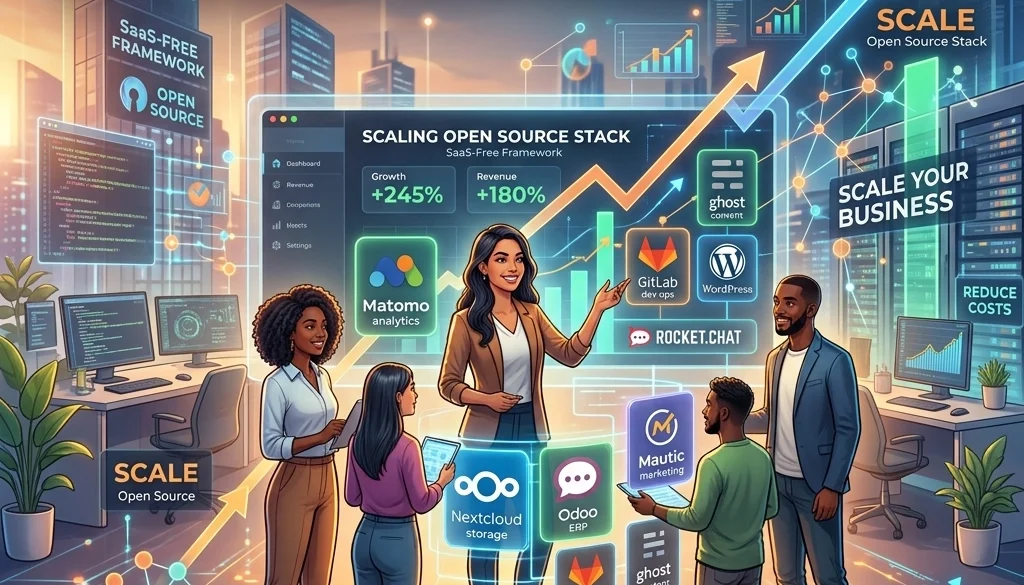
The Proven SaaS-Free Framework: How to Scale Your Business Using Open Source Alternatives
Framework Definition and Economic Rationale
The SaaS-Free Framework is a methodology for business operations that replaces subscription-based software with self-hosted, open source alternatives. The primary objective is the elimination of monthly recurring revenue (MRR) outflows to third-party vendors.
Statistical data indicates that the average enterprise utilizes over 130 SaaS applications. This creates a fragmented data environment and significant financial overhead. By transitioning to open source deployments, businesses retain data sovereignty and reduce operational expenses. The cost of infrastructure: primarily Virtual Private Servers (VPS): is lower than the cumulative cost of individual software licenses.
Marketrun facilitates this transition through open source deployment services.
Core Infrastructure: VPS Setup and Management
The foundation of a SaaS-free environment is the Virtual Private Server (VPS). VPS setup and management require the selection of a provider and the implementation of a management layer.
Provider Selection
Selection criteria include uptime guarantees, hardware specifications, and geographical location.
- Hetzner: Cost-effective infrastructure located in Europe and North America.
- DigitalOcean: Standardized droplets with integrated managed databases.
- Linode (Akamai): High-performance computing options.
Server Provisioning
The operating system utilized is typically a Linux distribution, such as Ubuntu 22.04 LTS or Debian. Provisioning involves SSH key configuration, firewall setup (UFW), and the disabling of root password authentication.
Management Layers
Manual server management is replaced by automation tools. These tools provide a graphical user interface (GUI) for deployment, similar to the experience offered by Heroku or Vercel.
- Coolify: An open source PaaS (Platform as a Service) that automates the deployment of applications and databases via Docker.
- Dokku: A lightweight PaaS implementation that utilizes Git pushes for deployment.
- CapRover: A simplified management tool for containerized applications.

Open Source SaaS Alternatives: The Replacement Matrix
Specific SaaS categories are replaced by mature open source projects. Each alternative offers comparable functionality without license fees.
Customer Relationship Management (CRM) and ERP
Proprietary tools like Salesforce or HubSpot are replaced by systems that offer modularity.
- ERPNext: A comprehensive suite covering accounting, CRM, and inventory.
- Odoo (Community Edition): A modular platform for business process management.
Marketing Automation
Email marketing and lead nurturing are transitioned from Mailchimp or Klaviyo to self-hosted platforms.
- Mautic: Provides lead tracking, email marketing, and automated workflows.
- Listmonk: A high-performance newsletter and mailing list manager.
Workflow Automation
Inter-application connectivity, traditionally handled by Zapier or Make, is managed internally.
- n8n: A fair-code workflow automation tool that supports self-hosting.
- Activepieces: An open source alternative focusing on ease of use and business automation.
Detailed implementation strategies for these tools are available in the AI agents and automations guide.
Data and Backend Infrastructure
Scaling a business requires robust data management. Proprietary backend services are replaced by open source platforms.
Backend-as-a-Service (BaaS)
- Supabase: An open source alternative to Firebase. It provides a PostgreSQL database, authentication, and real-time capabilities.
- Appwrite: A backend server for web, mobile, and flutter developers.
Database Management
Databases are hosted on the same VPS infrastructure or dedicated database servers.
- PostgreSQL: The standard for relational data.
- NocoDB: Transforms any database into a smart spreadsheet, replacing Airtable.
Analytics
User tracking and data visualization are conducted via privacy-focused tools.
- Matomo: A full-featured alternative to Google Analytics that ensures 100% data ownership.
- Plausible: A lightweight, privacy-friendly analytics dashboard.

Communication and Collaboration
Internal and external communication systems are hosted locally to ensure security and reduce per-user costs.
Team Messaging
- Mattermost: A secure, self-hosted alternative to Slack.
- Rocket.Chat: A customizable communication platform including omni-channel support.
Document Collaboration
- Nextcloud: A replacement for Google Workspace or Microsoft 365, providing file storage, calendars, and document editing.
- OnlyOffice: An online office suite that integrates with Nextcloud for real-time collaboration.
Video Conferencing
- Jitsi Meet: A fully encrypted, open source video conferencing solution without usage limits.
Technical Implementation Workflow
The transition process follows a specific sequence of operations.
- Audit: Identify all current SaaS subscriptions and usage metrics.
- Infrastructure Sizing: Calculate the CPU, RAM, and storage requirements for the replacement stack.
- VPS Deployment: Provision servers and install a management layer (e.g., Coolify).
- Data Migration: Export data from SaaS providers and import into open source databases.
- DNS Configuration: Map subdomains (e.g., crm.company.com) to the corresponding VPS containers.
- SSL Issuance: Implement automated certificate renewal via Let's Encrypt.
Marketrun provides custom software solutions to assist with complex migrations.
Security and Maintenance Protocols
The removal of SaaS vendors necessitates internal responsibility for security and maintenance.
Update Management
System updates are performed regularly. Containerized deployments simplify this process through image versioning.
- Watchtower: Automates the update process for Docker containers.
Backup Strategy
Data redundancy is critical.
- Off-site Backups: Encrypted backups are sent to S3-compatible storage (e.g., MinIO or AWS S3).
- Point-in-Time Recovery: Databases are configured for regular snapshots.
Monitoring
- Uptime Kuma: A self-hosted monitoring tool that alerts administrators to service interruptions.
- Netdata: Provides real-time performance monitoring for VPS hardware.

Financial Impact and ROI
The shift to an open source framework results in immediate capital expenditure (CapEx) for setup, followed by significantly lower operating expenses (OpEx).
| Category | SaaS Monthly Cost (Estimated) | Open Source Monthly Cost (VPS) |
|---|---|---|
| CRM | $150 | $0 |
| Automation | $100 | $0 |
| Analytics | $50 | $0 |
| Messaging | $80 | $0 |
| Infrastructure | $0 | $40 |
| Total | $380 | $40 |
The reduction in monthly costs allows for the reallocation of capital toward growth and AI development. Calculating the exact return on investment is possible using the AI automation ROI calculator.
Scalability and Future-Proofing
Open source software scales horizontally and vertically. As business demands increase, VPS resources are adjusted (vertical scaling) or additional nodes are added to a cluster (horizontal scaling).
The use of Docker and Kubernetes ensures that the business is not locked into a single hosting provider. The entire infrastructure stack is portable.
For organizations operating internationally, understanding the cost structures is essential. Comparison data is available in the custom software India vs USA cost guide.
Implementation Support
The deployment and management of a SaaS-free framework require technical expertise in Linux administration, Docker, and network security.
Marketrun offers services for:

Detailed pricing for these services is located on the Marketrun pricing page. Further information regarding specific implementations for different regions can be found for US clients and India clients.
The transition to open source alternatives is a strategic decision. It prioritizes long-term financial stability and data control over short-term convenience. The framework is applicable to startups and established enterprises seeking to optimize their technological stack.