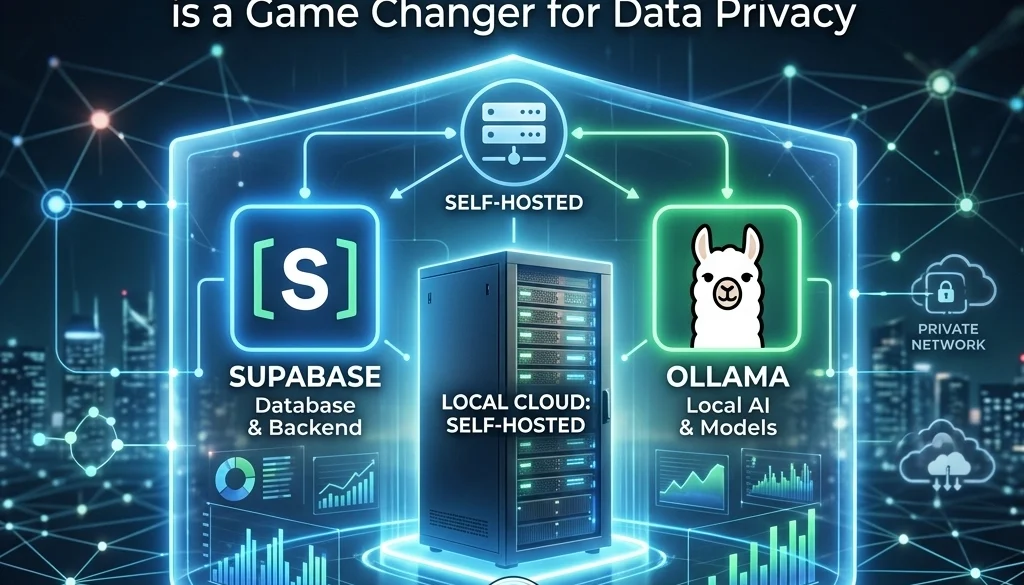
Ownership Matters: Why Self-Hosting Supabase and Ollama is a Game Changer for Data Privacy
Infrastructure Autonomy in 2026
The current technological landscape on Wednesday, 22 of April 2026, reflects a shift in data management priorities. Organizations are transitioning from third-party software-as-a-service (SaaS) models toward self-hosted open source tools. This change is driven by the necessity for absolute data sovereignty, enhanced security, and financial efficiency.
Centralized cloud environments present risks regarding data exposure and regulatory non-compliance. By utilizing infrastructure controlled by the organization, these risks are mitigated. Marketrun provides specialized open source deployment services to facilitate this transition.
Data Privacy and Regulatory Compliance
Data privacy is governed by strict legal frameworks including GDPR, HIPAA, and various regional data protection acts. Storing sensitive information on external servers introduces variables outside an organization’s direct control.
Self-hosting ensures that data remains within the defined network perimeter. This architecture permits granular control over access logs, encryption keys, and storage locations. Compliance is simplified when the data residency is verifiable and static.

Supabase: Backend Sovereignty
Supabase functions as an open-source alternative to proprietary backend-as-a-service platforms. It integrates several core components:
- PostgreSQL Database: A relational database for structured data storage.
- Authentication: Management of user identities and access rights.
- Storage: Handling of large files and assets.
- Realtime: Subscriptions to database changes via WebSockets.
- Edge Functions: Serverless logic execution.
When an organization self-hosts Supabase, every database query and user authentication request is handled on internal hardware or a private cloud instance. This prevents third-party providers from accessing metadata or user patterns. Detailed technical guides on this subject are available on our blog.
Ollama: Private Artificial Intelligence
Large Language Models (LLMs) typically require significant computational resources. Proprietary AI providers require data to be transmitted to their servers for processing. This creates a privacy gap for organizations handling proprietary code or confidential client information.
Ollama enables the local execution of LLMs. In 2026, local inference capabilities have reached a state where high-performance models can run on standard server hardware.
- Zero Data Leaks: Conversations and training data do not exit the local environment.
- Offline Availability: Systems remain functional without internet connectivity.
- Model Selection: Organizations can deploy specific models tailored to their requirements without external interference.
For more information on implementing these systems, refer to our guide on self-hosting LLMs in 2026.

n8n and Automation Control
Workflow automation often involves connecting multiple disparate services. Using a cloud-based automation tool means sensitive API keys and data payloads transit through a third-party intermediary.
n8n is an extendable workflow automation tool. When self-hosted, all automation logic and data movement stay within the organization's infrastructure. Marketrun offers n8n deployment services to help businesses build secure, private automation pipelines.
Advantages of Self-Hosted Automation:
- Internal Service Integration: Connect to internal databases and tools that are not exposed to the public internet.
- No Execution Limits: Unlike SaaS models that charge per execution, self-hosted n8n is limited only by hardware capacity.
- Auditability: Every workflow execution is logged locally for security audits.
Mitigation of Vendor Lock-in
Vendor lock-in occurs when an organization becomes dependent on a specific provider's proprietary technology. This leads to escalating costs and technical debt.
Portability
Open source tools like Supabase and n8n utilize standard formats. PostgreSQL is the foundation of Supabase; therefore, data can be migrated to any PostgreSQL-compatible environment. There are no proprietary file formats preventing a transition between infrastructure providers.
Cost Predictability
SaaS pricing models often scale with usage, leading to unpredictable monthly expenses. Self-hosting requires a fixed investment in hardware or cloud compute resources. Marketrun assists in calculating the AI automation ROI to determine the long-term financial benefits of this approach.

Technical Implementation and Management
Deploying self-hosted open source tools requires a systematic approach. Most modern open-source applications are distributed as Docker containers, which simplifies deployment and version control.
Deployment Architecture
A typical self-hosted stack involves:
- Virtual Private Cloud (VPC): An isolated network environment.
- Container Orchestration: Tools like Kubernetes or Docker Compose to manage services.
- Reverse Proxy: Nginx or Traefik to handle incoming traffic and SSL termination.
- Backup Systems: Automated snapshots of databases and storage volumes.
Marketrun specializes in custom software and infrastructure setup to ensure these systems are resilient and secure.
Security Considerations
Self-hosting transfers the responsibility of security to the organization. Essential practices include:
- Regular patching of the host operating system and container images.
- Implementing strict firewall rules.
- Using multi-factor authentication for all administrative interfaces.
- Monitoring system logs for unauthorized access attempts.
Strategic Comparison: Self-Hosted vs. Managed
| Feature | Self-Hosted | Managed SaaS |
|---|---|---|
| Data Ownership | Full | Partial / Shared |
| Privacy | Maximum | Subject to Provider Terms |
| Customization | Unlimited | Limited by API |
| Maintenance | High | Low |
| Cost over time | Decreasing | Increasing |
Organizations requiring high levels of security, such as those in healthcare or finance, find the self-hosted model more compatible with their operational requirements. Marketrun provides solutions for both US-based and international clients looking to optimize their tech stack.

Future-Proofing with Marketrun
The transition to self-hosted infrastructure is a strategic decision for 2026. It ensures that an organization’s most valuable asset, data, remains protected and under its absolute control.
Marketrun assists businesses in navigating the complexities of AI development and mobile/web app deployment using open-source foundations. By prioritizing ownership, companies avoid the vulnerabilities associated with centralized cloud dependency.
To explore specific implementation strategies for your organization, review our pricing or consult our documentation on self-hosting LLMs.

Summary of Status:
- Infrastructure: Self-hosted open source.
- Tools: Supabase, Ollama, n8n.
- Primary Benefit: Data ownership and privacy.
- Service Provider: Marketrun.
Data sovereignty is no longer optional for competitive enterprises. Implementing self-hosted tools is the standard for maintaining integrity in a digital-first economy.