Stop Wasting Time on Manual Tasks: 5 AI Automation Workflows Every SMB Needs
Operational Overview
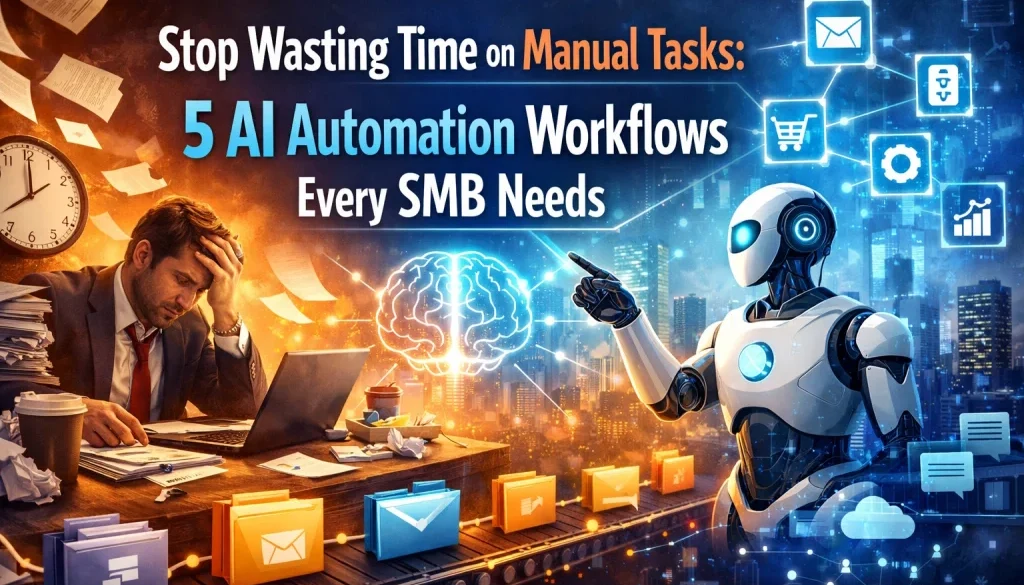
Manual operations in Small and Medium Businesses (SMBs) result in measurable efficiency losses. Administrative overhead accounts for a significant percentage of weekly labor hours. The implementation of ai automation workflows facilitates the reclamation of 10 to 20 hours per week per employee. These systems utilize ai agents for business and orchestration platforms such as n8n to execute repetitive tasks without human intervention.
The following sections detail five specific workflows designed for SMB integration.
1. Automated Lead Enrichment and Triage
Lead management requires the collection, verification, and categorization of incoming data. Manual entry into a CRM system is prone to error and consumes time.
Technical Architecture
The workflow initiates when a new lead is submitted via a web form or email. A webhook transmits this data to n8n. An AI agent is tasked with the following operations:
- Data Extraction: Identification of name, company, and contact details.
- External Verification: The agent queries external databases or social profiles to retrieve company size, industry, and revenue data.
- Intent Analysis: The agent evaluates the message content to determine the lead's urgency and potential value.
- CRM Injection: The enriched data is pushed to a CRM (e.g., Salesforce, HubSpot).
System Logic
The use of ai development allows for conditional logic based on lead scoring. High-value leads trigger an immediate notification via Slack or Microsoft Teams. Low-value leads are placed into an automated nurture sequence.

2. Autonomous Customer Support and Ticket Resolution
Customer inquiry volume often exceeds the capacity of small support teams. AI agents serve as the primary interface for initial contact.
Implementation Strategy
The system connects an AI agent to the company’s internal knowledge base and documentation. This is often achieved through a RAG (Retrieval-Augmented Generation) architecture.
- Input: Customer submits a query via email or chat.
- Processing: The agent searches self-hosting llms or cloud-based models for relevant information.
- Resolution: If the solution exists in the documentation, the agent drafts a response.
- Escalation: If the query is complex, the agent categorizes the ticket and assigns it to a human representative.
Operational Benefit
This workflow ensures 24/7 availability. It reduces the average response time from hours to seconds. Documentation regarding this process can be found at Marketrun Solutions.
3. Intelligent Invoice Processing and Financial Reconciliation
Financial data entry involves high labor costs and significant risk of manual error. AI automation workflows streamline the accounts payable process.
Workflow Components
Using n8n and OCR (Optical Character Recognition) technologies, the following steps are executed:
- Detection: Invoices are intercepted from a dedicated email folder or cloud storage (e.g., Google Drive).
- Extraction: An AI agent identifies line items, tax amounts, invoice numbers, and due dates.
- Validation: The system cross-references the invoice with existing purchase orders or contracts.
- Execution: Validated data is sent to accounting software such as QuickBooks or Xero.
Error Mitigation
The system is configured to flag discrepancies. If an extraction confidence score falls below a defined threshold, the item is moved to a manual review queue. This maintains financial integrity while automating 90% of the volume. SMBs interested in cost-effective implementation often compare offshore development options.

4. Multi-Channel Content Distribution and Repurposing
Marketing consistency is required for brand visibility but is labor-intensive. AI agents for business can manage the distribution of intellectual property across multiple platforms.
Execution Process
When a primary piece of content (e.g., a blog post or technical report) is published on the Marketrun blog, the workflow is triggered:
- Summarization: The AI agent creates short-form summaries optimized for different social platforms.
- Formatting: The agent generates LinkedIn posts, Twitter threads, and email newsletter segments based on the source material.
- Scheduling: n8n interfaces with social media APIs or scheduling tools to queue the posts.
- SEO Optimization: The agent audits the content against current AI website SEO standards.
Resource Allocation
This automation removes the need for a dedicated social media coordinator for basic distribution tasks. Human input is limited to final approval of the generated copy.
5. Meeting Intelligence and Automated Task Delegation
Internal and external meetings generate data that is frequently lost or ignored due to the absence of immediate documentation.
Workflow Sequence
The integration of transcription services with AI agents allows for the following:
- Capture: A meeting recording is uploaded to a monitored directory.
- Transcription: The audio is converted to text using models such as Whisper.
- Analysis: An AI agent identifies key decisions, unresolved questions, and specific action items.
- Delegation: Action items are automatically converted into tasks within project management software (e.g., Jira, Asana, or custom software solutions).
- Notification: Relevant stakeholders receive a summary and their assigned tasks via email or internal messaging.
Efficiency Gains
This workflow ensures accountability. It eliminates the time required for post-meeting synthesis and manual task creation.

Quantitative Impact Analysis
The adoption of these five workflows correlates with a reduction in operational costs. The following table illustrates the average time savings per week for a typical SMB with 20 employees.
| Workflow Area | Manual Hours (Weekly) | Automated Hours (Weekly) | Hours Saved |
|---|---|---|---|
| Lead Management | 15 | 2 | 13 |
| Customer Support | 30 | 10 | 20 |
| Financial Admin | 10 | 1 | 9 |
| Content Marketing | 12 | 3 | 9 |
| Meeting Admin | 8 | 1 | 7 |
| Total | 75 | 17 | 58 |
Data regarding the return on investment for these implementations can be calculated using the AI Automation ROI Calculator.
Technical Requirements for Implementation
To deploy these ai automation workflows, specific infrastructure is required:
- Orchestration Layer: n8n is recommended for its open-source flexibility and self-hosting capabilities.
- LLM Access: APIs for GPT-4, Claude, or self-hosted local models.
- API Connectivity: Access to existing business software (CRM, Accounting, Project Management).
Marketrun provides specialized services for AI website creation and mobile/web application development to support these integrations.
Implementation Strategy
SMBs are advised to follow a phased approach:
- Audit: Identify the most time-consuming manual processes.
- Pilot: Deploy a single workflow, such as lead enrichment, to validate the logic.
- Scale: Integrate additional workflows based on performance data and employee feedback.
- Maintenance: Regularly update AI prompts and agent parameters to ensure continued accuracy.
For detailed pricing on implementation and consulting, refer to the Marketrun pricing page. Specialized support is available for both US-based clients and India-based clients.
Conclusion
Manual task execution is an impediment to scalability. The transition to ai agents for business and structured ai automation workflows is a technical requirement for modern SMBs. By utilizing tools like n8n and high-performance LLMs, businesses achieve significant labor reductions and improved data accuracy. Further resources on Windows-specific software and offshore development are available for organizations seeking comprehensive digital transformation.