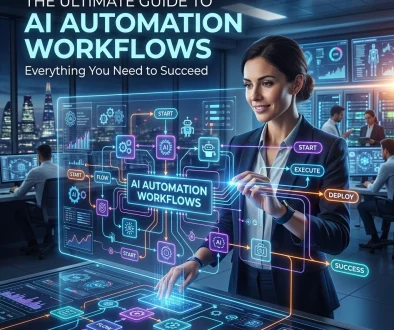
How to Save 20 Hours a Week: The SMB Guide to AI Automation Workflows
Operational Status: SMB Resource Inefficiency
Small and Medium Businesses (SMBs) currently allocate significant human capital to repetitive digital maintenance. Internal audits indicate that manual data entry, lead triaging, and routine customer communication consume approximately 30% to 40% of the standard workweek. These tasks are characterized by high volume, low cognitive requirement, and high susceptibility to human error.
The implementation of ai automation workflows addresses this resource drain. Systematic deployment of autonomous systems allows for the reclamation of 10 to 20 labor hours per week per department. This transition shifts human focus from tactical execution to strategic oversight.
Primary Framework: n8n and AI Agents for Business
The modern automation stack for SMBs is centered on orchestration and intelligence.
Orchestration Layer: n8n
n8n is utilized as the primary workflow engine. It facilitates the connection between disparate software applications (SaaS) and internal databases. Unlike traditional linear automation tools, n8n supports complex branching logic, loops, and self-hosted deployments. This capability is critical for maintaining data sovereignty and reducing operational costs. For organizations requiring specialized infrastructure, Marketrun's open-source deployment services provide the necessary technical foundation.
Intelligence Layer: AI Agents
AI agents for business function as autonomous entities capable of decision-making within a workflow. While standard automation follows "If This, Then That" (IFTTT) logic, AI agents utilize Large Language Models (LLMs) to interpret intent, summarize text, and generate contextually appropriate responses.
The integration of these agents into n8n workflows enables the automation of non-linear tasks, such as sentiment analysis and complex document synthesis. Details on these specific technologies are available at Marketrun AI Automations.

Workflow Analysis: Customer Service Optimization
Customer service departments experience the highest immediate ROI from AI integration. The objective is the reduction of ticket volume handled by human agents.
Automated Triage and Resolution
AI agents are deployed to intercept incoming inquiries via email or chat.
- Input: Customer query is received.
- Analysis: The AI agent categorizes the query (e.g., billing, technical support, general inquiry).
- Action:
- If the query matches a known FAQ, the agent retrieves the relevant information and provides a resolution.
- If data is required (e.g., order status), the agent queries the internal database via API.
- If the query is complex, it is routed to the appropriate human department with a prepared summary of the interaction.
Quantifiable Impact
Data suggests that 60-70% of routine inquiries can be resolved without human intervention. This results in a direct saving of 12-15 hours per week for support staff. Implementation strategies for these systems can be explored through Marketrun’s AI Development solutions.
Workflow Analysis: Sales and Lead Management
Lead management is often subject to delays that negatively impact conversion rates. AI automation workflows ensure instantaneous response times.
Lead Scoring and Enrichment
Manual research of new leads is time-intensive. An automated workflow executes the following steps:
- Trigger: A new lead submits a form on the website.
- Enrichment: The workflow utilizes external APIs to pull company size, industry, and revenue data.
- Scoring: An AI agent evaluates the lead against the Ideal Customer Profile (ICP).
- Distribution: High-priority leads are injected into the CRM and the sales team is notified via Slack or Teams. Low-priority leads are placed into an automated nurture sequence.
Scheduling and Preparation
AI agents manage the scheduling of discovery calls. Following a booking, the agent scans the lead's website and recent news, generating a "Pre-meeting Intelligence Brief" for the sales representative. This reduces manual preparation time by approximately 30 minutes per meeting.

Workflow Analysis: Marketing Operations
Marketing departments utilize AI to maintain consistent output across multiple channels without proportional increases in headcount.
Content Repurposing and Distribution
A single pillar content piece (e.g., a blog post or webinar) is processed by an AI agent to generate:
- Five social media updates for LinkedIn and X.
- A summary for the weekly newsletter.
- Meta descriptions and Alt-text for SEO.
This workflow is managed within n8n, ensuring that content is scheduled and published across platforms automatically. The result is a reduction in administrative marketing labor by 8-10 hours per week. Further information on optimizing digital presence is available at Marketrun AI Website Creation.
Automated Reporting
Weekly KPI reporting often requires manual data extraction from Google Analytics, CRM, and ad platforms. Automated workflows compile this data into a centralized dashboard or a summarized document, delivering insights to stakeholders every Monday morning without manual intervention.
Workflow Analysis: Document Processing and Data Extraction
Manual data entry from invoices, contracts, and receipts is a high-latency process.
Intelligent Document Processing (IDP)
AI agents equipped with Optical Character Recognition (OCR) capabilities are used to scan incoming PDF documents.
- Extraction: The agent identifies key fields such as Invoice Number, Date, Total Amount, and Line Items.
- Validation: The extracted data is cross-referenced with existing purchase orders in the accounting software.
- Input: Validated data is automatically entered into the ERP or accounting system (e.g., QuickBooks, Xero).
This automation eliminates 3-5 hours of manual data entry per week and significantly reduces the error rate associated with manual input.

Implementation Strategy: The Three-Tier Approach
Successful implementation of AI automation workflows follows a structured progression to minimize operational disruption.
Tier 1: Immediate Efficiency (The Quick Wins)
Focus on high-frequency, low-complexity tasks.
- Email auto-responders.
- Calendar scheduling.
- Notification alerts.
Estimated Savings: 2-4 hours/week.
Tier 2: Process Integration
Focus on multi-step workflows involving two or more software platforms.
- Lead-to-CRM pipelines.
- Automated invoicing.
- Content distribution.
Estimated Savings: 5-10 hours/week.
Tier 3: Strategic Transformation
Deployment of specialized AI agents for complex decision-making and customer-facing interactions.
- Autonomous customer support bots.
- Predictive sales analytics.
- Custom software integrations.
Estimated Savings: 10-20+ hours/week.
For a detailed analysis of the financial impact of these tiers, refer to the AI Automation ROI Calculator.
Risk Mitigation and Data Security
The transition to AI-driven workflows requires a focus on security. SMBs often prefer self-hosting their Large Language Models to ensure that proprietary data does not leave their controlled environment. This approach mitigates risks associated with third-party data breaches.
Technical guidance on local deployments can be found in the Self-Hosting LLMs 2026 Guide.
Continuous Monitoring
Automations are not static. Regular audits of n8n execution logs and AI agent outputs are necessary to ensure continued accuracy. Systems should be configured with "human-in-the-loop" checkpoints for critical financial or legal decisions.

Strategic Conclusion
The adoption of ai agents for business is a prerequisite for operational scalability in 2026. By offloading 20 hours of manual labor per week to automated systems, SMBs reallocate 1,000 hours per year toward growth, innovation, and client relationships.
Marketrun provides the technical expertise to design, deploy, and maintain these systems. Organizations seeking to optimize their workflows may consult our solutions page for tailored implementation plans.
For further reading on the evolution of these technologies, the AI Agents and Automations Guide 2026 provides an exhaustive overview of current industry standards.