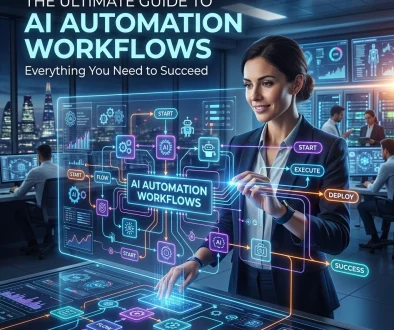
The Ultimate Guide to AI Automation Workflows: Everything You Need to Succeed Without High SaaS Fees
1. Definition of AI Automation Workflows
AI automation workflows represent the integration of machine learning and artificial intelligence into operational sequences. These systems execute tasks with minimal human intervention. The primary goal is to automate business operations with ai by replacing manual data handling with algorithmic processing.
Traditional automation follows fixed logic. AI automation utilizes Large Language Models (LLMs), Natural Language Processing (NLP), and computer vision to interpret unstructured data. This allows systems to manage variables that fluctuate.
1.1 Technical Components
- Data Ingestion: The collection of information from sources such as email, PDFs, or databases.
- Intelligence Layer: The application of AI to categorize, summarize, or extract intent.
- Action Layer: The execution of a command in a secondary system based on the AI output.

2. Identification of Workflow Candidates
To automate business operations with ai, identification of suitable processes is required. Processes with high volume and predictable inputs are primary targets.
2.1 Criteria for Automation
- High Frequency: Tasks performed multiple times per hour or day.
- Low Complexity of Judgment: Decisions based on existing data patterns.
- Unstructured Data Input: Processes involving text or images that require interpretation.
- Standardized Output: Results that follow a specific format for use in other systems.
2.2 Examples of Workflow Candidates
- Invoicing: Extraction of line items from PDF attachments and entry into accounting software.
- Customer Support: Classification of tickets and generation of draft responses.
- Data Migration: Transformation of legacy data into modern schema formats.
- Lead Scoring: Analysis of website interaction data to prioritize sales outreach.

3. Architecture of AI Automation Workflows
The structure of ai automation workflows follows a sequence of triggers, filters, and actions.
3.1 Triggers
A trigger initiates the workflow.
- Event-Based: A new record in a CRM or an incoming email.
- Time-Based: A scheduled check of a directory every 60 minutes.
- Webhook-Based: A push notification from a third-party application.
3.2 Filtering and Logic
Filters prevent the execution of unnecessary tasks. Logic defines the path based on AI analysis.
- Conditional Branching: If AI classifies an email as "Urgent," the workflow follows Path A. If classified as "Inquiry," it follows Path B.
- Data Validation: Checking if the extracted data meets required confidence thresholds.
3.3 Intelligence Processing
The intelligence layer uses specific models for specific tasks.
- Extraction: Pulling names, dates, and amounts from text.
- Sentiment Analysis: Determining the emotional state of a user.
- Translation: Converting data from one language to another for global operations.
Detailed solutions for these structures are available at Marketrun AI Automations.
4. Connecting Disparate Systems
Advanced automation requires communication between software that lacks native integrations.
4.1 API Integration
Application Programming Interfaces (APIs) allow systems to exchange data. Custom software development facilitates these connections when off-the-shelf tools fail. Information on custom bridges can be found at Marketrun Custom Software.
4.2 Webhooks and Callbacks
Webhooks transmit data in real-time. When an event occurs in System A, a POST request is sent to the workflow endpoint. The workflow processes the payload and updates System B.
4.3 Robotic Process Automation (RPA)
RPA is used for legacy systems without APIs. It simulates human interaction with a graphical user interface (GUI). AI enhances RPA by identifying screen elements and handling dynamic layouts.

5. Reducing SaaS Fees through Open Source and Self-Hosting
High SaaS fees often stem from per-execution or per-seat pricing models. Cost efficiency is achieved by deploying open-source alternatives and self-hosting models.
5.1 Open Source Platforms
Tools such as ActivePieces provide the framework for automation without the recurring costs of proprietary platforms.
- ActivePieces: Offers a no-code builder and the ability to self-host on private infrastructure.
- n8n: A fair-code tool that allows for complex logic and extensive integrations.
5.2 Self-Hosting LLMs
Instead of paying for API calls to closed-source models (e.g., GPT-4), businesses can host open-source models (e.g., Llama 3, Mistral). This reduces variable costs and increases data privacy.
- Compute Costs: Transitioning from API billing to fixed server costs.
- Privacy: Data remains within the corporate firewall.
Guidance on this transition is available in the Self-Hosting LLMs 2026 Guide and the Self-Hosting LLMs solution page.
6. Advanced Tips for Workflow Optimization
6.1 Prompt Engineering for Workflows
The quality of AI output depends on the structure of the prompt within the workflow.
- Few-Shot Prompting: Providing examples of input and output to the model.
- System Instructions: Defining the role and constraints of the AI (e.g., "Output only JSON format").
6.2 Error Handling and Human-in-the-loop (HITL)
Workflows must account for AI uncertainty.
- Confidence Thresholds: If the AI is less than 85% certain, the task is routed to a human for review.
- Fallback Paths: If an API call fails, the system retries or notifies an administrator.
6.3 Chaining Agents
Complex operations are broken into smaller tasks performed by specialized agents. One agent extracts data, a second agent validates the data against a database, and a third agent executes the final update. See more at the AI Agents and Automations Guide.

7. Implementation Strategy
Successful deployment follows a phased approach.
7.1 Phase 1: Mapping
Document the current manual process. Identify every step, decision point, and data source.
7.2 Phase 2: Prototyping
Build a minimum viable automation (MVA). Focus on a single high-impact segment of the workflow. Test with historical data.
7.3 Phase 3: Scaling
Deploy the workflow into production. Monitor performance via logs and dashboards. Expand the workflow to include secondary systems.
7.4 Phase 4: Refinement
Review the logs for errors or inefficiencies. Update prompts and logic to improve accuracy.
8. Financial Analysis of Automation
Calculating the Return on Investment (ROI) is necessary for business justification.
8.1 Metric Tracking
- Time Saved: Minutes per task multiplied by the number of tasks.
- Error Reduction: The cost of correcting manual entry errors.
- Throughput: The volume of data processed per hour.
8.2 Cost Comparison
| Factor | SaaS Platform | Self-Hosted / Custom |
|---|---|---|
| Initial Cost | Low | High |
| Recurring Cost | High (Per seat/task) | Low (Server maintenance) |
| Data Privacy | Third-party dependent | Internal control |
| Customization | Limited to platform tools | Unlimited |
Utilize the AI Automation ROI Calculator to determine specific savings.

9. Regulatory and Security Considerations
Automating business operations with ai requires adherence to data protection standards.
9.1 Data Encryption
Ensure all data in transit between disparate systems is encrypted via TLS/SSL.
9.2 Access Control
Implement Role-Based Access Control (RBAC). Limit the permissions of automation agents to the minimum required to perform the task.
9.3 Compliance
Verify that automated processes comply with regional regulations such as GDPR or CCPA. Self-hosting models provide an advantage in meeting residency requirements. Detailed information for different regions can be found for US clients and India clients.
10. Future Trends in AI Workflows
The landscape of ai automation workflows continues to evolve toward autonomous agents.
10.1 Agentic Workflows
Systems that can plan their own steps to achieve a goal rather than following a rigid sequence.
10.2 Multi-Modal Inputs
Workflows that process video, audio, and text simultaneously to make decisions.
10.3 Edge Automation
Running automation logic on local devices rather than in the cloud to reduce latency and enhance security.
For organizations seeking to implement these technologies, Marketrun provides specialized services in AI development and Open Source Deployment. Further reading is available on the Marketrun Blog.