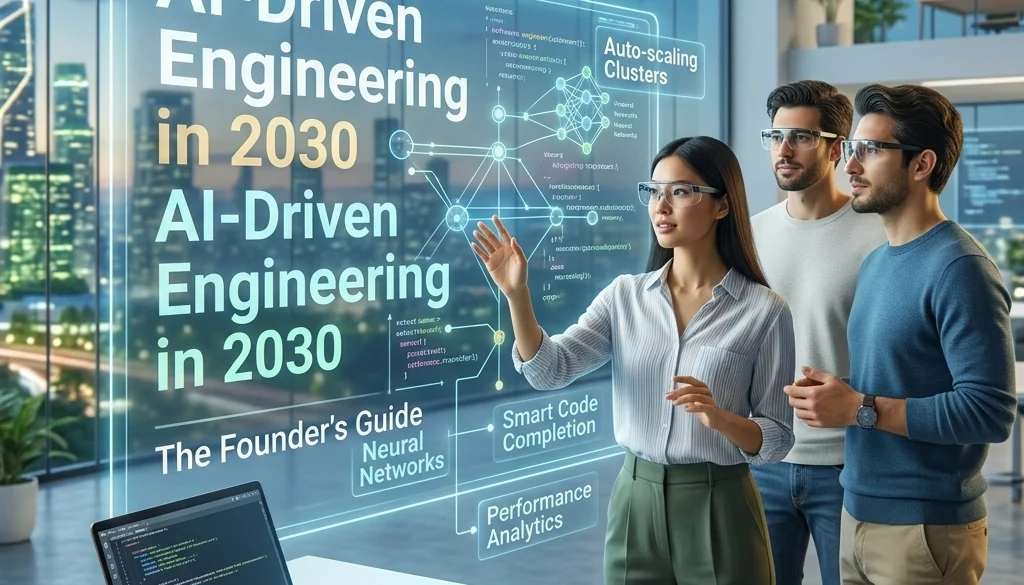
The Founder’s Guide to AI-Driven Engineering: What Your Dev Team Looks Like in 2030
Current State of Software Engineering (2026)
Software engineering in 2026 is characterized by the integration of large language models into existing workflows. Current metrics indicate a transition from manual syntax entry to prompt-based generation. Most development teams utilize AI for code completion, unit test generation, and documentation. However, the human-to-output ratio remains high. Engineering organizations typically maintain specialized roles for front-end, back-end, and infrastructure management.
2030 Technical Trajectory and Predictions
By 2030, the technical landscape for software development is projected to undergo a 1,000x increase in compute requirements for primary models. This shift necessitates a complete restructuring of the engineering department. The emphasis transitions from writing code to the orchestration of autonomous systems.
Shift in Personnel Requirements
Engineering teams in 2030 are categorized by a reduction in total headcount and an increase in output per unit. A single operator functions with the technical capacity previously attributed to a ten-person department.
- AI Orchestrator: Replaces the Traditional Lead Developer. Focuses on the configuration of agentic workflows.
- Data Architect: Manages the retrieval-augmented generation (RAG) pipelines and vector database integrity.
- Security Auditor: Monitors AI-generated code for vulnerabilities and ensures compliance with sovereign data regulations.
Structure of the Autonomous Engineering Team
The 2030 development team operates as a hierarchy of AI agents managed by a limited number of human controllers. These agents perform specific functions within the lifecycle of a software product.
AI Agents for Business Operations

Agents are deployed to handle specific business logic and customer-facing interfaces. These ai agents for business operate 24/7 without human intervention. They perform the following tasks:
- Real-time bug mitigation and patch deployment.
- Dynamic feature scaling based on user traffic.
- Continuous integration and deployment (CI/CD) without manual triggers.
Custom AI Solutions for SMBs: Technical Implementation
Small and medium-sized businesses (SMBs) utilize custom ai solutions for smbs to achieve enterprise-level technical capabilities. The implementation involves specific architectural layers:
Data Ingestion Layer
The system captures unstructured data from internal business processes. This data is processed through automated cleaning pipelines to ensure high-fidelity training sets for specialized models.
Model Fine-Tuning and Hosting
Infrastructure is shifted toward self-hosting llms to ensure data privacy and reduce latency. Organizations move away from generalized public APIs toward proprietary models hosted on local or private cloud instances. This prevents data leakage and ensures adherence to regional data protection laws.
Application Logic Layer
The core functionality of the software is determined by a series of interconnected autonomous agents. These agents utilize the proprietary data to execute tasks specific to the business domain.
Comparison of Regional Engineering Costs and Efficiency
Economic factors influence the distribution of engineering resources. The gap between developed and developing markets narrows as AI tooling standardizes output quality.
| Metric | USA (2030 Estimate) | India (2030 Estimate) |
|---|---|---|
| Average Team Size | 2-3 Persons | 3-5 Persons |
| Productivity Output | 500k LOC/Month | 500k LOC/Month |
| Cost Efficiency | Low | High |
| Specialized AI Talent | High Density | High Density |
Detailed analysis of these cost structures is available in the custom software india vs usa cost 2026 guide.
Evolution of Development Methodologies
The Agile methodology is superseded by Autonomous Iterative Development (AID).
Phase 1: Requirement Specification
Human operators define objective functions rather than specific features. The system interprets business goals and translates them into technical requirements.
Phase 2: Agentic Prototyping
Autonomous agents generate multiple architectural prototypes within hours. These prototypes are subjected to synthetic user testing to determine optimal performance metrics.
Phase 3: Continuous Evolution
The software does not reach a "finished" state. It continuously adapts to new data inputs and user behaviors. Feedback loops are closed by AI agents that adjust the codebase in real-time.

Infrastructure and Deployment Standards
By 2030, custom software is built on decentralized infrastructure. Key components include:
- Edge Computing Integration: Code is executed closer to the user to minimize latency in AI response times.
- Open Source Dominance: Most open source deployment strategies involve pre-configured AI containers.
- Hardware Acceleration: Engineering teams manage specialized NPU (Neural Processing Unit) allocations alongside standard CPU/GPU resources.
Challenges in AI-Driven Engineering
The transition to an AI-driven engineering team involves specific technical hurdles:
- Technical Debt Management: AI systems can generate code at a rate that exceeds human comprehension, leading to "black box" legacy systems.
- Validation Complexity: Ensuring the correctness of non-deterministic outputs requires new testing frameworks.
- Resource Intensity: The compute power required for constant model inference increases operational overhead.
Marketrun’s Vision for 2030 Software Development
Marketrun prioritizes the transition toward high-efficiency, AI-integrated teams. The focus is on reducing the time-to-market for complex software solutions through automated engineering workflows.
Automation of the Frontend
The creation of user interfaces is handled by systems like ai website creation. Layouts and user experiences are generated based on conversion data and behavioral analysis.
Mobile and Web Synergy
Development for mobile web apps utilizes a single agentic core that adapts the delivery format to the user's device specifications automatically.
Enterprise Automation
For larger organizations, ai automations replace manual middleware. Data flows between disparate systems are managed by intelligent agents that resolve schema conflicts without human oversight.
Projected Economic ROI
The return on investment (ROI) for adopting AI-driven engineering is calculated by the reduction in labor hours and the increase in system uptime. Businesses can utilize the ai automation roi calculator to project these gains over a five-year period.
Cost Reduction Factors
- Elimination of manual QA testing.
- Reduction in management overhead due to autonomous coordination.
- Lower infrastructure costs through AI-optimized resource allocation.
Revenue Generation Factors
- Rapid deployment of new features.
- Enhanced user retention through personalized AI experiences.
- Market expansion enabled by lower development barriers.
Conclusion of Forecast
The 2030 engineering landscape is defined by the obsolescence of manual coding and the rise of the AI Orchestrator. Organizations that fail to integrate ai development into their core engineering processes will face significant competitive disadvantages. The migration toward self-hosting llms and agentic workflows is an operational necessity.
Further technical specifications and pricing for current AI solutions are available at marketrun.io/pricing. For detailed insights into offshore development trends, refer to the offshore web mobile apps guide.
Final Technical Summary
| Component | Status | Description |
|---|---|---|
| Development Speed | Accelerated | 10x – 50x increase in deployment frequency. |
| Team Composition | Compact | Focus on high-level system design. |
| Code Quality | High | Standardized through automated verification. |
| Maintenance | Autonomous | Self-healing systems handle 95% of incidents. |
For ongoing updates on AI engineering trends, monitor the Marketrun blog.