Business Automation Secrets Revealed: How to Connect Your Apps and Automate Business Operations with AI
Automation Infrastructure Overview
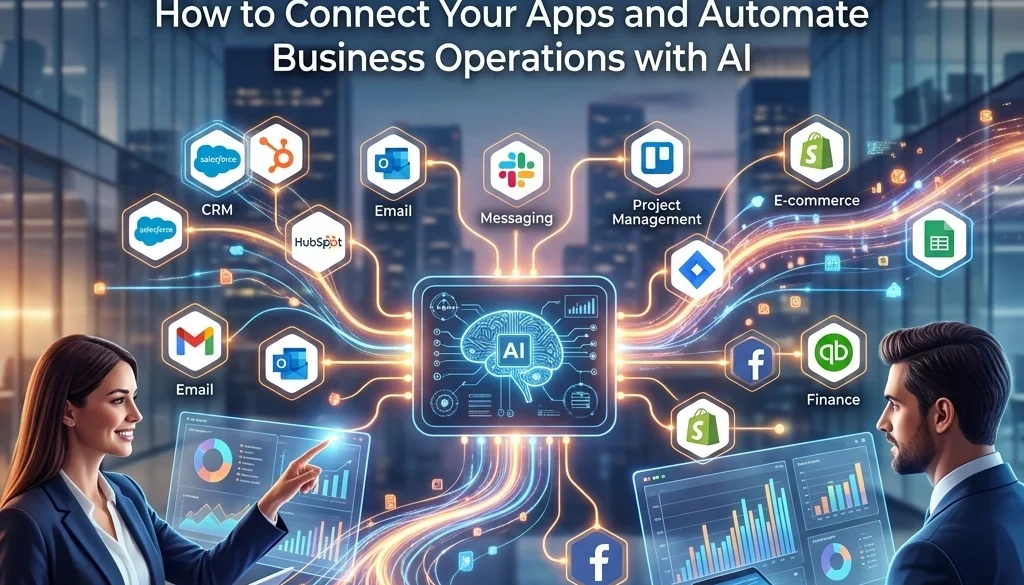
The integration of artificial intelligence into business operations facilitates the transition from manual task management to autonomous workflow execution. Organizations utilize AI to establish connectivity between disparate software applications, ensuring data consistency and operational speed. This transformation relies on a foundation of real-time synchronization and intelligent orchestration.
Effective business automation requires the identification of siloed data sets and the implementation of bridges that allow information to flow without human intervention. The primary objective is to automate business operations with ai to reduce latency and eliminate input errors.

Core Technologies for App Connectivity
Robotic Process Automation (RPA)
RPA remains a fundamental component for connecting legacy systems that lack modern API access. Software robots emulate human interactions with user interfaces to execute rule-based tasks. When combined with AI, these bots move beyond static scripts to handle variable data formats.
Natural Language Processing (NLP)
NLP enables systems to interpret and process human language from emails, documents, and chat interfaces. This technology serves as a translator between unstructured communication and structured database entries. For more details on these integrations, refer to the AI agents and automations guide for 2026.
Machine Learning (ML)
ML algorithms analyze historical operational data to identify patterns. These insights allow the automation framework to make predictive decisions, such as identifying high-priority leads or predicting inventory shortages, and triggering appropriate workflows across connected apps.
Cloud Integration Layers
Cloud computing provides the scalable environment necessary for hosting automation middleware. These platforms act as a central hub where custom software and third-party SaaS tools exchange information via webhooks and REST APIs.

Strategic AI Automation Workflows
Designing ai automation workflows involves mapping the lifecycle of a business process from trigger to resolution. Connectivity is achieved through several technical layers:
Data Ingestion and Normalization
Information is gathered from multiple sources (CRMs, ERPs, social media). AI models normalize this data into a standardized format, ensuring compatibility across all connected systems.
Intent Interpretation
Modern automation systems utilize Large Language Models (LLMs) to understand the intent behind a data trigger. If a customer sends an inquiry, the system determines whether the intent is a support request, a sales lead, or a billing issue, then routes the information accordingly.
Autonomous Action Orchestration
Once intent is identified, AI agents execute a series of actions across different applications. This may include updating a record in a CRM, sending a notification via Slack, and generating an invoice in an accounting tool. Marketrun provides specialized AI automations to facilitate these complex sequences.
Functional Application Areas
Sales and Marketing Operations
Automation connects lead generation platforms directly to internal sales tools.
- Trigger: A lead submits a form on a landing page.
- AI Action: The system enriches the lead data using public profiles and internal databases.
- System Connection: Data is pushed to the CRM, and a personalized outreach email is drafted.
- Result: Reduced lead response time and higher conversion rates.
Human Resources and Talent Acquisition
AI automates the handoff between recruitment platforms and internal HR management systems.
- Trigger: A candidate completes an interview.
- AI Action: Interview transcripts are summarized, and sentiment is analyzed.
- System Connection: Summaries are uploaded to the candidate's profile, and follow-up tasks are assigned to the hiring manager.
Financial Process Automation
Connecting finance apps ensures real-time visibility into cash flow and reduces manual reconciliation.
- Trigger: An invoice is received in a monitored inbox.
- AI Action: Data extraction identifies the vendor, amount, and due date.
- System Connection: The invoice is matched against purchase orders in the ERP and scheduled for payment.

Implementation Procedures for Disparate Systems
The connection of disparate systems follows a structured technical approach:
- Inventory Assessment: All software tools currently in use are documented, along with their API capabilities or lack thereof.
- Middleware Selection: A central orchestration platform is selected to serve as the "brain" of the operation.
- API Integration: Secure connections are established using OAuth or API keys. For sensitive data, organizations may consider self-hosting LLMs to maintain data privacy.
- Workflow Configuration: Logic gates and AI decision points are programmed into the middleware.
- Testing and Validation: Workflows are run in a sandbox environment to ensure data integrity across all endpoints.
Technical Maintenance and Process Intelligence
Post-implementation, business operations require continuous monitoring. Process intelligence tools aggregate data from the automated workflows to identify bottlenecks.
- Error Handling: Automated systems must include "human-in-the-loop" triggers for instances where AI confidence scores fall below a defined threshold.
- Scalability: As transaction volumes increase, the underlying infrastructure must scale to prevent timeouts in app-to-app communication.
- Security: Regular audits of API permissions and data encryption protocols are mandatory to prevent unauthorized access between connected systems.

ROI and Economic Impact
The financial justification for connecting apps via AI is measurable through several key performance indicators (KPIs).
| Metric | Impact of AI Automation |
|---|---|
| Operational Speed | Up to 90% reduction in process cycle time |
| Error Rates | Significant reduction in manual entry discrepancies |
| Resource Allocation | Shift of human labor to high-value strategic tasks |
| Operational Availability | 24/7 system functionality without additional overhead |
Organizations can utilize an AI automation ROI calculator to project specific savings based on their current manual workloads.
Transitioning to AI-Native Operations
The shift toward fully automated business operations is a multi-phase process. Initial steps involve automating high-volume, low-complexity tasks. Subsequent phases involve the deployment of AI development strategies that allow for more nuanced decision-making within workflows.
Marketrun assists businesses in navigating this technical landscape by providing custom software solutions and deployment expertise. For organizations operating across different geographical regions, understanding the cost implications is essential, such as the nuances detailed in the custom software India vs. USA cost 2026 guide.
Summary of Integration Benefits
Connecting applications through AI automation results in a cohesive digital ecosystem. The removal of manual data silos allows for a unified view of business health.
- Synchronization: Data is updated across all platforms simultaneously.
- Intelligence: Actions are taken based on context rather than just rigid rules.
- Efficiency: Business operations function at the speed of the underlying network and compute resources.
The systematic application of these "secrets" enables an organization to operate with minimal friction, ensuring that software tools serve as active participants in business growth rather than passive repositories of information.