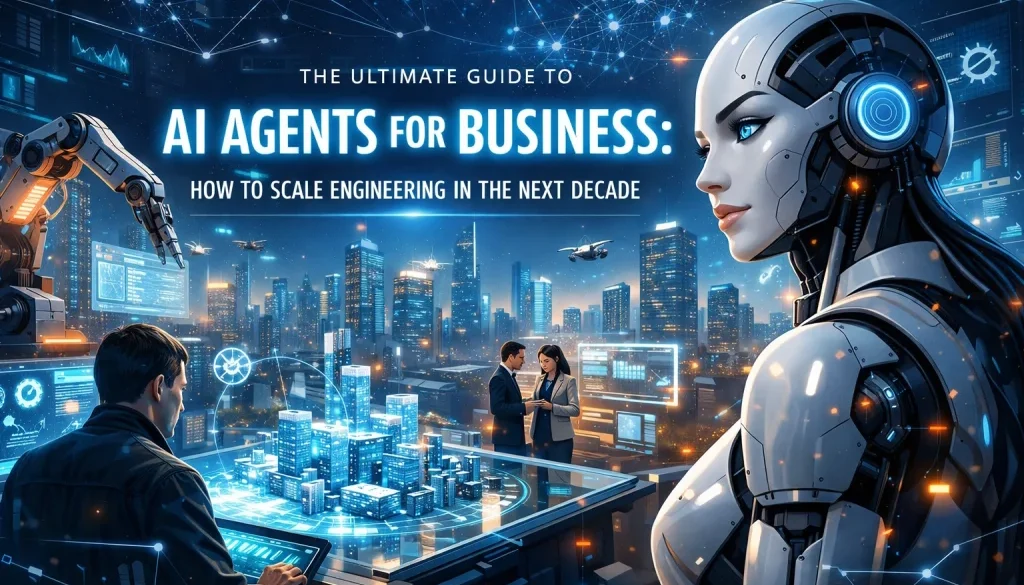
The Ultimate Guide to AI Agents for Business: How to Scale Engineering in the Next Decade
AI Agent Classification and Definition
AI agents are autonomous software entities designed to achieve specific goals through environmental interaction, data processing, and tool execution. Unlike traditional automation, AI agents utilize Large Language Models (LLMs) to reason and adapt to non-linear inputs.
Operational Categories
- Reactive Agents: Execute tasks based on immediate triggers.
- Limited Memory Agents: Utilize historical data to inform current decisions.
- Goal-Oriented Agents: Prioritize sequences of actions to reach a predefined end-state.
- Utility-Based Agents: Evaluate multiple paths to select the most efficient outcome based on cost or time metrics.
Marketrun specializes in deploying these systems through custom software and AI development.
Technical Architecture of Scalable AI Agents
Engineering AI agents at scale requires four primary technical pillars. Failure to implement any single pillar results in system degradation or inaccurate outputs.
1. The Reasoning Engine (The Brain)
Selection of the underlying LLM determines the cognitive limit of the agent.
- Claude Sonnet 4.6: Utilized for high-volume customer service and standard business logic.
- GPT-5.4: Utilized for complex reasoning and tasks requiring high mathematical precision.
- Llama 4 (Open Source): Utilized for self-hosting LLMs to maintain data privacy and reduce latency.
2. Contextual Memory Systems
Agents require the ability to retain state.
- Short-term Memory: Maintains context within a single session or transaction.
- Long-term Memory: Utilizes Vector Databases (e.g., Pinecone, Weaviate) and Retrieval-Augmented Generation (RAG) to access historical business data.
3. Tool Integration (Function Calling)
Agents interact with external environments through APIs. Functional connections include:
- CRMs: Salesforce, HubSpot.
- Communication: Slack, Microsoft Teams, Email.
- Databases: SQL, NoSQL.
- Web Interaction: AI website creation and management tools.
4. Planning and Orchestration
This layer breaks down complex objectives into a directed acyclic graph (DAG) of sub-tasks. It handles error correction, loops, and termination triggers.

Phased Implementation Roadmap for Business
Scaling AI engineering requires a methodical transition from isolated prototypes to integrated ecosystems.
Phase 1: High-Impact Proof of Concept (30 Days)
Objective: Identify a single workflow with measurable friction.
- Target Areas: Customer support ticket resolution, automated data entry, or lead qualification.
- Success Metric: Demonstrable ROI within one month.
- Constraint: Use custom AI solutions for SMBs to minimize initial overhead.
Phase 2: Multi-Function Deployment
Once a POC is validated, agents are deployed across adjacent departments.
- Sales: Automated lead qualification and CRM updates.
- Finance: Invoice reconciliation and transaction verification.
- Marketing: Autonomous content generation and SEO monitoring via AI website SEO tools.

Phase 3: Governance and Infrastructure Establishment
Expansion necessitates a centralized control layer.
- Data Permissions: Define agent access levels.
- Action Logging: Audit trails for every decision made by the autonomous system.
- Cost Control: Monitor token usage and API costs to ensure economic viability.
Scaling Engineering via Multi-Agent Swarms
The next decade of software is defined by "Multi-Agent Systems" (MAS). In this model, multiple specialized agents communicate to solve enterprise-level problems.
Swarm Orchestration
- The Manager Agent: Distributes tasks to specialized agents and reviews the final output.
- The Specialist Agents: Execute specific functions (e.g., a "Coder Agent," a "Reviewer Agent," and a "QA Agent").
- Conflict Resolution: Protocols for when two agents provide conflicting data or recommendations.
Engineering Impact
Engineering teams shift from writing line-by-line code to managing agentic workflows. This increases the leverage of a single engineer by an estimated factor of 10. Businesses can utilize offshore web and mobile apps guides to understand the global distribution of this labor.

Functional Applications Across Business Verticals
Customer Support and Success
AI agents handle Tier 1 and Tier 2 support requests.
- Capability: Resolve billing disputes, update account settings, and troubleshoot technical issues.
- Availability: 24/7/365 operational status.
- Scalability: Horizontal scaling by increasing compute resources during peak hours.
Sales and Marketing
- Lead Generation: Agents crawl LinkedIn and company websites to identify prospects.
- Appointment Setting: Real-time calendar synchronization for sales teams.
- Campaign Optimization: Autonomous adjustment of ad spend based on conversion performance.
Operations and Logistics
- Inventory Management: Predicting stock shortages and initiating purchase orders.
- Workflow Automation: Moving data between siloed enterprise systems without manual intervention.

Infrastructure: SaaS vs. Self-Hosting
Decision-making regarding deployment models is determined by security requirements and budget.
SaaS/Cloud-Based Agents
- Pros: Low initial setup time, managed updates, access to top-tier models (GPT-5, Claude).
- Cons: Recurring subscription costs, data privacy concerns for sensitive information.
Self-Hosted LLMs
- Pros: Data remains within the company firewall, zero per-token costs after initial hardware investment, full customization.
- Cons: Higher initial setup complexity, hardware maintenance requirements.
- Resource: Guide to self-hosting LLMs in 2026.
Marketrun provides open-source deployment services for organizations opting for private infrastructure.
Economic Outlook and ROI Analysis
The transition to AI agents is driven by cost efficiency and output volume.
Cost Comparison: India vs. USA
Engineering costs vary significantly by region. AI agents further disrupt this dynamic by automating standardized tasks regardless of location.
- USA: High cost for specialized AI oversight.
- India: Competitive rates for building and maintaining the agentic infrastructure.
- Reference: Custom software India vs USA cost 2026.
Measuring ROI
ROI is calculated based on:
- Labor Hours Saved: Total manual hours replaced by agent runtime.
- Error Reduction: Decrease in costs associated with human error in data entry or processing.
- Throughput Increase: Ability to handle 10x the volume of requests without increasing headcount.
Utilize the AI automation ROI calculator to determine specific savings.

Future Trajectory: 2026–2036
The next decade will see the transition from "AI as a tool" to "AI as a workforce."
- 2026-2028: Massive adoption of single-purpose agents for SMBs and mid-market firms.
- 2029-2032: Proliferation of multi-agent swarms in the enterprise sector.
- 2033-2036: Autonomous corporations where core operations are managed by AI agents with human executive oversight.
Marketrun Strategic Alignment
Marketrun facilitates this transition by providing:
Current system status: AI agents are ready for deployment. Engineering scalability is achievable through systematic implementation of autonomous workflows. For further information on services, visit the solutions page.