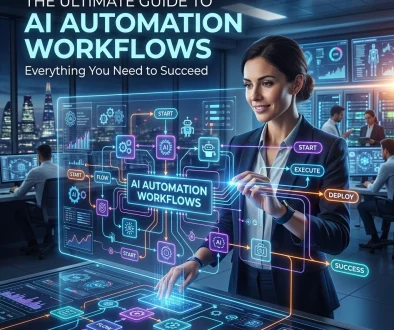
The Proven Framework to Automate Business Operations with AI Without Hiring More Staff
The Scalability Constraint in Manual Operations
Traditional business growth requires a linear increase in headcount to match operational demands. This model results in rising overhead costs and increased management requirements. Manual operations depend on human intervention for data entry, task routing, and internal communication. These processes are subject to human error and latency.
The transition to an automated framework allows for the expansion of output without the proportional addition of staff. This is achieved by implementing an operating system where AI agents manage routine coordination and task execution.
The Three-Pillar Framework for AI Automation
Automate business operations with AI by focusing on three functional areas: onboarding, role workflows, and self-serve systems. These pillars constitute the technical foundation for scalable operations.
Pillar 1: Onboarding Automation
Onboarding encompasses the technical and administrative integration of new entities into the company environment. Manual onboarding involves repetitive data entry across multiple platforms.
Operational Components of Automated Onboarding:
- Data Collection: Automated forms capture required information.
- Account Provisioning: Systems trigger the creation of credentials in CRM, project management, and communication tools.
- Information Distribution: AI agents deliver standard operating procedures (SOPs) based on the specific role or client type.
The automation of these steps reduces the time-to-productivity for new personnel. It ensures that all administrative requirements are met without the supervision of senior management.
Pillar 2: Role Workflow Automation
Role workflows consist of the recurring tasks performed by staff members within specific departments. AI automation workflows target these tasks to create elastic capacity.
Functional Categories of Workflow Automation:
- Task Routing: Incoming communications are analyzed by Large Language Models (LLMs) to determine priority and destination.
- Document Processing: AI extracts data from invoices, contracts, and reports, then populates the relevant databases.
- Approval Chains: Systems monitor task completion and trigger subsequent actions or notifications to stakeholders.

When these workflows are automated, the output of existing staff increases. The focus shifts from administrative execution to strategic oversight. Details regarding specific implementations can be found at Marketrun AI Automations.
Pillar 3: Self-Serve Internal Systems
Self-serve systems remove the need for human-to-human coordination for information retrieval. Traditional models rely on managers or experienced staff to provide guidance on company protocols.
Mechanism of Self-Serve AI:
- Knowledge Base Integration: Internal documentation, previous project data, and policy manuals are indexed.
- Intent Recognition: Personnel interact with an AI interface to query information or request task status.
- Response Generation: The AI provides the exact documentation or data point required.
This system reduces the volume of internal messages and meetings. It prevents management burnout by decentralizing information access.

Integrating Disparate Systems for Unified Operations
A significant barrier to automation is the existence of disconnected software platforms. Information silos prevent the flow of data required for end-to-end automation.
Connectivity Methods
1. Application Programming Interfaces (APIs):
APIs allow different software programs to communicate directly. The framework utilizes APIs to push and pull data between CRM systems, financial software, and project management tools.
2. Webhooks:
Webhooks facilitate real-time data transmission. When an event occurs in one system (e.g., a payment is received), a webhook notifies the automation layer to trigger the next step (e.g., generating an invoice).
3. Middleware and Custom Logic:
In cases where native integrations are unavailable, custom software development is required to bridge the gap. This involves writing scripts that transform data formats to ensure compatibility across the stack. Technical specifications for these bridges are available via Custom Software Solutions.

AI Automation Workflows for Specific Business Functions
Automate business operations with AI by applying logic-based workflows to core functions.
Financial Operations
- Invoice Generation: Triggers are set upon project milestone completion. The system generates and sends invoices to clients automatically.
- Expense Tracking: AI categorizes receipts and updates ledger entries in real-time.
- Reporting: Data from disparate sources is aggregated into weekly or monthly financial reports without manual compilation.
Customer Support and Engagement
- Ticket Categorization: AI agents analyze support tickets to identify the core issue and assign it to the appropriate technical resource.
- Sentiment Analysis: Systems monitor client communications to flag potential escalations before they require human intervention.
- Automated Follow-ups: Outreach is triggered based on user inactivity or specific lifecycle stages.
Human Resources and Internal Coordination
- Scheduling: AI manages calendars by identifying available slots across multiple time zones and booking meetings based on priority.
- Performance Monitoring: Automated systems track KPIs and generate summaries for review.
Technical Security and Infrastructure
The deployment of AI within business operations necessitates robust security protocols. Protecting sensitive data is a primary requirement for any automation framework.
Self-Hosting LLMs
To maintain data privacy, businesses may choose to self-host their AI models. This prevents proprietary data from being sent to third-party providers. Information on this infrastructure is located at Self-Hosting LLMs 2026 Guide.
Data Encryption and Access Control
- At-Rest and In-Transit Encryption: All data moving through automation workflows must be encrypted.
- Role-Based Access Control (RBAC): Access to automated systems is restricted based on the user's role within the organization.
Financial Impact and Return on Investment (ROI)
The implementation of an AI-driven operational framework results in measurable financial shifts.
Cost Scalability:
The cost of maintaining an automated workflow is fixed or increases at a marginal rate relative to volume. In contrast, the cost of human labor increases linearly.
Efficiency Gains:
- Reduction in labor hours for routine tasks.
- Decrease in error rates and associated rectification costs.
- Increase in the speed of service delivery.
Specific ROI calculations can be performed using the AI Automation ROI Calculator.
Implementation Roadmap
The transition to automated operations is executed in phases to minimize disruption.
- Audit of Current Processes: Identify repetitive, high-volume tasks that lack complex decision-making requirements.
- Tool Selection and Integration: Select the necessary AI agents and connectivity middleware.
- Workflow Design: Map the logic of each process, including triggers, conditions, and actions.
- Testing and Iteration: Run workflows in a sandbox environment to verify accuracy.
- Full Deployment: Implement the workflows into the production environment.
For organizations requiring specialized technical assistance in this transition, visit Marketrun AI Development.
Operational State: Automated
The objective of this framework is the establishment of a business environment where growth is decoupled from headcount. By automating onboarding, role workflows, and self-serve systems, an organization achieves higher output with existing resources. The focus of the workforce shifts from manual execution to the management of automated systems. This results in an operationally efficient and financially scalable business entity.
The integration of disparate systems via AI automation workflows ensures that data flows without friction. The result is a sterile, efficient, and predictable operational state. For further technical documentation and solution overviews, refer to the Marketrun Solutions page.