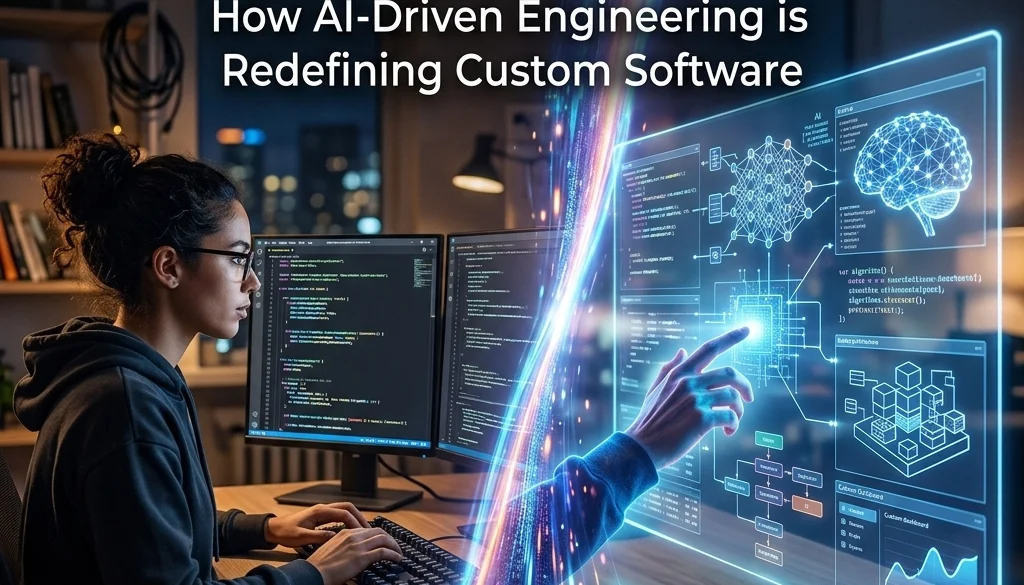
Is Manual Coding Dead? How AI-Driven Engineering is Redefining Custom Software
Current Status of Manual Programming
The practice of manual coding is undergoing a structural shift. Manual coding is defined as the human-driven input of alphanumeric characters to form executable syntax. As of March 2026, the necessity for human operators to write every line of code is decreasing. Statistical data indicates that 85% of software developers utilize artificial intelligence (AI) assistance in daily operations.
The transition is identified as a shift from syntax production to system orchestration. AI models generate the mechanical components of software. Human engineers provide the architectural parameters and business logic requirements. Manual coding is not defunct, but its primary function has changed from creation to verification.
Automated Components in Software Development
AI systems currently execute specific, labor-intensive development tasks. The following categories are subject to high levels of automation:
Boilerplate Generation
Boilerplate code constitutes repetitive sections of code required for basic functionality. AI-driven engineering produces these segments based on standard design patterns. This eliminates the need for manual repetition in foundational project setup.
Debugging and Error Correction
Automated systems identify syntax errors and logical inconsistencies in real-time. Debugging, previously a manual diagnostic process, is now an automated monitoring function. AI identifies patterns in failures and proposes corrective code blocks.
Documentation Retrieval and Implementation
The requirement for developers to manually search technical documentation is reduced. AI models ingest large-scale documentation repositories. Relevant technical specifications are retrieved and integrated into the codebase via direct prompts.

The Evolution of the Developer Role
In the current technological landscape, the role of the developer is redefined by three primary functions:
- System Design: The conceptualization of how software components interact.
- Architectural Decisions: Selection of infrastructure, databases, and frameworks.
- Curation and Guidance: Directing AI agents to generate specific modules and verifying the output for security and performance.
The shift is from "writer" to "editor." Developers utilize AI development tools to manage complexity rather than managing individual lines of code.

AI Agents for Business Integration
The implementation of ai agents for business is a primary objective for modern engineering teams. These agents are autonomous or semi-autonomous software entities designed to perform specific tasks without continuous human intervention.
Capabilities of AI Agents
- Process Automation: Execution of multi-step workflows across different software platforms.
- Data Analysis: Processing of unstructured data to generate reports and actionable insights.
- Customer Interaction: Management of queries and service requests through natural language processing.
Marketrun prioritizes the deployment of these agents to reduce operational overhead. Detailed information on these implementations is available in our AI agents and automations guide for 2026.
Custom AI Solutions for SMBs
Small and Medium Businesses (SMBs) represent a significant sector for AI-driven engineering. Custom AI solutions for SMBs focus on specific operational efficiencies rather than general-purpose tools.
Implementation Categories for SMBs
- Internal Knowledge Bases: Using RAG (Retrieval-Augmented Generation) to make company data searchable for employees.
- Inventory Management: Predictive models for stock levels and supply chain requirements.
- Personalized Marketing: Automated generation of content and targeted advertising based on historical customer data.
Marketrun provides custom software tailored to these specific needs. These solutions are developed with an emphasis on cost-efficiency and rapid deployment.
Market Growth and Velocity Metrics
The AI code tools market is projected to expand at a compound annual growth rate (CAGR) of 25.62% from 2026 to 2035. This growth is driven by the demand for increased development velocity.
Velocity Indicators
- Development Speed: Reports indicate speed increases ranging from 100x to 1000x compared to traditional manual methodologies.
- Friction Reduction: AI reduces the cognitive load associated with starting new projects and learning unfamiliar frameworks.
- Iteration Frequency: Accelerated code generation allows for more frequent testing and deployment cycles.

Architectural Integrity and Security
The reliance on AI-generated code necessitates a focus on system architecture and security. While AI generates syntax, human oversight ensures that the resulting system is resilient.
Key Considerations
- Data Modeling: Defining how information is structured and stored remains a human-led task.
- Security Considerations: AI-generated code must be audited for vulnerabilities and compliance with data protection regulations.
- Performance Optimization: High-level tuning of system resources to ensure scalability and speed.
For organizations requiring high levels of data privacy, self-hosting LLMs is a viable strategy. This ensures that proprietary data remains within the organization's controlled infrastructure. More information is provided in our 2026 guide on self-hosting LLMs.
Comparative Analysis: Manual vs. AI-Driven Engineering
| Feature | Manual Coding | AI-Driven Engineering |
|---|---|---|
| Primary Activity | Syntax Input | Prompt Engineering & Orchestration |
| Error Rate | High (Human Error) | Low (Syntax), Medium (Logic) |
| Production Speed | Linear | Exponential |
| Skill Requirement | Language Proficiency | Architectural Design & Logic |
| Scalability | Limited by Man-Hours | Scalable via Compute Power |
Marketrun Vision for the Next Decade
Marketrun views the next decade of software development as an era of total integration between AI agents and human architects. The objective is the creation of software that is self-correcting and highly adaptive to business changes.
Strategic Focus Areas
- Autonomous Systems: Developing software that can update its own logic based on real-world feedback.
- Seamless Integration: Connecting disparate business systems via AI automations.
- Global Delivery Models: Utilizing global talent pools to manage AI-driven projects, as detailed in the analysis of custom software costs between India and the USA.

Challenges in AI-Driven Development
Despite the benefits, several challenges persist in the transition away from manual coding.
Code Quality and Technical Debt
AI systems may generate code that functions but is difficult to maintain if not properly structured. Technical debt can accumulate if the human curator does not enforce strict standards.
Dependency on Model Providers
Heavy reliance on third-party AI models introduces risks related to service availability and pricing changes. Marketrun addresses this through open-source deployment strategies, allowing for independence from specific proprietary platforms.
Skill Gap
The transition requires existing developers to acquire new skills in system orchestration and AI prompting. This shift necessitates ongoing training and adaptation to new toolsets.
Conclusion of Current State
Manual coding is not dead, but it has been demoted from a primary task to a secondary verification step. AI-driven engineering is the standard for modern custom software. The focus for businesses in 2026 is the strategic implementation of ai agents for business and the procurement of custom ai solutions for smbs.
Marketrun continues to provide infrastructure and expertise in this evolving field. Our services include mobile and web app development and specialized Windows software solutions, all optimized via AI-driven engineering processes.
For further information on pricing and service tiers, refer to the Marketrun pricing page. Technical updates and further industry analysis are available on the Marketrun blog.