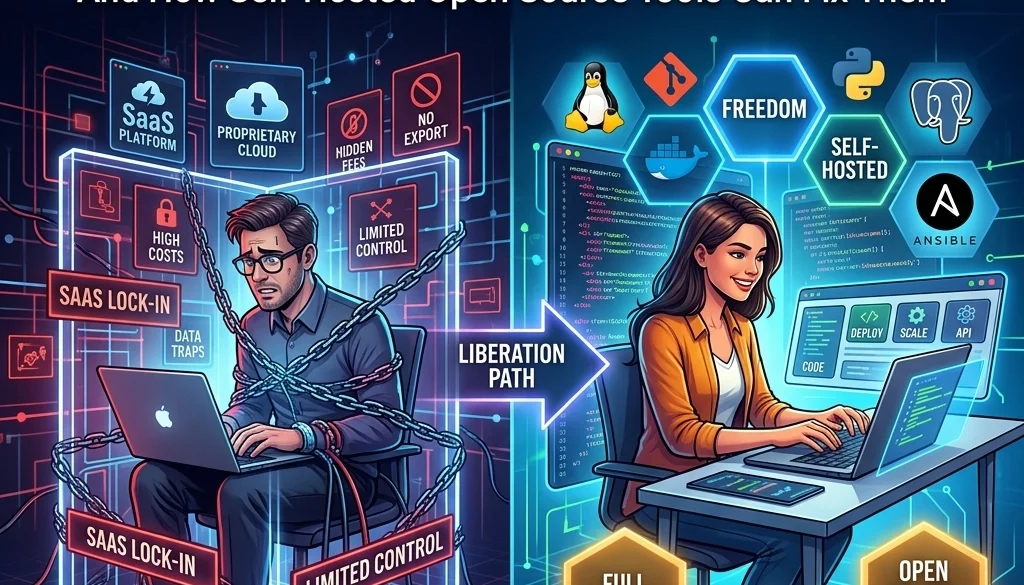
7 Mistakes You’re Making with SaaS Lock-in (and How Self-Hosted Open Source Tools Can Fix Them)
1. Lack of Data Portability and Ownership
SaaS platforms store user data in proprietary formats. Database schemas are hidden. Access is restricted to specific APIs. Retrieval of full data sets is often restricted or technically complex.
The Impact of Data Gravity
Data gravity increases as more information is stored within a single provider. Migration costs become prohibitive. Organizations remain with suboptimal providers to avoid the expense of data extraction and re-formatting.
Self-Hosted Solution: Supabase
Supabase is an open-source alternative to Firebase. It utilizes PostgreSQL. Users maintain direct access to the database. Exporting data is a standard SQL operation. There are no proprietary layers between the organization and its data. Full ownership is maintained at the infrastructure level.

2. Inflexible Cost Scaling and Renewal Price Hikes
SaaS pricing models often include per-user or per-execution fees. These costs scale linearly or exponentially with usage. Annual price increases of 10% to 30% are common industry standards.
Financial Predictability
Operational expenses (OPEX) become volatile. Budgeting for long-term growth is difficult when the vendor controls the pricing structure.
Self-Hosted Solution: Infrastructure Control
Using self-hosted open source tools allows organizations to decouple software costs from usage volume. Costs are redirected to compute resources. Organizations choose their cloud provider or utilize on-premise hardware. This stabilizes the budget. For more details on budgeting, see the AI automation ROI calculator.
3. Vulnerability to Feature Sunsetting and Version Changes
Vendors deprecate features or change interfaces without user consent. Workflows built on specific functionalities break when those functionalities are modified or removed.
Dependency Risks
Reliance on a third-party roadmap creates operational risk. If a vendor pivots its product strategy, the customer must adapt or migrate.
Self-Hosted Solution: Version Pinning
Self-hosting allows for specific version pinning. Updates are performed on a controlled schedule. Compatibility testing occurs before deployment. The software environment remains static until the organization decides to upgrade.
4. API Rate Limiting and Latency
SaaS tools communicate via public internet APIs. These APIs have rate limits. High-frequency operations result in throttled requests or increased costs. Network latency is introduced during every external request.
Performance Bottlenecks
Automations and data processing tasks are limited by the vendor’s infrastructure performance and rate-limiting policies.
Self-Hosted Solution: n8n Deployment Services
n8n is an open-source workflow automation tool. When deployed internally, workflows interact with other internal systems at local network speeds. There are no external rate limits. Organizations utilizing n8n deployment services achieve higher throughput for complex automations.

5. Non-Compliance with Data Residency Regulations
SaaS providers often process data in regions that do not align with specific legal requirements such as GDPR, CCPA, or local sovereign laws. Data shared with SaaS vendors is stored on third-party servers.
Regulatory Exposure
Legal departments cannot guarantee the physical location or the access logs of data stored in multi-tenant SaaS environments.
Self-Hosted Solution: Localized Deployment
Self-hosting ensures data stays within defined geographic boundaries. All logs and access controls are managed by the internal IT team. This satisfies strict compliance audits for healthcare, finance, and government sectors. Marketrun provides custom software solutions for organizations requiring strict data sovereignty.
6. Intellectual Property Exposure in AI Models
Sending proprietary data to closed-source LLM providers via API exposes sensitive information. This data may be used for model training or stored indefinitely by the provider.
Privacy Risks in AI
Corporate secrets, codebase logic, and customer interactions are transferred to external entities. This creates a leakage risk for intellectual property.
Self-Hosted Solution: Ollama
Ollama enables the local execution of large language models. Inference occurs on internal hardware. No data leaves the organization’s network. This is critical for self-hosting LLMs in 2026. Models like Llama 3 or Mistral are run in a private environment, ensuring complete privacy. Refer to the self-hosting LLMs 2026 guide for technical specifications.

7. Forced Workflow Conformity
SaaS products are designed for the mass market. Organizations must often change their internal processes to fit the limitations of the software.
Operational Inefficiency
Custom business logic requires "workarounds" when the SaaS platform does not support specific edge cases.
Self-Hosted Solution: Source Code Customization
Open source software allows for direct modification of the source code. Organizations extend functionality to meet specific business requirements. Systems are integrated deeply into existing stacks without the constraints of a rigid SaaS UI.
Transitioning from SaaS to Self-Hosted Infrastructure
The transition requires a shift from subscription management to infrastructure management.
Deployment of Supabase for Data Management
- Environment Setup: Utilize Docker or Kubernetes.
- Configuration: Define environment variables for database credentials and API keys.
- Migration: Map existing SaaS data structures to PostgreSQL schemas.
- Verification: Confirm data integrity and connection strings.
Deployment of n8n for Automation
- Instance Provisioning: Set up a virtual private server (VPS) or local server.
- Installation: Use the n8n Docker image for standardized deployment.
- Authentication: Configure internal OIDC or LDAP for user access.
- Workflow Porting: Rebuild or import workflows from existing SaaS automation tools. Marketrun offers n8n deployment services to facilitate this process.
Deployment of Ollama for Private AI
- Hardware Selection: Ensure GPU availability for efficient inference.
- Execution: Run the Ollama binary or container.
- Model Selection: Pull required models (e.g.,
ollama pull llama3). - Integration: Connect internal applications via the local Ollama API.

Advantages of Software Ownership
Ownership eliminates the risk of sudden service termination. It provides a permanent license to the technology used to run the business.
- Total Control: Decisions regarding updates, security patches, and features are made internally.
- Cost Efficiency: Long-term costs are reduced by eliminating recurring per-user fees.
- Enhanced Security: Security configurations are tailored to specific institutional needs rather than a one-size-fits-all SaaS security model.
Marketrun assists businesses in migrating from restrictive SaaS environments to robust, open-source deployments. This transition ensures that the software serves the business, rather than the business serving the vendor's bottom line.
Comparative Summary: SaaS vs. Self-Hosted
| Feature | SaaS Model | Self-Hosted Open Source |
|---|---|---|
| Data Control | Vendor Managed | User Owned |
| Pricing | Subscription/Variable | Infrastructure/Fixed |
| Customization | Low (API/Plugins) | High (Source Code) |
| Privacy | Third-party Access | Internal Only |
| Updates | Forced | Controlled |
| Scalability | Tier-based | Resource-based |
Organizations seeking to maximize operational efficiency and security must evaluate their current SaaS stack for lock-in risks. The move toward self-hosting reflects a broader trend in AI and custom software development where ownership is prioritized over convenience.
For organizations operating internationally, understanding these technical shifts is vital. Marketrun provides specialized guidance for both US clients and India clients looking to implement sovereign technical stacks.