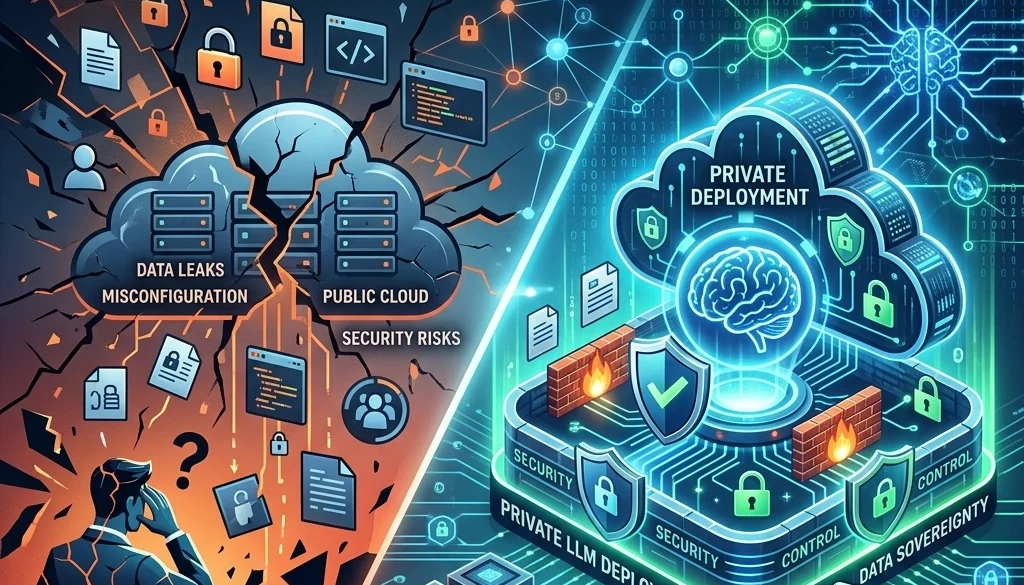
7 Mistakes You’re Making with AI Data Security (and How Private LLM Deployment Fixes Them)
Data Security Status: Artificial Intelligence Integration
The integration of Large Language Models (LLMs) within corporate infrastructure introduces specific security vulnerabilities. Current methodologies for AI adoption often prioritize utility over data integrity and confidentiality. Identifying these failures is a prerequisite for establishing secure custom AI solutions for SMBs.
1. Failure in Data Quality and Governance
Systematic errors in data collection and labeling result in compromised AI outputs. Data poisoning occurs when training sets contain inaccurate or malicious information.
- Inaccurate Labeling: Manual labeling errors lead to model degradation.
- Data Contamination: External data sources introduce biases.
- Audit Deficit: Lack of tracking regarding data origin and modification history.
Private LLM deployment allows for localized data cleaning processes. Information remains within controlled environments, ensuring that only verified datasets influence model behavior.
2. Excessive Access Provisioning
Internal AI systems are frequently granted broad access to corporate repositories. This configuration permits chatbots to retrieve sensitive financial documents or personnel files.
- Information Leakage: Unauthorized retrieval of internal data by employees via AI interfaces.
- Horizontal Escalation: AI agents accessing directories beyond the scope of the immediate task.
- Exposure: 50% of IT leaders identify data leakage as a primary concern in AI implementation.
Restricting AI access to specific data silos is a function of self-hosting LLMs. This architecture prevents the model from interacting with the entire corporate network.

3. Absence of Granular Role-Based Access Control (RBAC)
AI applications often operate outside existing identity provider frameworks. This results in a lack of oversight regarding who can generate, modify, or extract data.
- Identity Fragmentation: AI tools utilize independent authentication silos.
- Permissions Overlap: Users retain access levels within the AI tool that exceed their corporate roles.
- Extraction Risk: Users can extract bulk data through prompt engineering.
Deployment of private LLMs enables integration with centralized LDAP or Active Directory systems. This ensures the principle of least privilege is maintained across all AI interactions.
4. Unsecured Handling of Personally Identifiable Information (PII)
The transmission of names, locations, and internal communications to public AI providers poses a risk to regulatory compliance.
- Transmission Risk: PII is transmitted over public networks to third-party servers.
- Data Retention: Third-party providers may retain input data for model training purposes.
- Compliance Violations: Handling PII through public APIs often conflicts with GDPR and HIPAA mandates.
Local deployments facilitate the anonymization and encryption of PII before the data reaches the inference engine. Data remains on-site, fulfilling residency requirements.

5. Vulnerability Inheritance from Foundation Models
Utilizing third-party foundation models introduces inherited vulnerabilities. These models are opaque, making the detection of backdoors or security flaws difficult.
- Model Opacity: Internal weights and logic of public models are not accessible for security audits.
- Supply Chain Risk: Updates to a public model can introduce new security regressions without notice.
- Dependency: Operational stability depends on the uptime and security posture of the provider.
With private LLM deployment, organizations utilize open-source models that permit full code and weight inspection. This transparency allows for independent security verification.
6. Insufficient Monitoring and Auditing
Governance is often treated as a static checkbox rather than a continuous process. Monitoring is frequently limited to login events, ignoring the actual data exchange between the user and the AI.
- Oversight Gap: Lack of real-time analysis of prompt and response content.
- Forensic Deficit: Absence of logs for reconstructing security incidents involving AI agents.
- Shadow AI: Employees utilizing unauthorized AI tools due to a lack of secure internal alternatives.
Private deployments include comprehensive logging mechanisms. Every interaction is recorded within internal databases for retrospective analysis and compliance reporting.
7. Reliance on Public APIs for Sensitive Operations
Public APIs like those provided by OpenAI or Anthropic operate on shared infrastructure. This multi-tenant environment introduces risks associated with data cross-contamination.
- Multi-tenancy Risks: Potential for data to be accessed by other users of the service due to system errors.
- Latency and Outages: Business operations are interrupted by external service downtime.
- Cost Scaling: High volume usage of public APIs leads to unpredictable operational expenditures.
Transitioning to custom software solutions on private servers mitigates these risks by providing dedicated compute resources.

Infrastructure Solution: Private LLM Deployment
The transition from public AI services to private infrastructure addresses the identified security failures. The following components define a secure private deployment:
Localized Inference
Inference occurs on hardware owned or controlled by the organization. Data packets do not traverse the public internet for processing. This is critical for maintaining GDPR and HIPAA compliance.
Air-Gapped Environments
For high-security requirements, AI models are deployed in air-gapped environments. This prevents all external communication, eliminating the possibility of remote data exfiltration.
Custom Safety Layers
Organizations can implement custom guardrails between the user and the model. These layers filter outgoing responses for sensitive information and block incoming prompts that attempt injection attacks.
Hardware Specification for Private AI
Deployment requires specific hardware configurations to ensure performance stability:
- Compute: High-memory GPUs (e.g., NVIDIA H100 or A100 series).
- Storage: High-speed NVMe drives for rapid model weight loading.
- Network: 10Gbps+ internal networking for data retrieval from local vector databases.
Regulatory Compliance Integration
Private LLM deployment is the primary method for ensuring AI usage adheres to legal frameworks.
GDPR Requirements
- Right to Erasure: Private deployments allow for the complete removal of user data from internal databases and fine-tuning sets.
- Data Residency: Ensures all processing occurs within specific geographic boundaries.
- Security of Processing: Organizations maintain full control over encryption standards and access logs.
HIPAA Requirements
- Business Associate Agreements (BAA): Managing data internally removes the need for complex third-party BAAs regarding AI processing.
- Integrity: Ensures patient data is not modified or corrupted by external model updates.
- Access Control: Strict logging of who accessed specific health information via the AI interface.

Implementation Roadmap for SMBs
Transitioning to secure AI infrastructure involves three distinct phases.
Phase 1: Assessment and Selection
Identify high-risk data areas. Select an appropriate open-source foundation model (e.g., Llama 3, Mistral, or Falcon). Evaluate hosting requirements on marketrun.io/pricing.
Phase 2: Deployment and Integration
Configure the model on internal servers or a Virtual Private Cloud (VPC). Integrate the AI with existing RBAC and identity providers. Establish the vector database for Retrieval-Augmented Generation (RAG).
Phase 3: Monitoring and Refinement
Implement continuous logging. Conduct regular security audits of model outputs. Refine safety layers based on observed user interactions.
Technical Considerations for Secure Deployment
| Component | Public API Deployment | Private LLM Deployment |
|---|---|---|
| Data Privacy | Provider Controlled | Organization Controlled |
| Model Transparency | Black Box | Full Visibility |
| Compliance | Complex / Limited | Simplified / Native |
| Security Customization | None | Extensive |
| Internet Dependency | Required | Optional (Air-gap possible) |
For further technical details on AI implementation, refer to the AI agents and automations guide 2026.
Conclusion of Security Assessment
The security risks associated with public AI models are a result of data centralization and lack of oversight. Private LLM deployment provides a mitigation strategy by returning control of the data and the model to the organization. Secure AI integration is a function of infrastructure choice.
To initiate a transition to secure AI, examine Marketrun's AI development solutions. Organizations requiring specific regional expertise can find more information for US clients and India clients.