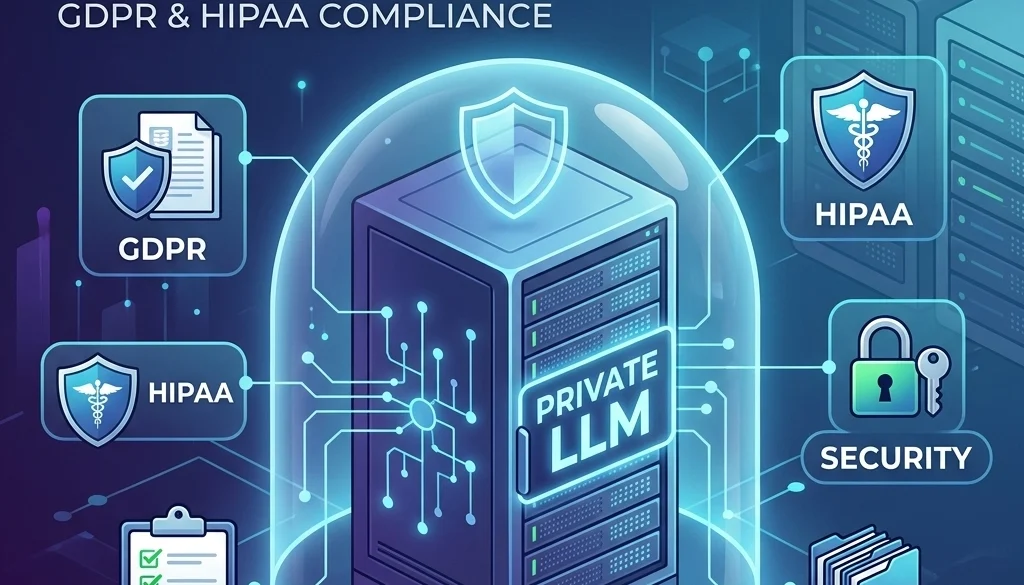
The Ultimate Guide to Private LLM Deployment: Everything You Need to Succeed with GDPR & HIPAA Compliance
Definition of Private LLM Deployment
Private LLM deployment is the localized execution of Large Language Models on restricted infrastructure. This infrastructure is categorized as on-premises hardware or isolated virtual private clouds. All data processing occurs within a defined network perimeter. Data transfer to external third-party providers is absent. This architecture is used for the management of sensitive information.
Systems utilizing public APIs transfer data to external servers. These servers are managed by third-party entities. Private deployment removes the dependency on these entities. The organization retains total data sovereignty.

Compliance Framework: GDPR
The General Data Protection Regulation (GDPR) mandates the protection of personal data for individuals within the European Union. Private LLM deployment facilitates adherence to several specific articles.
Article 6: Lawful Basis for Processing
Organizations must establish a legal basis for processing personal data. Private deployments allow for the configuration of models to process only specified data sets. Data minimization is enforced by limiting the model’s access to internal databases.
Article 22: Automated Decision-Making
GDPR requires transparency in automated decisions. Local deployment provides visibility into the model’s parameters and system prompts. Logs are maintained locally to document the logic behind AI-generated outputs.
Article 32: Security of Processing
This article requires the implementation of technical and organizational measures to ensure security. Private infrastructure supports the encryption of data at rest and in transit. Access is restricted to authorized personnel.
For technical assistance with these requirements, refer to Marketrun AI Development.
Compliance Framework: HIPAA
The Health Insurance Portability and Accountability Act (HIPAA) regulates the protection of Protected Health Information (PHI).
Required Technical Safeguards
- Access Control: Systems must restrict access to PHI. Local LLMs utilize Role-Based Access Control (RBAC).
- Audit Controls: All interactions with the LLM are logged. These logs include timestamps, user identifiers, and the content of queries.
- Integrity: Measures are implemented to prevent the unauthorized alteration of PHI.
- Transmission Security: Encryption is required for all data moving across the network.
PHI Identification
There are 18 identifiers that constitute PHI under HIPAA. Private LLM deployment prevents these identifiers from leaving the internal environment. Public APIs present a risk of data leakage during the training or logging phases of the third-party provider.
Organizations in the healthcare sector utilize self-hosting LLMs to maintain these standards.

Data Security Architecture
The security of a private LLM is built upon multiple layers.
Network Isolation
The deployment is situated behind a firewall. Inbound and outbound traffic is restricted. Air-gapped configurations are possible where the system has no connection to the public internet. This configuration eliminates external attack vectors.
Encryption Protocols
Data at rest is protected via full-disk encryption (AES-256). Data in transit is protected via Transport Layer Security (TLS 1.3).
Authentication Mechanisms
Multi-factor authentication (MFA) is required for system access. API keys are rotated on a defined schedule. Unauthorized access attempts are monitored and recorded.
Comparative Analysis: Private Deployment vs. Public API
| Feature | Public API (e.g., OpenAI) | Private LLM Deployment |
|---|---|---|
| Data Location | Third-party servers | Local/Internal servers |
| Data Ownership | Shared/Variable | Full Sovereignty |
| GDPR Compliance | Complex (Data Transfer) | Direct (Local Processing) |
| HIPAA Compliance | Requires BAA | Direct Control |
| Internet Dependency | Mandatory | Optional/Air-gapped |
| Operational Cost | Variable (Per Token) | Fixed (Infrastructure) |
Custom AI solutions for SMBs often prioritize private deployment to avoid the recurring costs and security risks associated with public API usage. Further information on cost comparisons is available at Marketrun pricing.
Technical Implementation Requirements
Model Selection
Models are selected based on the specific task and hardware availability.
- Llama 3: General purpose reasoning.
- Mistral: Efficiency in smaller hardware environments.
- Specialized Models: Trained for medical or legal data sets.
Quantization
Quantization reduces the memory requirements of the model. Common formats include GGUF and EXL2. This allows models to run on standard consumer or professional GPUs without loss of functional accuracy.
Inference Engines
Engines such as Ollama, vLLM, or Text-Generation-WebUI are utilized to serve the model. These engines provide an API interface for integration with existing software.
Implementation details are documented in the Self-Hosting LLMs 2026 Guide.

Physical and Administrative Safeguards
Compliance requires more than technical software configuration.
Physical Security
Servers are housed in secure locations. Access to the physical hardware is restricted to authorized technicians. Visitor logs are maintained. Environmental controls prevent hardware failure.
Administrative Policies
- Acceptable Use Policy (AUP): Defines how staff interact with the AI.
- Training: Personnel are trained on data handling procedures.
- Incident Response: A plan exists for the event of a security breach.
- Risk Assessment: Annual audits are performed to identify vulnerabilities.
Marketrun Solutions for Private AI
Marketrun provides the infrastructure and software engineering required for private LLM deployment.
Custom Software Integration
The LLM is integrated into existing business workflows. This includes custom web applications and mobile platforms.
Link: Custom Software Development
Open Source Deployment
Marketrun utilizes open-source models to avoid vendor lock-in. This ensures long-term viability and the ability to modify the model as needed.
Link: Open Source Deployment Services
AI Automations
Private LLMs are used to automate internal processes such as document analysis and customer support without exposing proprietary data.
Link: AI Automations
Data Minimization and Retention
Systems are configured to adhere to data retention policies.
- Prompt Deletion: Prompts are deleted after processing.
- No Training Logs: Local systems are configured to NOT use input data for model fine-tuning unless explicitly initiated by the administrator.
- Database Scrubber: Automated scripts remove PHI/PII from datasets before they are used for model fine-tuning.
Hardware Specifications for SMBs
Deployment requires specific hardware components.
- GPU: NVIDIA A100 or H100 for high-demand environments. RTX 3090/4090 for smaller scale tasks.
- RAM: High-capacity DDR4 or DDR5 memory to support model loading.
- Storage: NVMe SSDs for fast model weights loading.
Marketrun assists in the procurement and setup of these systems.
Link: Marketrun Home

Summary of Compliance Status
Private LLM deployment is a state of infrastructure where data security is prioritized. GDPR and HIPAA requirements are met through local processing, strict access controls, and network isolation. This method provides a controlled environment for the utilization of advanced AI technologies within regulated industries.