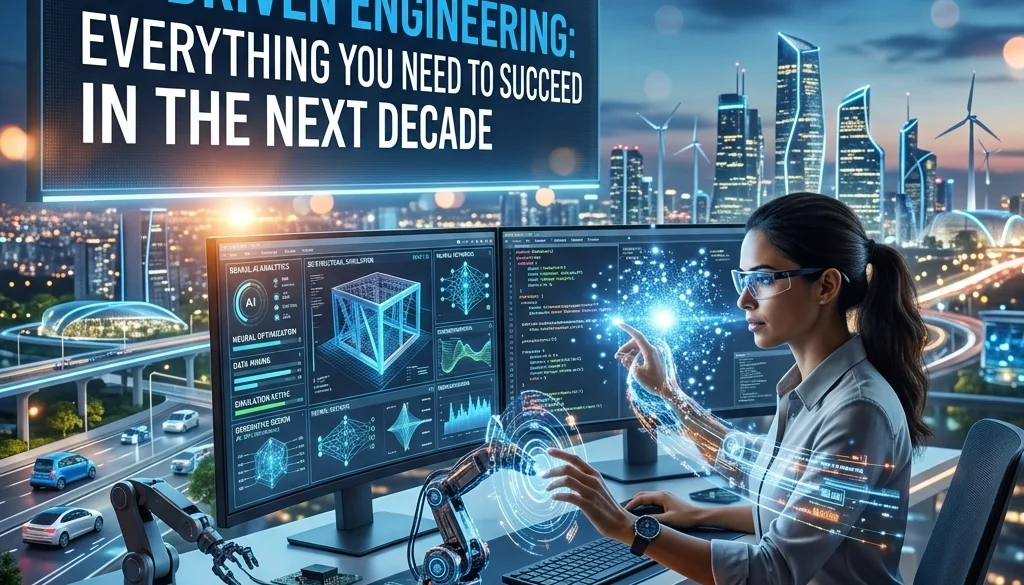
The Ultimate Guide to AI-Driven Engineering: Everything You Need to Succeed in the Next Decade
Status: Global Engineering Transition (2026-2036)
The current state of engineering is defined by a shift from manual implementation to autonomous orchestration. The decade spanning 2026 to 2036 is identified as the period where AI-driven engineering moves from experimentation to standardized industrial protocol. Organizations are categorized by their integration of autonomous agents, efficiency-focused models, and AI-native structures.
Success in this decade is predicated on the transition from static software development to dynamic, intent-driven engineering environments. This guide documents the technical requirements, strategic shifts, and implementation frameworks necessary for maintaining operational relevance in an AI-dominated landscape.
Autonomous Orchestration and Agentic AI
Agentic AI systems function as the primary operational workforce. Manual coding is replaced by the orchestration of super agents. These agents utilize standardized protocols to communicate and execute multi-step workflows.
Functional Parameters of AI Agents for Business
- Intent-Driven Execution: Systems interpret high-level objectives and generate required technical steps without human intervention.
- Multi-Step Workflow Management: Agents maintain state across complex processes, including design, testing, and deployment.
- Collaborative Logic: Agents operate in clusters, assigning sub-tasks to specialized models based on computational efficiency and skill set.
The implementation of ai agents for business reduces technical debt by ensuring that code generation is consistent with architectural constraints. Engineering teams function as orchestrators rather than executors.

Efficiency Standards and Hardware-Aware Models
Computational constraints are a primary factor in engineering design. The industry is pivoting from massive, centralized Large Language Models (LLMs) to smaller, hardware-aware models designed for specific tasks.
Core Efficiency Trends
- Quantization and Optimization: Mathematical techniques reduce the precision of model weights, enabling high performance on localized hardware.
- ASIC and Edge Acceleration: Application-Specific Integrated Circuits (ASICs) are utilized to run AI models at the edge, reducing latency and reliance on cloud infrastructure.
- Open-Source Gap Convergence: Performance parity is observed between proprietary systems and open-source models. This facilitates the use of self-hosting LLMs for data privacy and cost control.
The selection of model size and deployment location is now a critical engineering decision. Efficiency-focused models are prioritized for real-time applications where latency and power consumption are restricted.
Multimodal Reasoning and Physical Systems Integration
Next-generation engineering systems process text, images, video, and sensory data simultaneously. This multimodal capability allows for the integration of digital logic with physical reality.
Generative Design and Manufacturing
AI-driven generative design utilizes algorithms to create solutions based on performance parameters.
- Counter-Intuitive Optimization: Systems generate designs that exceed human-led performance standards while minimizing material usage.
- Simulation-Based Validation: Designs are automatically tested in virtual environments before physical prototyping.
- Smart Manufacturing: Integration of IoT sensors and AI improves precision and reduces worker exposure to hazards.
Digital Twins and IoT
Digital twins are established as the standard for lifecycle management. These virtual replicas of physical assets are updated in real-time via IoT sensors. Data-driven insights allow for predictive maintenance, identifying potential failures before downtime occurs.

Custom AI Solutions for SMBs
Small and Medium-sized Businesses (SMBs) are identified as the sector with the highest potential for operational transformation through custom AI solutions for SMBs.
Implementation Frameworks for SMBs
- Modular AI Deployment: Utilizing pre-built modules for automation to reduce initial capital expenditure.
- Niche-Specific Training: Training smaller models on proprietary business data to provide specialized insights.
- Automation of Routine Operations: Implementation of AI for customer support, inventory management, and lead generation.
Marketrun provides custom software development to facilitate this transition, focusing on ROI and long-term scalability. The objective is to replace manual processes with autonomous systems that scale without a linear increase in headcount.
AI-Native Organizational Structures
The architecture of the engineering organization is being rebuilt around AI capabilities. Information Technology (IT) teams are restructured as leaner, strategic entities.
Structural Indicators
- Embedded Governance: Ethical and operational guardrails are integrated directly into the software development lifecycle (SDLC).
- Modular Architecture: Systems are designed for zero-touch deployment pipelines, allowing AI agents to push updates autonomously.
- Global Collaboration Tools: AI-augmented tools analyze project history to provide intelligent suggestions, enabling effective coordination between US and India-based teams.
Organizational success is measured by the speed of the feedback loop between data collection, model training, and deployment.

Workforce Evolution and Career Path Adjustment
A significant skills gap exists in AI governance and agentic orchestration. The demand for traditional manual coding is decreasing, while the demand for AI engineering expertise is increasing.
Required Competencies
- Orchestration Engineering: The ability to manage and debug clusters of autonomous agents.
- AI Governance: Ensuring compliance with data privacy regulations and ethical standards.
- Edge Deployment Management: Knowledge of deploying and optimizing models on local hardware and IoT devices.
Engineers must adapt to a role that involves high-level system design and oversight rather than granular task execution.
Strategic Advantages of AI-Driven Engineering
Implementation of the protocols described results in measurable gains in productivity and safety.
Quantitative Results
- Accelerated R&D: Design spaces that previously took months to explore are processed in days through simulation.
- Reduced Operational Downtime: Predictive maintenance reduces unplanned outages by identifying wear patterns in real-time.
- Safety Improvement: Autonomous systems make real-time decisions to avoid environmental hazards in industrial settings.
The convergence of AI with physical and digital systems defines the current competitive landscape. Organizations failing to implement ai automations are expected to experience diminishing returns on legacy engineering practices.

System Status: Foundation for the Future
The foundational elements for AI-driven engineering include high-quality data and unified documentation. These assets are critical for the training and operation of agentic systems. Engineering leaders are advised to prioritize the following:
- Data Unification: Aggregating siloed data into accessible repositories for AI processing.
- Governance Implementation: establishing frameworks for AI-human collaboration and accountability.
- Infrastructure Scaling: transitioning to modular, AI-ready tech stacks.
Marketrun assists in these transitions through AI website creation and open source deployment. Detailed planning for the next decade of engineering is a requirement for operational stability.
Final Notification
Technical specifications and market conditions are subject to continuous update. Engineering protocols must remain flexible to accommodate rapid advancements in model reasoning and computational efficiency. Access further technical resources at marketrun.io/blog.