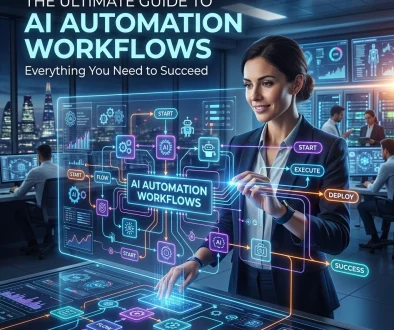
The Ultimate Guide to AI Automation Workflows: Everything You Need to Scale Your SMB
Operational Status of AI Automation
AI automation workflows consist of sequences of tasks executed by software systems without human intervention. These systems utilize Large Language Models (LLMs) and Application Programming Interfaces (APIs) to manage business operations. Research indicates that 73% of small and medium businesses (SMBs) maintain manual processes for core functions. Transitioning to automated systems targets scheduling, invoicing, and communication.
Implementation of ai automation workflows reduces manual labor by 10 to 20 hours per week per operational unit. Systems operate 24 hours daily. Errors associated with human fatigue are eliminated. Data processing occurs in real-time.
Architecture of Automated Systems
A functional workflow requires a trigger, a logic processor, and an action.
- Trigger: An event initiates the workflow. Examples include a received email, a form submission, or a timestamp.
- Logic Processor: An AI model or conditional statement evaluates the input data. Structured data is extracted from unstructured text.
- Action: The system executes a task. Examples include updating a database, sending a notification, or generating a document.
Connectivity between disparate systems is established through integration platforms such as Make, n8n, or Zapier. These platforms serve as intermediaries between software applications that lack native compatibility.

Lead Qualification Workflows
Lead qualification is the primary workflow for revenue generation. Manual lead processing results in delayed response times. Automated systems capture lead data from sources including:
- Web forms
- Social media advertisements
- Google Business Profile messages
The AI model evaluates the lead based on predefined criteria. Leads meeting specific thresholds are routed to the sales department. Leads below the threshold receive automated follow-up sequences. Data is synchronized with the Customer Relationship Management (CRM) system. This process ensures that human resources focus on high-probability conversions. To automate business operations with ai, lead qualification provides measurable ROI within the initial week of deployment.
Appointment and Scheduling Logic
Scheduling automation eliminates back-and-forth communication. The workflow integrates calendar software with communication channels.
- Input: User selects a time slot via an interface.
- Verification: System checks availability in real-time.
- Confirmation: System creates a calendar event and sends notifications.
- Follow-up: Automated reminders are dispatched via SMS or email 24 hours prior to the event.
This workflow reduces no-show rates. Administrative time spent on coordination is removed.
Financial Operation Workflows
Invoicing and payment tracking are automated to maintain cash flow. The system monitors the status of accounts receivable within accounting software.
- Trigger: An invoice reaches its due date without a payment confirmation.
- Action: A notification is generated and sent to the client.
- Logic: The system adjusts the tone of subsequent reminders based on the duration of the delinquency.
Automated financial workflows protect capital. Manual monitoring of bank statements and invoice logs is no longer required.

Customer Feedback and Review Management
Reputation management requires systematic monitoring of public feedback. Automated workflows scan platforms for new reviews.
- Detection: System identifies a new entry on Google or Yelp.
- Analysis: AI categorizes the sentiment of the review.
- Drafting: System generates a response based on the sentiment and content.
- Approval: A human operator reviews and publishes the response, or the system publishes directly if confidence scores exceed 95%.
Systematic responses improve search engine visibility and customer trust.
Inventory and Supply Chain Automation
Inventory workflows prevent stockouts and overstocking. Systems integrate point-of-sale (POS) data with supplier databases.
- Threshold Monitoring: System tracks quantity levels for every Stock Keeping Unit (SKU).
- Alert Generation: When stock falls below a defined limit, an alert is triggered.
- Order Creation: System generates a purchase order and sends it to the supplier for approval.
This automation maintains operational continuity. Manual inventory counts are reduced in frequency.

Connecting Disparate Systems
To automate business operations with ai, disparate systems must exchange data. This is achieved through three primary methods:
1. API-First Integration
Systems communicate directly via documented endpoints. This method is used for established software such as Salesforce, HubSpot, or QuickBooks. It provides the highest level of stability.
2. Webhooks
A system sends real-time data to a specific URL when an event occurs. This eliminates the need for constant polling and reduces server load.
3. Robotic Process Automation (RPA)
For legacy systems lacking APIs, RPA mimics human interaction with the user interface. This is a secondary option when modern integration is unavailable.
Custom solutions may be required for unique business logic. Marketrun provides custom software to bridge gaps between incompatible legacy tools.
Deployment Methodology
Implementation follows a structured five-phase roadmap.
Phase 1: Operational Audit
The business identifies repetitive tasks. Time expenditure for each task is recorded. High-frequency, low-complexity tasks are prioritized for automation.
Phase 2: Workflow Mapping
Technical specifications are drafted. Triggers, required data fields, and terminal actions are defined. Permission levels are established using the principle of least privilege.
Phase 3: Development and Integration
Workflows are constructed in a sandbox environment. AI agents are configured. Connections to existing CRM or ERP systems are verified.
Phase 4: Testing and Rollout
Systems are tested using sample data sets. Initial production rollout is limited to 10% of total volume. Performance is monitored for errors or logic failures. Full deployment occurs after 48 hours of error-free operation.
Phase 5: Maintenance and Optimization
Workflows are reviewed weekly. AI model performance is evaluated for drift. API updates are applied to prevent system breakage.

Data Governance and Privacy
Automated workflows must comply with data protection regulations.
- Standardization: Data fields are standardized across all systems.
- Deduplication: Records are merged based on unique identifiers such as email or phone numbers.
- Security: Encryption is applied to data in transit and at rest.
- Self-Hosting: For sensitive data, self-hosting LLMs ensures that information remains within the corporate perimeter.
Centralized governance prevents the accumulation of "bad data" which degrades AI performance.
Cost and Resource Allocation
Budgeting for AI automation involves initial build costs and ongoing maintenance.
- Pilot Phase: A proof of concept typically requires a timeframe of 4 to 8 weeks.
- Maintenance: 60% of total lifecycle costs are attributed to post-deployment maintenance. This includes model updates, scaling, and training.
- Infrastructure: Costs are determined by token usage, API subscription fees, and hosting.
Detailed pricing structures depend on the complexity of the integrations and the volume of data processed.
Scalability and Productization
SMBs utilize automation to scale without increasing headcount. Automated workflows enable the creation of productized services. These services are delivered in recurring monthly tiers.
- Tier 1: Basic lead capture and notification.
- Tier 2: Full CRM integration and automated follow-up.
- Tier 3: Comprehensive operational automation including finance and inventory.
A single operator manages multiple clients using templated workflows and monitoring dashboards. Efficiency increases as the library of templates grows.
Technical Requirements for Implementation
Successful deployment requires a specific tech stack.
- Workflow Engine: n8n (open-source) or Make.
- AI Models: Claude 3.5, GPT-4, or Llama 3 for text processing.
- Database: PostgreSQL or Airtable for state management.
- Communication: Twilio for SMS, SendGrid for email, Slack for internal alerts.
The selection of tools depends on the existing infrastructure of the SMB. Integrating these tools allows for the creation of a cohesive ai website and SEO strategy.

Conclusion of Systems Overview
AI automation workflows are functional components for business scaling. The transition from manual to automated processes involves mapping existing logic to software-driven actions. Connectivity between disparate systems is the primary technical hurdle. Once established, these workflows operate continuously. ROI is measured through time reclamation and increased output volume.
Businesses seeking to implement these systems should begin with an audit of manual tasks. Initial focus on lead qualification and appointment booking provides the fastest path to operational efficiency. Maintenance is a requirement for long-term stability. Data governance ensures the integrity of the automated environment.